Herald endorsement: Our recommendation on Florida’s Amendment 6 | Opinion

READ MORE
Editorial Board’s General Election Endorsements
In advance of the upcoming general elections on Tuesday, Nov. 5, 2024, the Editorial Board interviewed and researched candidates to better understand their views on various issues and how their policies will affect their constituents. The goal is to give voters a better idea of who’s the best candidate for each race.
Expand All
Florida voters are being asked to repeal a constitutional amendment that allows taxpayer money to be used by candidates running for top state offices, including governor.
A “yes” vote for Amendment 6 — the Repeal of Public Financing for Statewide Campaigns — would kill the Florida program that provides matching, public financing for those running for office, a boost for candidates with limited financial means.
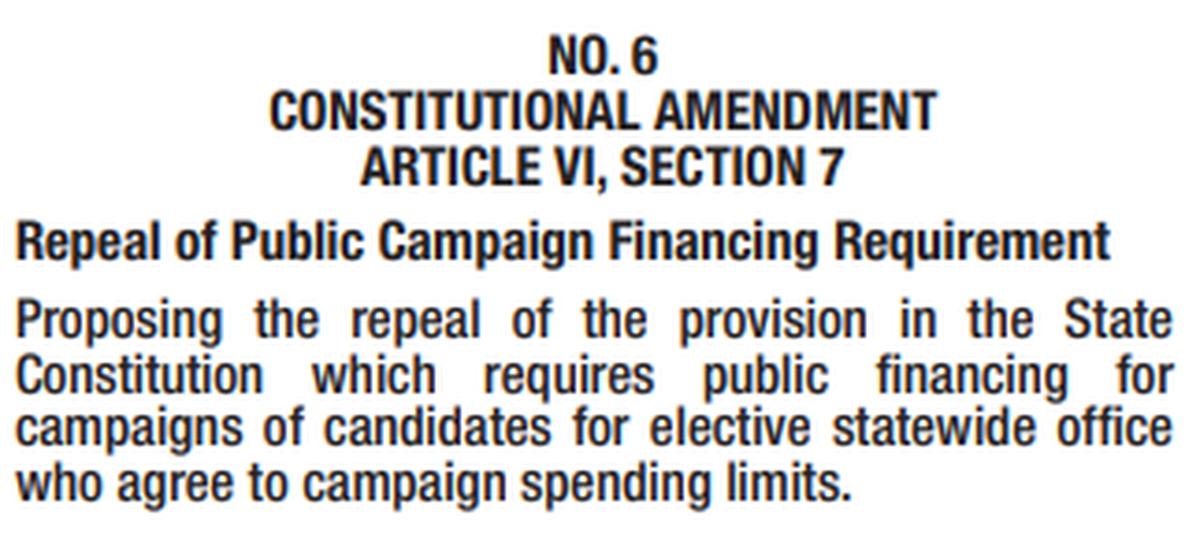
We recommend a “no” vote, which will keep the original 1998 constitutional amendment on the books. Although this measure has not always worked entirely as Floridians had hoped, it was passed due to concerns over the high cost of running for office — and remains a reality. If this measure is repealed, it’s unlikely any such protective action will ever make it to the Florida constitution again.
The goal of the amendment is to create a more even financial playing field and to prevent only the wealthy from running and financing their own races.
The campaign financing program is open to candidates for governor and three Cabinet seats: attorney general, chief financial officer and commissioner of agriculture.
To qualify, a candidate must raise a minimum amount ($150,000 for gubernatorial candidates; $100,000 for the three other offices) and agree to certain campaign spending limits. In return, they can access matching funds for contributions from Floridians, up to $250 per contributor.
In 2022, $13 million in taxpayer money was spent on the program, and the candidates benefiting included Gov. Ron DeSantis in his reelection bid and his Democratic challenger, Charlie Crist.
To pass, Amendment 6 needs at least 60% of voters to approve. A similar repeal effort in 2010 failed with 52%.
The push to put Amendment 6 on the ballot came from the Republican-controlled Legislature. Sen. Travis Hutson, of Flagler, sponsor of the Senate bill, maintains taxpayer money could be better spent in other areas. Hialeah State Rep. Tom Fabricio (R-Miami Lakes-Hialeah) sponsored the House bill.
Those opposing the measure include the League of Women Voters and Floridians for Open Democracy, backed by the nonpartisan Common Cause Florida, who say public financing encourages those who are not wealthy to run, leading to a more diverse pool of candidates. If the amendment is repealed, they say women and people of color will find it more difficult to finance a run. They are right.
Voting against Amendment 6 is a step towards safeguarding Florida’s democratic process and ensuring that all voices have a chance to be heard.
The Herald Editorial Board recommends voting NO on Amendment 6.
BEHIND THE STORY
MOREWho decides the political endorsements?
In advance of local and state elections, Miami Herald Editorial Board members interview political candidates, as well as advocates and opponents of ballot measures. The Editorial Board is composed of experienced opinion journalists and is independent of the Herald’s newsroom. Members of the Miami Herald Editorial Board are: Amy Driscoll, editorial page editor; and editorial writers Isadora Rangel and Mary Anna Mancuso. Read more by clicking the arrow in the upper right.
What does the endorsement process look like?
The Miami Herald Editorial Board interviews political candidates to better understand their views on public policy and how their policies will affect their constituents. Board members do additional reporting and research to learn as much as possible about the candidates before making an endorsement. The Editorial Board then convenes to discuss the candidates in each race. Board members seek to reach a consensus on the endorsements, but not every decision is unanimous. Candidates who decline to be interviewed will not receive an endorsement.
Is the Editorial Board partisan?
No. In making endorsements, members of the Editorial Board consider which candidates are better prepared to represent their constituents — not whether they agree with our editorial stances or belong to a particular political party. We evaluate candidates’ relevant experience, readiness for office, depth of knowledge of key issues and understanding of public policy. We’re seeking candidates who are thoughtful and who offer more than just party-line talking points.
This story was originally published October 7, 2024 at 5:50 PM.

.png)




.png)













.png)