Herald endorsement: Our recommendation on Florida’s constitutional Amendment 1 | Opinion
READ MORE
Editorial Board’s General Election Endorsements
In advance of the upcoming general elections on Tuesday, Nov. 5, 2024, the Editorial Board interviewed and researched candidates to better understand their views on various issues and how their policies will affect their constituents. The goal is to give voters a better idea of who’s the best candidate for each race.
Expand All
Florida and the country need less partisan divide — not more of it — especially when it comes to public education.
That’s why Florida voters should reject constitutional Amendment 1 in the General Election.
The proposal, placed on the Nov. 5 ballot by the Republican-led Legislature, would “require members of a district school board to be elected in a partisan election rather than a nonpartisan election,” as they are now. If at least 60% of voters approve Amendment 1, candidates will have to run as Democrats or R
epublicans starting in 2026 and parties will nominate their own candidates for these elections.
As the U.S. becomes more polarized, so have nonpartisan school boards. Candidates might not run with a D or an R next to their name but their party affiliations are often known by voters. Yet that’s not an excuse to dive into the deep end of partisanship and make it worse.
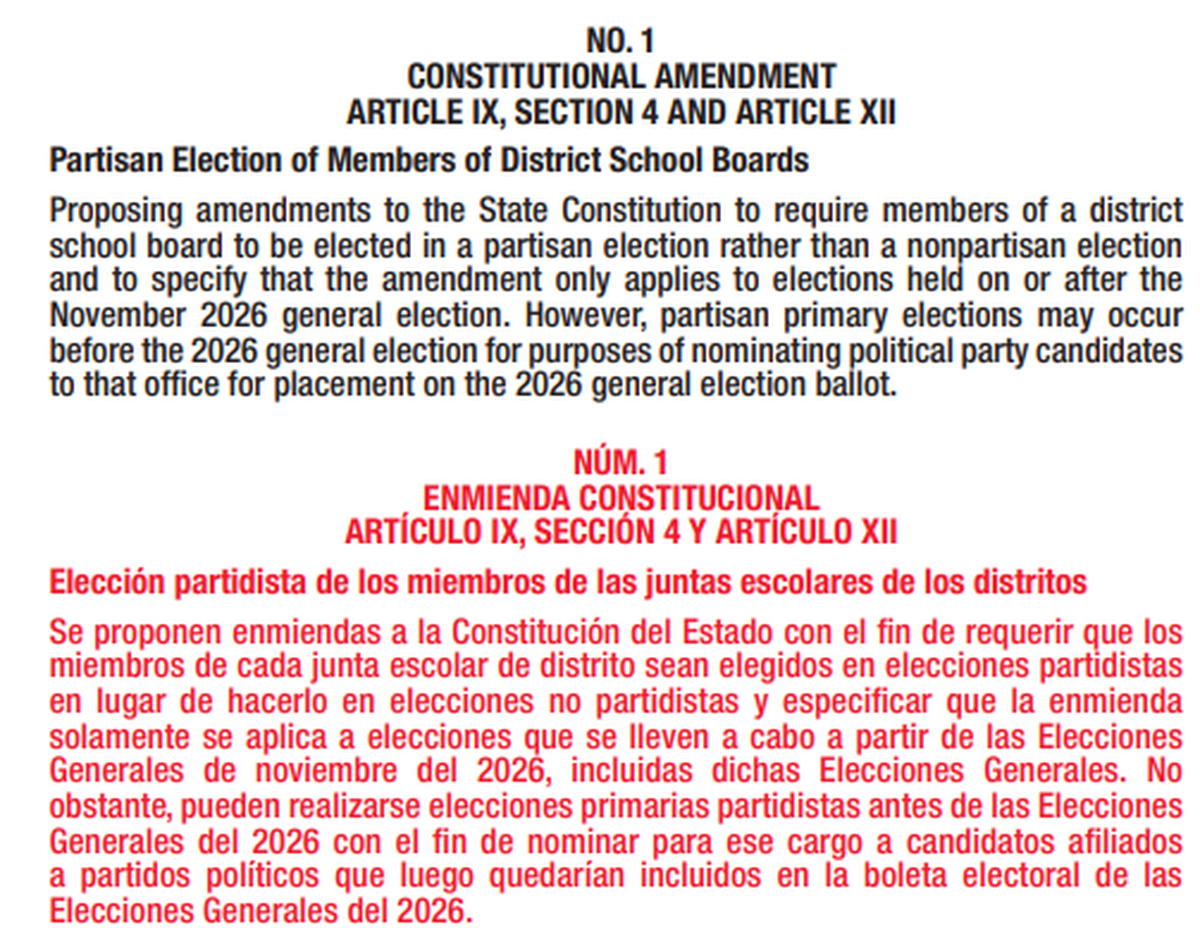
The nonpartisan nature of school boards still forces members to focus on education and not party politics most of the time. Issues like graduation and literacy rates, school safety and teacher pay are not Republican or Democratic. If those boards become partisan, members will have to appeal to more ideological party primary voters instead of all of voters living in a district. Independent voters — those not registered with either major party — represent a growing share of the electorate but would be excluded from those primaries.
That’s how you end up with elected officials less concerned about education policy and more prone to political battles.
In the past few years, Florida has become ground zero for culture wars surrounding public schools with laws meant to remove what Republicans consider “woke” culture from classrooms. Students aren’t reading or doing math better because of laws like the parental rights one known as “Don’t say gay,” which bans instructions on gender identity and sexual orientation.
In 1998, Florida voters chose to have nonpartisan school boards. It’s no wonder that the same politicians, like Gov. Ron DeSantis, who have injected partisan politics into education want to change that.
The Herald Editorial Board recommendations voting NO on Florida’s Amendment 1.
BEHIND THE STORY
MOREWho decides the political endorsements?
In advance of local and state elections, Miami Herald Editorial Board members interview political candidates, as well as advocates and opponents of ballot measures. The Editorial Board is composed of experienced opinion journalists and is independent of the Herald’s newsroom. Members of the Miami Herald Editorial Board are: Amy Driscoll, editorial page editor; and editorial writers Isadora Rangel and Mary Anna Mancuso. Read more by clicking the arrow in the upper right.
What does the endorsement process look like?
The Miami Herald Editorial Board interviews political candidates to better understand their views on public policy and how their policies will affect their constituents. Board members do additional reporting and research to learn as much as possible about the candidates before making an endorsement. The Editorial Board then convenes to discuss the candidates in each race. Board members seek to reach a consensus on the endorsements, but not every decision is unanimous. Candidates who decline to be interviewed will not receive an endorsement.
Is the Editorial Board partisan?
No. In making endorsements, members of the Editorial Board consider which candidates are better prepared to represent their constituents — not whether they agree with our editorial stances or belong to a particular political party. We evaluate candidates’ relevant experience, readiness for office, depth of knowledge of key issues and understanding of public policy. We’re seeking candidates who are thoughtful and who offer more than just party-line talking points.
This story was originally published October 5, 2024 at 5:00 AM.
.png)


.png)

.png)