Herald recommends: In District 28, our choice will be a breath of fresh air in Congress | Editorial
.png "Democratic congressional candidate Robert Asencio (left) runs against Republican U.S. Rep. Carlos Gimenez in the race for U.S. House District 28.")
READ MORE
Editorial Board November 2022 Election Recommendations
In advance of local and state elections, the Editorial Board interviews political candidates to better understand their views on various issues and how their policies will affect their constituents. The goal is to give voters a better idea of who’s the best candidate for each race. Read our November 2022 recommendations below:
Expand All
The Editorial Board takes the threats to this nation’s fragile democracy seriously. It’s a concern that has informed our choices for the U.S. House of Representatives. Here is the Board’s recommendation in Florida’s Congressional District 28.
Democratic congressional candidate Robert Asencio told the Miami Herald his race against first-term Republican U.S. Rep. Carlos Gimenez, Miami-Dade’s former high-profile mayor, is very much a David and Goliath battle.
He’s right.
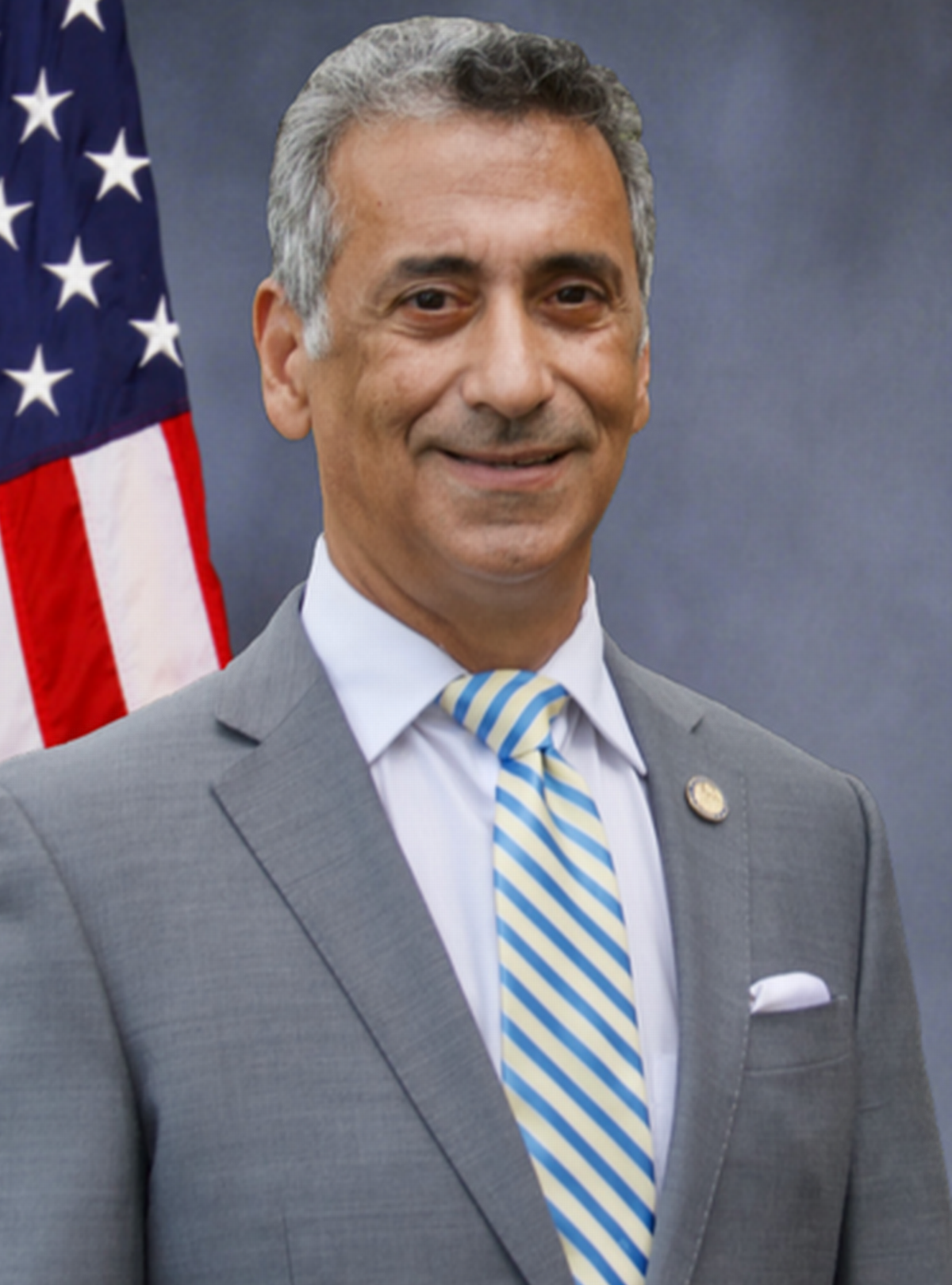
But Asencio has an appealing platform of finding ways to assist those in his district through these challenging economic times.
Gimenez is among those who voted against certifying the 2020 elections in two states, Arizona and Pennsylvania, because of changes that allowed for late ballot counting in those states, he told the Miami Herald. The congressman also said he knew his vote would not have changed the outcome of the election. Is that a good enough excuse? No. When Herald reporter Charles Rabin asked him if he would have voted the same way had he believed his vote would have changed the outcome, Gimenez at first didn’t answer, then called it “speculation.”
So, was he voting his conscience in voting to overturn the results in those two states, or simply sticking with the Republican pack?
Intentionally or not, Gimenez was doing former President Trump’s bidding in his claim that the election had been stolen.
However, he tweeted his congratulations to Biden and Vice President Kamala Harris on Inauguration Day and condemned the violent actions of the Jan. 6 insurrectionists on Local 10’s “This Week in South Florida.”
Unfortunately, the Board’s invitation to Gimenez to take part in a candidate interview went unanswered. Other Republican members of Greater Miami’s congressional delegation did the same or declined the invitation.
Asencio told the Board he does not want to be endorsed as a default candidate. We get it. After all, Gimenez has name recognition and nearly $2 million in his campaign coffers for re-election; Asencio is at about $30,000. Still, he is a solid challenger in a district where 35% of the voters are independent and will likely decide this race. The constituents in this district live from Sweetwater , to Kendall, to South Dade to the tip of Key West.
“We have a phenomenal grassroots phone bank and door-to-door knocking campaign,” Asencio said
Asencio is a retired Miami-Dade County Public Schools police captain and Army Reserves veteran who was elected to the Florida House in 2016. He lost his seat in 2018.
He has since run unsuccessfully for other offices and now seeks a seat in Congress after defeating Juan Paredes in the August Democratic primary.
“I’m running because too many people are hurting in our community and I think partisanship in Congress is hurting our country. . . . What we need is statesmanship,” Asencio told the Board.
In his first, two-year term in Congress, Gimenez has served in the Transportation and Infrastructure, Homeland Security and the Science, Space, and Technology committees.
Asencio says Gimenez’s district service has been “subpar.” He said that constituents describe Gimenez as a “ghost” because they never see him. And Gimenez has kept his second-term reelection campaign low-key. He unveiled his first TV ad just this Sunday on local television. He appeared at what is believed his first town hall with Asencio in the Florida Keys last week, where he announced that he fought for $4 million funding from FEMA to Key West to replace 423 wooden power distribution poles with ductile iron poles.
In July, Gimenez introduced a bill prohibiting civil aviation operations at Homestead Air Reserve Base. “Preserving the Homestead Air Reserve Base for its original intent and purpose is critical to protecting our national security interests,” Gimenez said. The airbase has been a central focus of special interests that wish to secure commercial passenger and cargo operations, also endangering the environment.
Gimenez has always said that he votes for what he thinks is right. But he seems to be doing less of that and more following the Republican pack.
However, he voted in favor of legal protections for transgender and same-sex marriage and, initially, for the creation of the Jan. 6 Commission, before, in the final vote, voting No on that one.
Unfortunately, like the other South Florida Republican congressional members, Gimenez voted against the infrastructure bill, the inflation-reduction bill, the homeowner’s assistance bill and the election-reform act. Had he talked to the Editorial Board, we would have asked him to explain why.
“At some point, you have to do more than just vote No; you have to come up with solutions for the people in the district,” Asencio said.
If he wins, Asencio said, he will create a workforce committee and open constituent centers throughout the district. He says the key to surviving in a Republican-controlled Congress is to “work across the aisle,” especially if the Republicans take back the House.
“To get things done, you need to build relations,” Asencio said.
For his political experience and belief in the democratic system, the Miami Herald Editorial Board recommends ROBERT ASENCIO for U.S. House District 28.
BEHIND THE STORY
MOREWho decides the political endorsements?
In advance of local and state elections, Miami Herald Editorial Board members interview political candidates, as well as advocates and opponents of ballot measures. The Editorial Board is composed of experienced opinion journalists and is independent of the Herald’s newsroom. Members of the Miami Herald Editorial Board are: Amy Driscoll, editorial page editor; and editorial writers Isadora Rangel and Mary Anna Mancuso. Read more by clicking the arrow in the upper right.
What does the endorsement process look like?
The Miami Herald Editorial Board interviews political candidates to better understand their views on public policy and how their policies will affect their constituents. Board members do additional reporting and research to learn as much as possible about the candidates before making an endorsement. The Editorial Board then convenes to discuss the candidates in each race. Board members seek to reach a consensus on the endorsements, but not every decision is unanimous. Candidates who decline to be interviewed will not receive an endorsement.
Is the Editorial Board partisan?
No. In making endorsements, members of the Editorial Board consider which candidates are better prepared to represent their constituents — not whether they agree with our editorial stances or belong to a particular political party. We evaluate candidates’ relevant experience, readiness for office, depth of knowledge of key issues and understanding of public policy. We’re seeking candidates who are thoughtful and who offer more than just party-line talking points.
This story was originally published October 18, 2022 at 7:36 AM.

.png)
.png)


.png)
.png)
.png)
.png)
.png)
.png)
.png)
.png)
.png)
.png)
.png)
.png)
.png)