Chapter 4: Accused of stalking cop who shot her son, she finds no mercy in Miami-Dade’s justice system
READ MORE
Guilty of Grief
A Miami Herald series about a police shooting of a young man lays bare Florida’s broken mental health system.
Expand All
Warning: This series includes scenes of graphic violence and language.
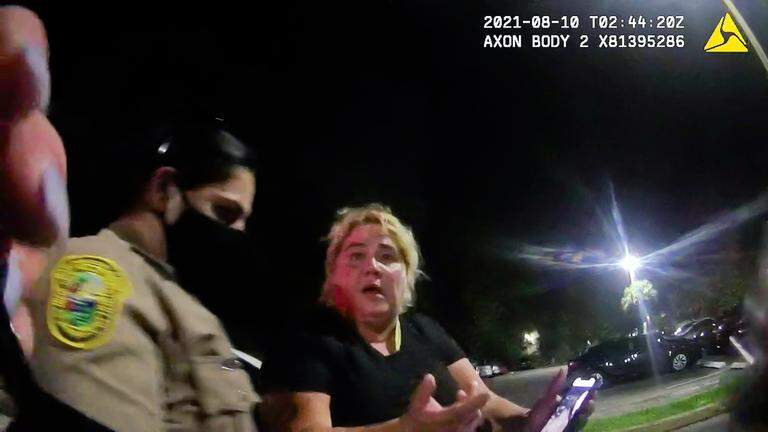
Gamaly Hollis is so panicked she’s peed her pants. She is afraid of what police might do next.
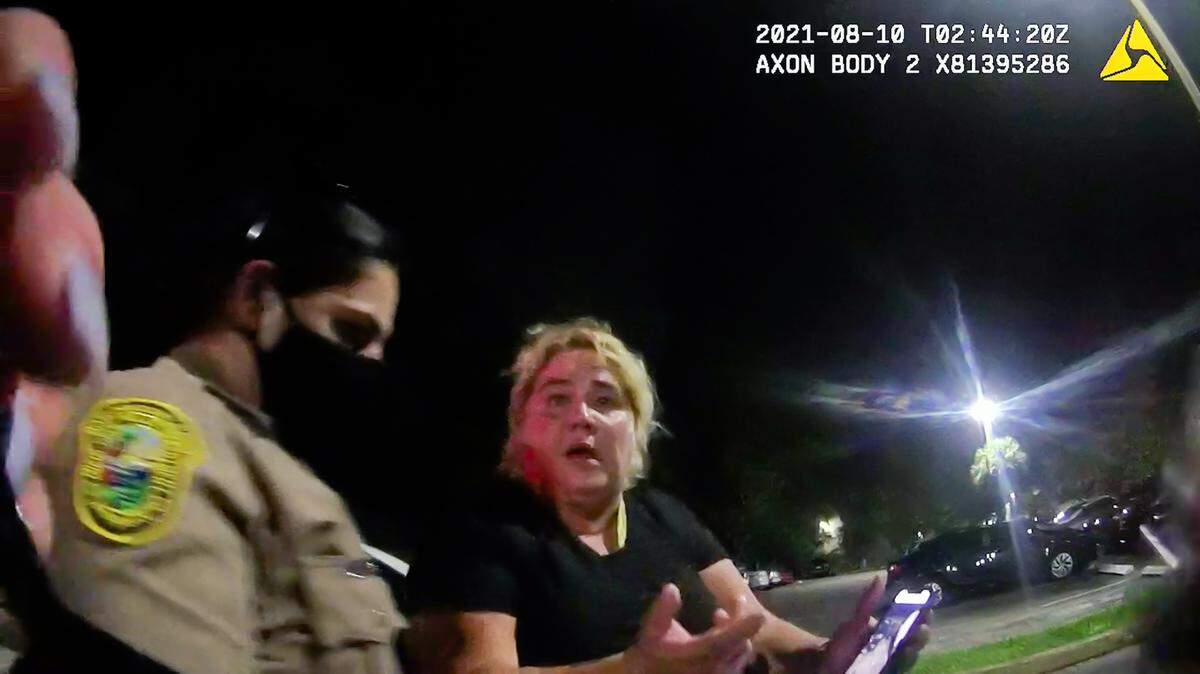
She’s stared down the barrel of a gun. She’s been tased in the chest and yanked from her SUV in the middle of a Kendall thoroughfare. She’s been wrestled to the ground, double cuffed, manhandled into a squad car and deposited at the Hammocks precinct. She’s got bruises on her arms and face.
Hollis asks two officers who are shackling her to a plastic chair if she can make a phone call. Can she have some water? What are the charges against her? Is she going to jail? Where are her dogs, Rollie and the Yorkies, “who I love like my son – they are the only thing I have.”
“You don’t shut up,” one officer snaps. “I told her 3,000 times to shut up.
“If I hear your voice one more time, I’m gonna stick you in a car, so we can’t hear you with the windows up. Let me hear your voice one more time. If you think I’m kidding, try me. I am sick and tired of hearing your voice. I dare you. I dare you to open your mouth again. I dare you.”
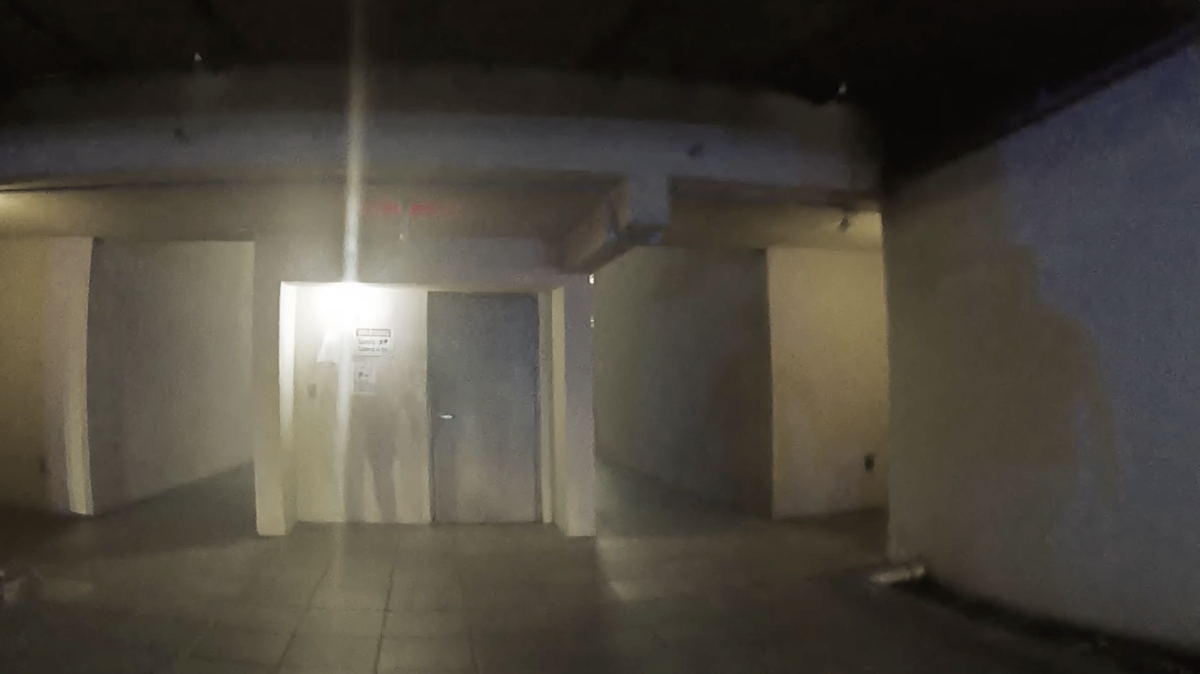
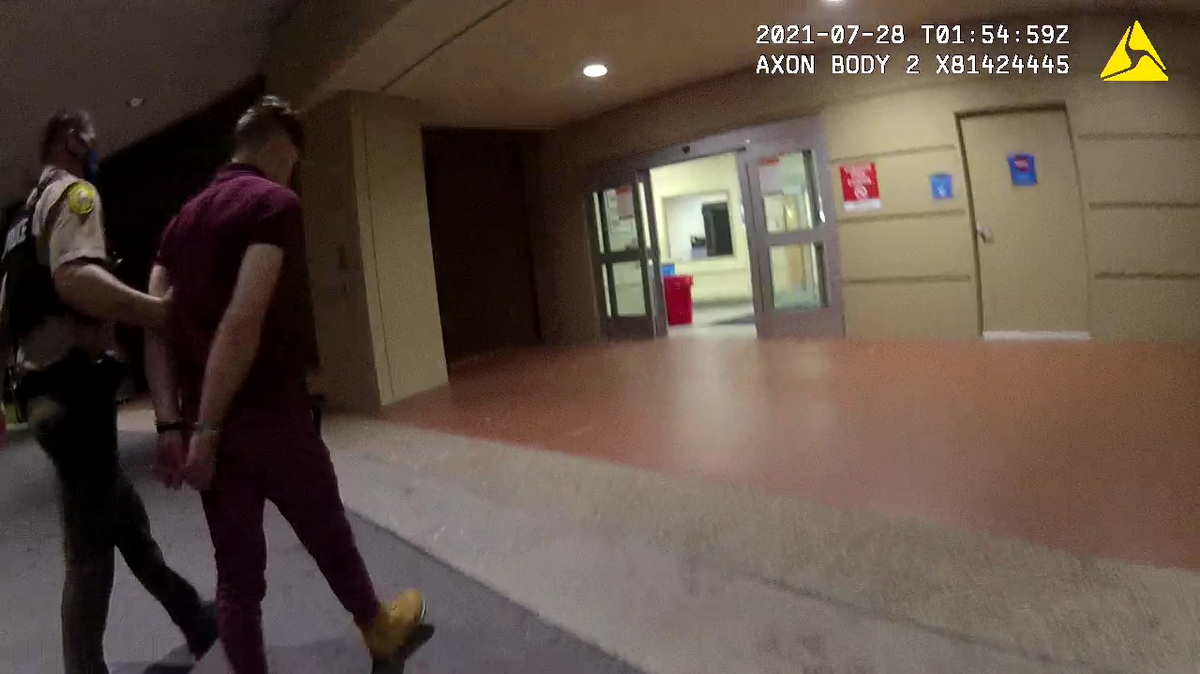
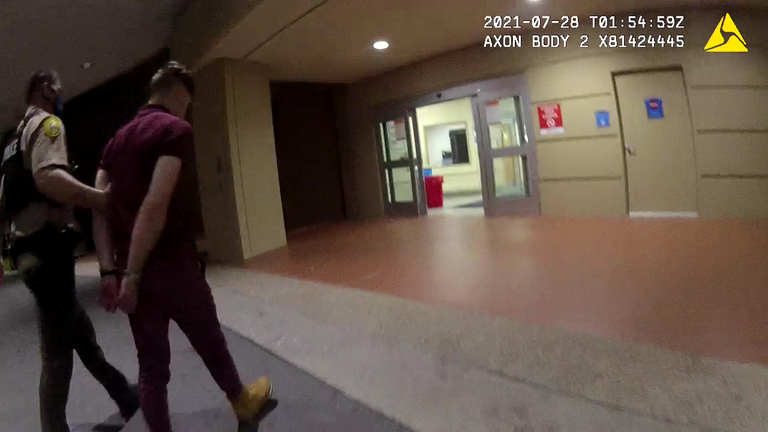
On the sweltering night of Aug. 22, 2022, Hollis is plunked down on a seat outside the back door of the station near Daniel Taveras, who was popped driving into his own neighborhood.
They had made the same unforgivable mistake: They disrespected the police.
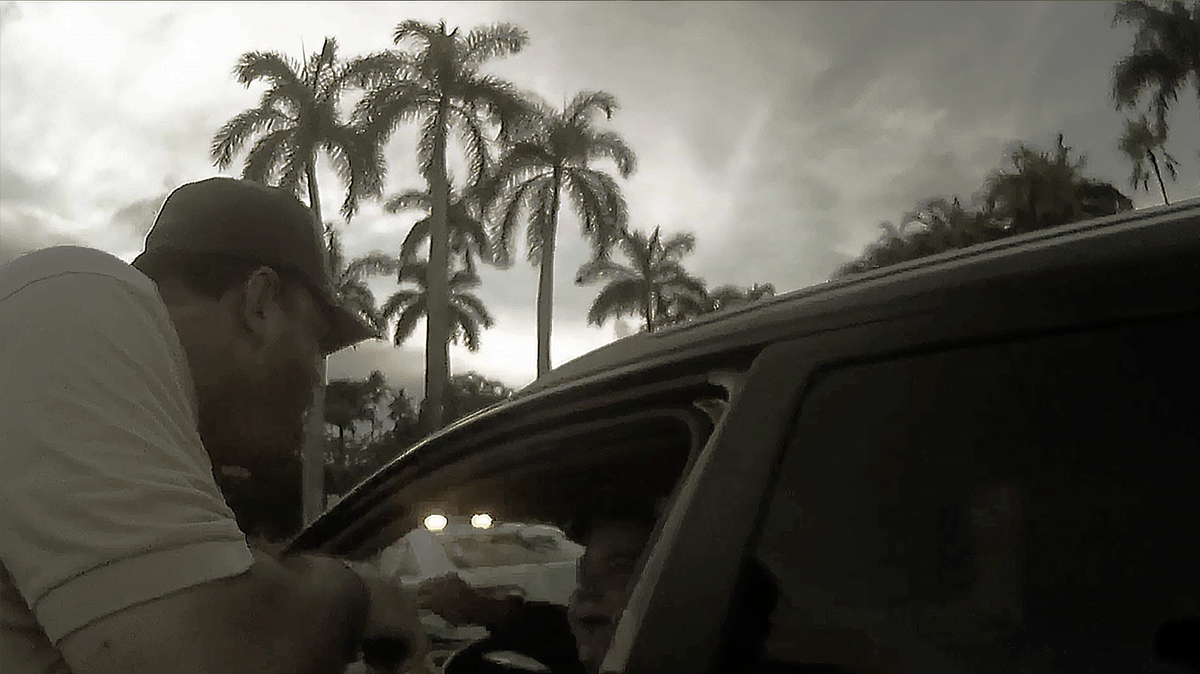
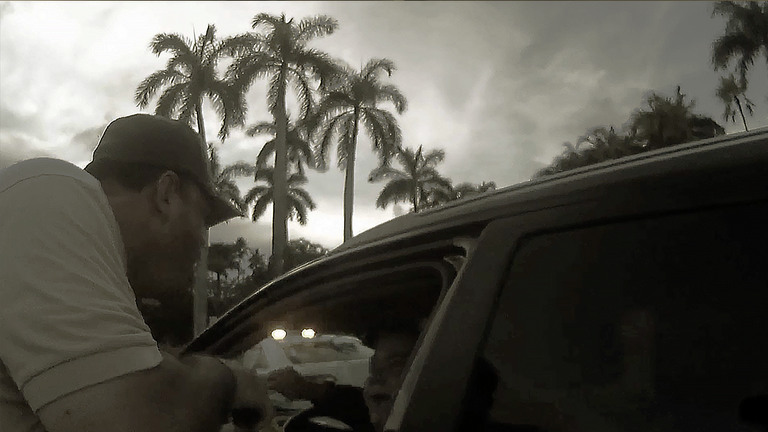
Taveras gave the middle finger to the cop who pulled him over for the offense of entering his gated subdivision from the wrong lane. Hollis called Officer Jaime Pino “asesino” – Spanish for killer – and wouldn’t cooperate when told to get out of her car.
Irritants. Head cases. 43s – police code for people with mental illness.
Hollis and Taveras would be detained outside the station until 3 a.m., when they were taken downtown and booked at the Turner Guilford Knight jail. In the intervening hours, police berate Hollis. They have little patience for the whining of a traumatized mother two months removed from witnessing an officer shoot her son dead.
Overwhelmed, Hollis lets out a piercing cry. Taveras places his left hand near his heart, but remains impassive.
“You don’t have any rights out here,” yells a cop who complains about being assigned to “babysit” Hollis. “You’re under arrest. Guess what? No, it’s not a free country for you anymore.”
“Oh, really,” Hollis answers.
“Yes really.”
“I know we are not living in a free country,” Hollis starts.
“We’re not,” the officer cuts her off.
“You guys come to my house and kill my son,” Hollis says.
“Exactly. Exactly. It’s not a free country.”
“You were given a direct order, and you can’t follow orders,” the officer says later. “This is what happens.” Other officers at the back entrance chuckle.
Hollis asks why Pino is patrolling her neighborhood – after she’d been reassured that Pino would be on desk duty until completion of the investigation into whether he had or had not used excessive force in Richard’s shooting.
“Whether he is supposed to or not, that is none of your business,” another officer answers.
“It is my business,” Hollis responds. “He killed my son.”
An unidentified motorcycle officer bends toward Hollis and warns her not to show up at any more crime scenes, “especially when you want me dead,” he says, gesturing with his palms pressed together. If she calls any cop a murderer, she will go to jail “again and again and again and again. Until you understand that you cannot do that.”
“Until you shoot me,” she says.
“Ah no, nobody’s gonna shoot you unless we have to, if you put our life in danger.”
“I no have anything, I no hurt anybody.”
“Which is why you’re not shot today,” the officer responds.
Hollis had crossed the thin blue line. She not onlytalked back to cops but called one of them a murderer in front of his police brethren. And she wasn’t finished. She’d soon take her crusade to social media. Police and prosecutors would make her pay for it.
In a broken system that fails to heal people with mental illness, fails to help parents whose kids can’t help themselves and fails the police officers caught in the middle, only Gamaly Hollis would be punished.
The price? She was sentenced to364 days in jail – and she faces up to two years more.
In the Miami-Dade criminal justice system, Hollis, with her shouts of asesino and accusatory posts on her barren Facebook page, rankedas big a menace as vicious stalkers and wife-beaters. A Herald analysis of Miami-Dade and Broward cases revealed that only 1.3 percent of people prosecuted for violating a stalking protective order were sentenced to the maximum of one year, and only 21 percent got any jail time at all.
Hollis says her offense was being a nobody nuisance attempting to amplify her voice on social media: Beware, “Pistolero” – Pino’s Instagram nickname – is back on the street.
39 Followers; One reply
Three days after her arrest at Charlestowne, Hollis turns to social media. She has finally confronted the police officer who killed Richard and found out his name: Jaime Pino. She feels compelled to get the word out, to prevent Richard from becoming another anonymous victim on the scroll of police shootings. Typing from her haunted apartment, Hollis uses Facebook to accuse Pino of being responsible for Richard’s death. In her first foray she posts photos of the Charlestowne entrance, a squad car in the foreground.
Subsequent posts, copied from Pino’s Facebook page, show Pino at a James Bond 007 exhibit. Pino at the shooting range he owns, aiming a pistol, his forearm tattooed with an eagle. Hollis’ message: “JAIME PINO ES UN ASESINO, MATO A MI HIJO.” Jaime Pino is a murderer, he killed my son.
Most of the photos she posts look like they come from a Pino family album – Pino with his wife and kids. Smiling relatives standing around a Christmas tree.
In another, Hollis juxtaposes a photo of Pino at the door of his squad car next to a school portrait of Richard wearing blue medical scrubs. “Police Jaime pino badge 5881, kill my son instantly at point blank,” Hollis writes. A similar post juxtaposes the same photo of Pino with pictures of Richard in the kitchen and in his high school uniform.
“Jaime pino asesino mataste a mi hijo a quemarropa,” she writes – which means point blank, “shot close enough to burn clothes.”
Another contains the message “Jaime Pino murderer, this is so you don’t make fun of me, bastard,” a riposte to his mocking of her at Charlestowne.
“Murderer is walking the streets after killing my son,” Hollis writes in Spanish above snapshots of Pino from his page.
But the posts do not go viral. How could they? Posting under the name Gamaly Cruz – her name before she married – Hollis until recently had 39 followers.
Only one post generates a comment, from a person named Nancy, saying “He has to pay,” and Hollis replying, “Thank you, he will pay.”
Hollis’ last post, before Pino and his union decided they’d seen enough, is the most unsettling. Under the heading “So true,” she posts an English to Spanish translation of the term “an eye for an eye,” with references to revenge or justice and a sample usage sentence that reads: “For murder I believe an eye for an eye is fair punishment.”
Hollis says her posts were not threats, but protests over her son’s killing.
“We have a right in this country to free speech,” Hollis later tells the Herald. “That’s why I left Cuba.”
The 33 Facebook posts over a two-month span, together with Hollis’ arrest at Charlestowne, are all Pino needs on Nov. 7, 2022, when he appears via Zoom before then-Judge Luise Krieger-Martin to request a restraining order against Hollis. Most of the requests Krieger-Martin presided over were from victims of domestic violence.
Pino is represented by a police union lawyer. Hollis appears by herself, holding a towel in front of her face.
“You look like you’re in some distress,” the judge says.
“I’m afraid of him,” Hollis replies, asking for her own protective order, saying Pino had previously threatened both her and her son.
Pino testifies that as he was leaving a crime scene at the Charlestowne gatehouse, he heard Hollis.
“At that point, she started to yell in Spanish that I’m a killer, that I’m an assassin, that I killed her son,” he says.
Hollis told officers “she was there because that’s where she lived, and she wasn’t leaving,” Pino testifies, and that another officer “grabbed me in fear that she was going to try to hit me with the car.” Pino says he “honestly thought [Hollis] was armed.”
When Krieger-Martin asks what made him fearful, Pino says Hollis was making “erratic movements” and rooting around in her console, suggesting she was looking for a gun.
It’s the first in a series of questionable court statementsfrom police. Body camera footage from Charlestowne reviewed by the Herald does not show Hollis saying she lived there or yelling at Pino. She remains seated and calm, her hands on the steering wheel. Hollis’ attorneys argued recently that Pino committed “perjury” by exaggerating his account.
State Attorney Katherine Fernandez Rundle’s office rejected the perjury allegations. Spokesman Ed Griffith said prosecutors would not comment, but they released a legal memo on Oct. 24 arguing that, even if police officers exaggerated the threats Hollis posed, it doesn’t matter because their perception of danger is “subjective.”
There was no “objective” proof that Pino lied, the memo said. Prosecutors gave Pino the benefit of the doubt, just as they did with Pino’s decision to shoot Richard.
The next witness is Christian Santos, a trainee supervised by Pino, who says Hollis pulled into a “very dynamic scene,” adding, “She was very confrontational. She was argumentative. She was there heightening up the scene. She was being an aggressor.”
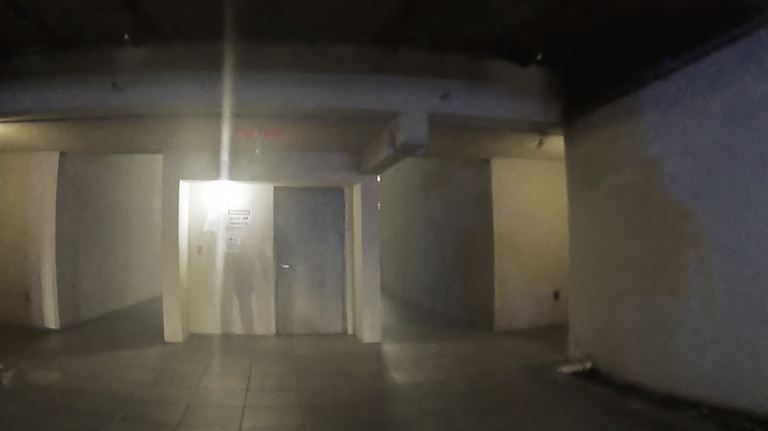
But body cam video footage reviewed by the Herald casts doubt on Santos’ description. In the “very dynamic scene,” a dozen police officers fist-bump each other with salutations of “bro,” chat, and direct traffic created by their posse of squad cars. One officer chews gum and types on her cell phone. Pino initiates conversation with Taveras about anime characters, dirt bikes, unicycles and Taveras’ Dr. Scholl’s shoes. Officers laugh in the background.
Sgt. Stephanie Llamas testifies that she met Hollis in the Hammocks station parking lot during one of Hollis’ three visits there in the days following the shooting of Richard on June 15, 2022.
“She told me that he murdered her son and she wanted to see him,” Llamas says three times.
“I said, ‘Ma’am, we can certainly sympathize,’” Llamas says she told Hollis. “‘I can’t imagine what you’re going through. This is incredibly tragic.’”
But body camera footage of their nearly nine-minute conversation does not show Hollis uttering the words “he murdered my son” or anything similar. Hollis said it over and over the night of Richard’s shooting and during her encounter with Pino, but not at the station that day. The footage reviewed by the Herald doesn’t include Llamas’ expression of empathy, either.
One witness who had a different view of the Charlestowne confrontation was never heard at the hearing: Daniel Taveras.
“How that whole thing escalated was crazy,” Taveras later told the Herald. “It’s like they had a grudge against her. I feel very sorry for what happened to her.”
The Miami-Dade Police Department would not comment on the Hollis case or allow officers to speak with reporters, said Detective Artemis Colome. “Unfortunately, we are unable to comment or discuss cases when attorneys are involved,” Colome said.
In September, Hollis filed a wrongful death lawsuit against the department and Pino.
As the hearing for the restraining order proceeds, Hollis answers questions from the judge. She says she was driving to the cemetery with Rollie to visit Richard’s grave when she noticed a gaggle of police cars at Charlestowne, and then saw “the murderer of my son” amid the commotion. She wanted to know his name and express her sorrow and anger.
“I decided to confront him, and tell him how I feel as a mother,” she says.
It was a coincidence that she came upon Pino, she asserts, and a surprise, considering she had been told by a detective investigating the shooting that Pino would be on desk duty. Yet there he was, back in the neighborhood.
“I want to make sure he’s not in the same area where I live because I’m afraid for me as a mother,” Hollis testifies. “So the people know who was the murderer of my son.”
Why did she share Facebook pictures of Pino’s family, Krieger-Martin asks.
“Because he’s laughing at me. He was laughing [in] my face how he killed my son.”
In what might have been the first – and last – moment in which a judge expressed compassion, Krieger-Martin gives her condolences to Hollis.
“I know this is a very, very tall order. I know it. And I’m so sorry for your loss,” the judge says. “I want to make this as painless for you as I can. I know that you’re in pain. I get it. I’m a mother too. I understand.”
Then, Krieger-Martin signs the order. Hollis must stay away and stop posting anything about Pino on social media for one year. If she violates it, she will go to jail.
The next judge, Hollis will find, won’t be as sympathetic.

Raising Richard
Hollis can recall the moment when the bond with her only child broke. Richard was 16 and had obtained his learner’s permit. She was teaching him how to drive on June 15, 2017, when they started arguing. Richard flipped off a driver who cut in front of him. Hollis told Richard to pull over. She left him in a parking lot to walk the half-mile home.
For most of Richard’s life it had been just the two of them. A diligent, curious little boy and his doting mother – then a drug-using, combative teen and his desperate mother, who chastised him for hanging out with kids who got high and skipped school.
“He was influenced by the wrong people,” Hollis says now. “When he was on drugs, I could not control him. He did not listen to me.”
After the aborted driving lesson, Richard called the police on his own mother, saying she slapped him on the head, bit his hands and forearm and pulled his hair in the car. Hollis pleaded no contest to child neglect charges and served probation – though adjudication was withheld and she was not convicted. Hollis said she lost her sales job at the Dadeland J.C. Penney after 11 years because of the incident.
Richard was assigned a guardian ad litem and left his mother’s apartment at Peppermill. During his senior year, he lived in two group homes for children and with one of his high school teachers. He sought and was granted legal emancipation from his mother by a judge. Following graduation from Ferguson High, he took his late father’s $957 monthly Social Security survivor’s benefits and moved north, where he enrolled in Tallahassee Community College.
“Mother, I’m leaving Miami forever. It’s my time now to become what I dreamed. I’m sad to see we couldn’t keep a relationship because you show no respect for your son and his choices. You’ll see you raised a legend. God will show us the way. Goodbye Mama,” Richard wrote in a July 1, 2018 farewell letter.
When the money ran out within a year — wasted on drugs and alcohol, Hollis says — she drove a U-Haul to Tallahassee and brought Richard back to Peppermill.She bought him a Rottweiler, Rollie, as promised. He enrolled at Miami Dade College, still determined to become a trauma doctor. But Richard’s homecoming was not what she expected. He was different. More disobedient, aggressive and paranoid.
“I blame completely the courts for taking power away from the mother and allowing my teenage son to leave my supervision when he needed a tough parent to encourage him to take the right path in life,” she said, listing half a dozen drugs Richard was taking. “He lost his ability to concentrate. He lost his self esteem. He hallucinated. He wouldn’t eat. He stopped taking showers because he said the soap and shampoo were harmful to his body.”
Mother and son, like the poles of a magnet, were alternately attracted and repelled by each other. They fought constantly until Richard’s death. They argued over his drug and alcohol abuse, his diet, his video games, his inability to keep part-time jobs at Publix, Home Depot and Pei Wei.
Richard hit his mom, threw the food she prepared for him in her face, yelled at her. He destroyed furniture, punched walls, shot up the ceiling with BB gun pellets, threw dishes across the apartment like Frisbees. He had periods of “deliriums,” she said, when he claimed he had a pregnant wife. When he was wasted, he missed classes. He changed his phone number constantly to dodge drug dealers who were after him, he told her. When Hollis tried to lock Richard out, he climbed up to their third-story terrace using satellite dish wires as scaffolding.
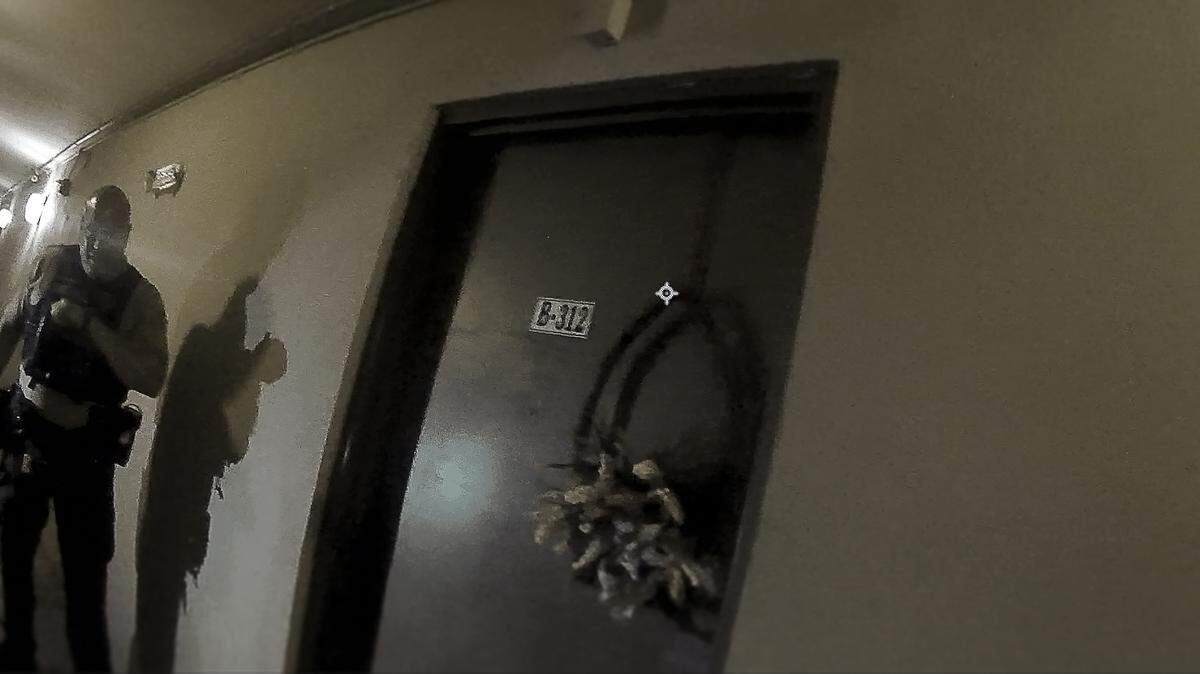
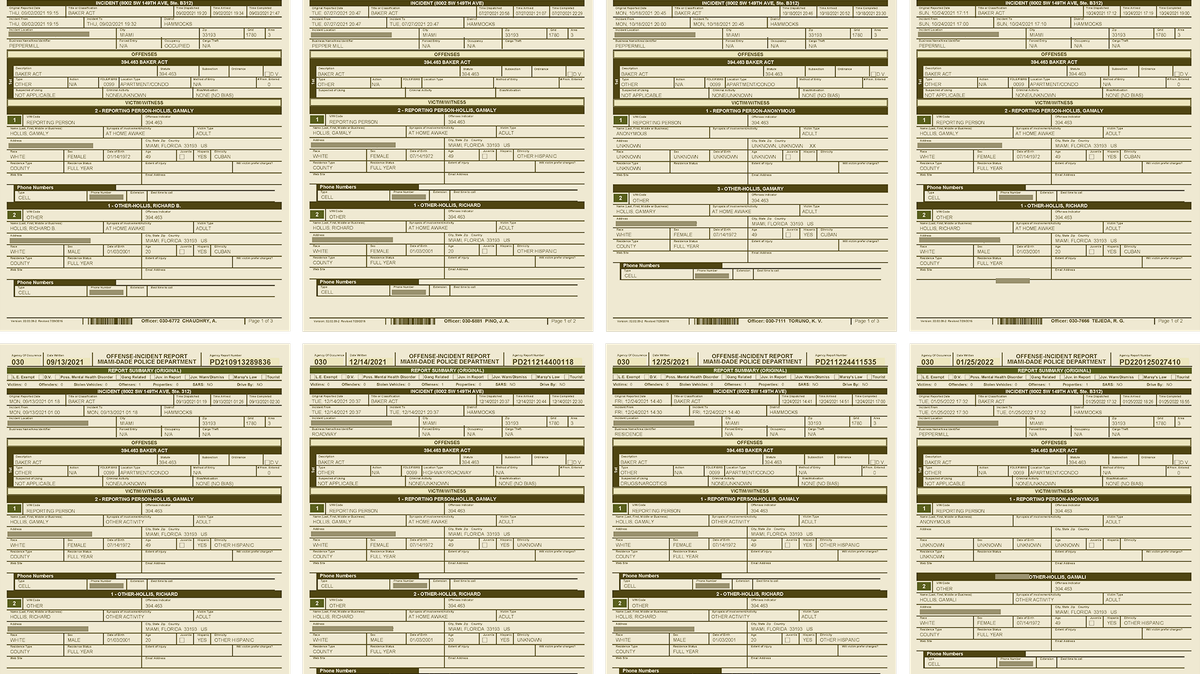
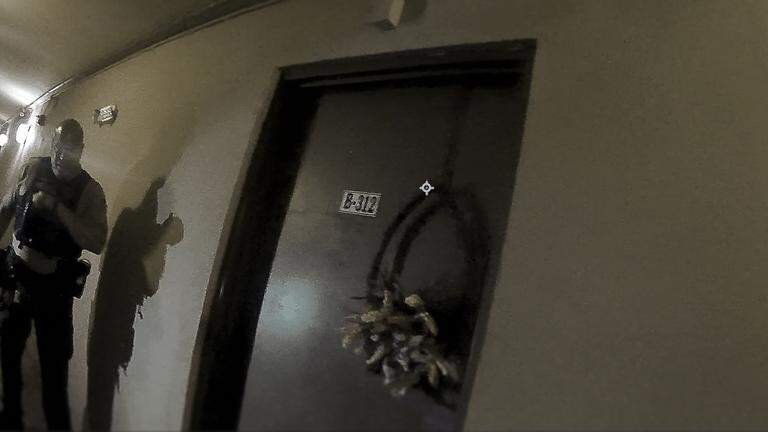
“Yeah, he’s mentally ill,” Hollis told a police officer she had called to B-312 on one of Richard’s bad days. “He’s supposed to take medication after he gets out of the hospital.” But “he doesn’t even pick it up.”
“I don’t want to put him in the street and somebody kill him, right? I support him and support him,” she said. She showed the officer her wet shirt. Richard had thrown a can of Sprite at her. “The whole day I’m working and he’s bullying me.”
Yet when Richard was arrested for shoving a neighbor on April 15, 2021, his first reaction was to cry out “Mami!” 13 times as he grappled with a police officer who kicked open his bedroom door, forced him onto his bed and tased him in the back. Twitching and groaning in pain, Richard called for his mother as police handcuffed him, dragged him out of B-312 and placed him in the back seat of a squad car.
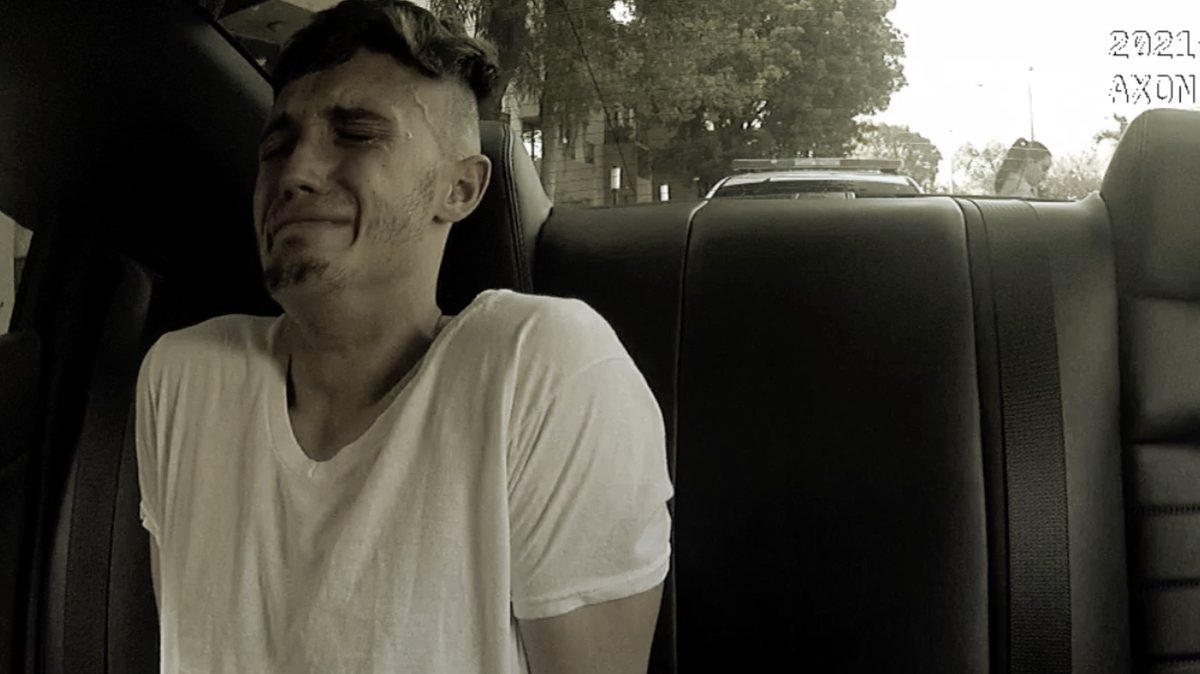
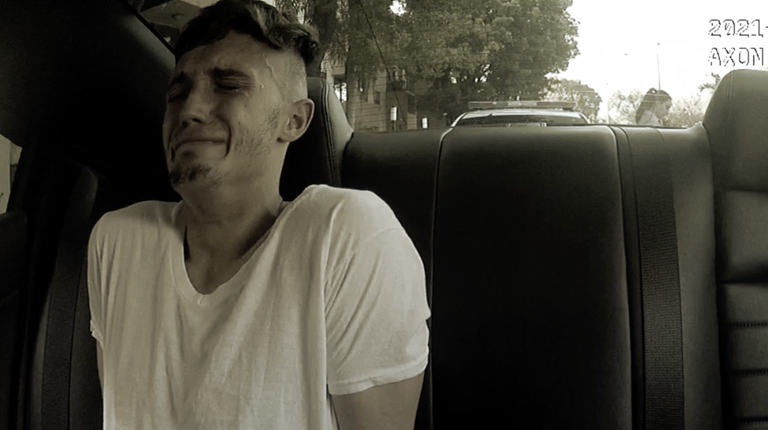
While Richard sat there, alone, for nearly 90 minutes, police body cam footage captured his changing expressions as he contemplated the mess he had gotten himself into.
Sweating in the squad car, Richard’s anger wilted into frustration. He turned his head from side to side, looking out the closed windows. He was trapped. He was defeated. He was ashamed. The deep line at the bridge of his nose, caused by his permanent scowl, was erased. And then the tough-talking kid started to cry. He bowed his head, let his shoulders sag, and wept.
Guilty
Within nine months of being ordered to leave Pino alone, Hollis is back in her Facebook echo chamber, her only forum. She knows the consequences, but she doesn’t care. On April 8, 2023, she posts a Google Maps image of Pino’s police car in front of his garage. There’s no address, but she adds a cryptic caption: “Bye Bye.”
When Pino finds out about the post from a relative, he reports it to police as a violation of his protective order, setting in motion Hollis’ arrest, trial and sentencing.
Hollis’ one-day trial commences with an agreement between prosecutors and defense attorneys that Richard’s killing will not be mentioned to jurors. Nor will his name. Nor will the history between Hollis and Pino. Nor will Pino’s 2021 warning that he’d kill Richard. Nor will Hollis’ trauma and grief. The jury will not be told the reason, the motivation behind Hollis’ actions.
The defense wants no mention of the word “stalking” either. But prosecutor Andres Perez says that could lead jurors to believe that Pino “is just a police officer that is picking on this poor old lady.”
The scope of the case is limited to whether she violated the protective order or not. Cut and dried.
Pino, dressed in street clothes, is first on the stand. Perez, asks “Why aren’t you dressed as a police officer today?”
“Because I’m not here on behalf of the department,” Pino answers. “I am here on behalf of myself.”
A Miami-Dade detective testifies that when he drove Hollis to jail on stalking charges, she asked him to give his colleague a message: “Tell Pino I am not done with him.”
Hollis declines to testify. Her attorneys argue that the “Bye Bye” post did not meet the bar of harassment. As with her previous postings, she had not sent it to Pino or his family or tagged him on it.
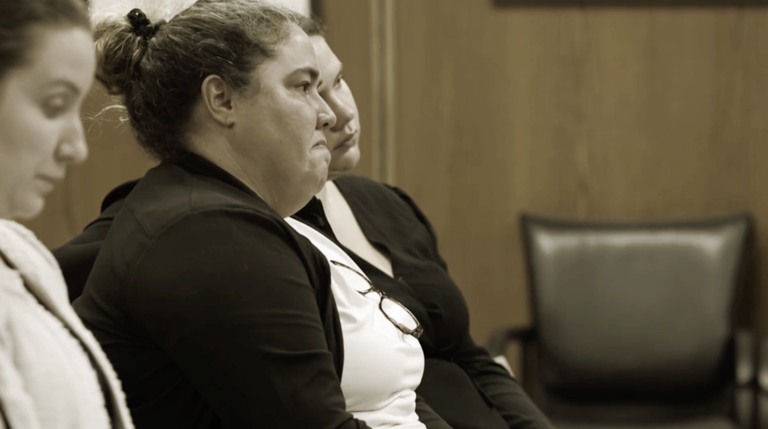
In about the time it takes the jury to polish off a pizza delivered by the bailiff, Hollis is found guilty.
‘You are still harboring deep, deep anger’
Two days later, Hollis is sentenced. But first, she is scolded, lectured and psychoanalyzed by the prosecutor and judge.
Perez says Hollis deserves the maximum penalty for her “vendetta” against Pino.
Pino should be praised as a hero who rushed into danger, but instead of thanking him, Hollis criticized a brave officer forced to make “an impossible choice” – to kill her son to save her, Perez says.
“Even though he willingly risked his life to protect the defendant, Gamaly Hollis, he did not willingly subject himself to the campaign of fear and harassment that ensued,” Perez says. “Instead of protector, he was called murderer, a title that he does not deserve.
“The defendant’s actions may, in part, be the result of grief – grief that we may not possibly understand. But to characterize her conduct as just grief would be injustice. It is the product of denial and guilt. Denial that she played no role in the misfortunes of her son. Guilt that she could not be the mother that he deserved.”
Perez delivers his diagnosis about Hollis’ state of mind.
“This denial and guilt transformed into a perverse attempt,” he says, “to right the wrongs that she did to her son during life.”
To Hollis, it’s as if the floor is collapsing beneath her. Her lawyers are taken aback. Pino, too, had condemned Hollis for being a failure as a mother.
“Ms. Hollis is not on trial for that,” says attorney Alesandra Arias. “And she has not done any wrongs to her son… She has lost her son. All she has right now is her dog, which she considers as her child.”
Good cop vs. bad mom. Hollis never stands a chance.
County Court Judge Cristina Rivera Correa announces she intends to impose “considerable jail time.” Hollis is defiant. They are missing the point.
“Can I say something? Can I talk?” Hollis blurts. “He murdered my son. He said he is going to kill my son before he killed my son.”
She shakes her head, as if she’s not hearing right. Everything is twisted upside down. She should thank Pino for killing her son? Richard’s death is her fault? She alone, an impoverished fruit peddler, a single mother with an ill boy, is to blame for the flaws of the mental health, law enforcement and justice systems?
Hollis lists her grievances, her voice hoarse and shrill. Pino blew her son’s stomach open “in front of me.” The cops are liars and the courts are corrupt. The judge had made up her mind from the start and planned to jail her “with a bunch of murderers.”
If Rivera Correa entertained any thought of mercy, it evaporates.
“The statements that you have made and the behavior that you have displayed here during the sentencing hearing further confirmed this court’s concern that you are still harboring deep, deep anger against someone who was investigated and exonerated,” Rivera Correa says, acknowledging the ghost in the room, the psychotic son whose existence was hidden from jurors.
The judge rebukes Hollis for calling Pino a “murderer” in open court, given his official exoneration. Hollis is outraged, insistent she has a right to free speech under the Constitution.
“Losing a child is a very difficult thing. And it can understandably cause a lot of the feelings that Ms. Hollis may be experiencing. However, she is channeling those feelings and addressing them in a very negative, destructive, violent and criminal way by sending messages to Mr. Pino,” the judge says.
There was no evidence that Hollis sent messages to Pino, though prosecutors claimed the police car photo and ambiguous “Bye Bye” were directed at him.
“I can sense that she still harbors that anger,” the judge says. “It looks like she is searching for somebody or something to blame. I don’t think that she has moved past that. I don‘t know whether she ever will move past that.”
Rivera Correa orders Hollis to spend 364 days in jail, minus the 45 days Hollis already served.
To Hollis, the 364-day sentence is the twist of a knife in an open wound. Not anger management counseling or probation, not three months or six months, but a pitiless piling on.
It’s a severe sentence for the crime, a Miami Herald review of South Florida court records shows. If Hollis had been just about any other person convicted of violating a protective order – one with no prior convictions or pattern of violent behavior – she likely would have faced probation or a few months in jail.
Rivera Correa declined to discuss the case, but Miami-Dade courts spokeswoman Eunice Sigler provided the Herald with a transcript of the sentencing hearing and an appeals court decision affirming Hollis’ conviction. “Judge Correa thanks you for the opportunity to comment; however, judicial ethics rules prohibit her from speaking about a pending case,” Sigler said.
Kit Gruelle, a domestic violence survivor who has spent 30 years as an advocate for battered spouses and their children – and trains police, prosecutors, health care providers and lawmakers – said such a harsh sentence was rare, and added: “That is universal. That’s across the country.”
For a judge to “drop the hammer” like Rivera Correa did, a stalker who violated a protection order typically has to present an “extreme threat,” such as a credible death threat, Gruelle said.
“It is outside of my experience for the courts to come down so heavily,” Gruelle said. “This is not in keeping with the way injunction cases typically work out.
“The basic facts of this case really set it apart. It is important to question what is at the bottom of this.”
South Florida court records confirm Gruelle’s contention. The Herald analyzed 161 Miami-Dade prosecutions from 2019 through this year using data from the Public Defender’s Office. In only 38 cases was a defendant given jail time, and, of those, only three received the maximum sentence.

One man had a history of prior arrests, and was considered so violent he was held in lockdown. Another committed multiple violations, and a third was charged with felony aggravated assault and gun possession by a convicted felon.
The Herald analyzed court records of 279 Broward County prosecutions – from 2017 through this year – of people charged with violating a protective order against stalking. In only 56 cases were they sentenced to any jail time; 23 of those got 100 days or fewer.
Just three defendants received the maximum sentence of one year.

Among the defendants who served significantly lighter sentences: A man who left a dead cat on his victim’s porch. A man who let the air out of his estranged wife’s tire, followed her to a gas station and hit her when she kneeled down to fill the tire. A man who punched his 14-year-old son in the mouth. A man who went to his ex-girlfriend’s home and beat up her new boyfriend. A man who choked and slapped his estranged wife.
Hollis’ attorneys aren’t the only ones questioning the punishment she’s received. In a May letter to Fernandez Rundle, the Florida Association of Criminal Defense Lawyers pointed to her case as one of several examples of “selective prosecution.”
Occasionally, penalties are heaviest not on offenders who are truly dangerous – but on those who are annoying or disrespectful, says Alex Piquero, who teaches sociology and criminology at the University of Miami. “There are people we are mad at, and people we are afraid of,” said Piquero, department chair and former director of the U.S. Bureau of Justice Statistics.
“People do stupid stuff but they don’t deserve jail space,” Piquero said. “We ought to reserve that precious space for people who are posing dangers. She is not one I would reserve bedspace for. Incarceration is a last resort.”
Hollis got out of jail on April 20, 2024. But she awaits trial on stalking and resisting charges that could lock her in a cell for another two years.
If Hollis was expecting the next trial to be her day in court, she was mistaken. On Sept. 12, Miami-Dade County Judge Jennifer Azar ruled jurors may not view video of Pino threatening to kill Hollis’ son.
Hollis’ defense is that she confronted Pino at the Charlestowne entrance because she was upset he’d been returned to gun-carrying duty a few miles away from where Richard was shot when he was supposed to be under investigation. She was frustrated that no one would answer her questions or give her records documenting her encounters with police.
“You’re referring to it as a murder. Is that how you intend to refer to the shooting during trial?” Azar asks.
“I’m referring to it as what it was,” replies Hollis’ attorney, Natahly Soler. “It was a murder.”
“No, it was an officer-involved shooting,” prosecutor Alecsander Kohn says.
Azar has the final word.
“Let me be clear,” she says. “We’re not trying a murder in this stalking case. This is a prosecution for the charge of stalking.”
At Richard’s Grave
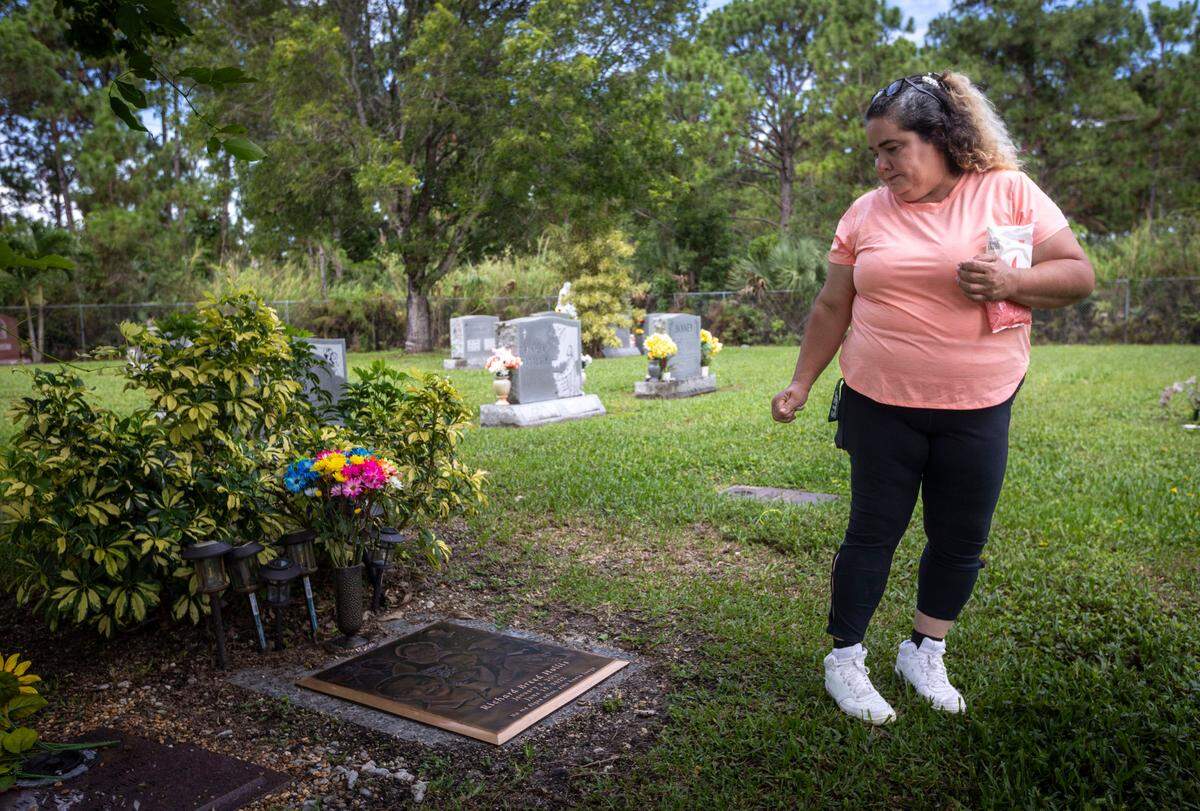
Hollis visits Richard’s grave at Woodlawn South Cemetery two or three times a week. She wipes off the bronze plaque engraved with images of Richard across the arc of his life. The joyful little boy in his mother’s embrace; the proud graduate dressed in cap and gown; the aspiring doctor, wearing scrubs, with a stethoscope around his neck. And, the doomed young man, posing with a stern face next to Rollie.
“I won’t say goodbye but I’ll see you later,” reads the inscription, in Spanish.
She laid Richard to rest in white slacks and dress shirt. Inside his coffin, she placed his gray North Face knapsack she packed with a change of clothes, new underwear and socks she bought at Dadeland Macy’s for $156.45. She wanted her handsome boy to be sharply dressed “when we meet in a new place,” she said through tears on a gray, stormy morning.
She buried Richard with his laptop, his birth certificate, his father’s passport, photographs.
She talks about karma.
“Whatever we do comes back to us,” she says.
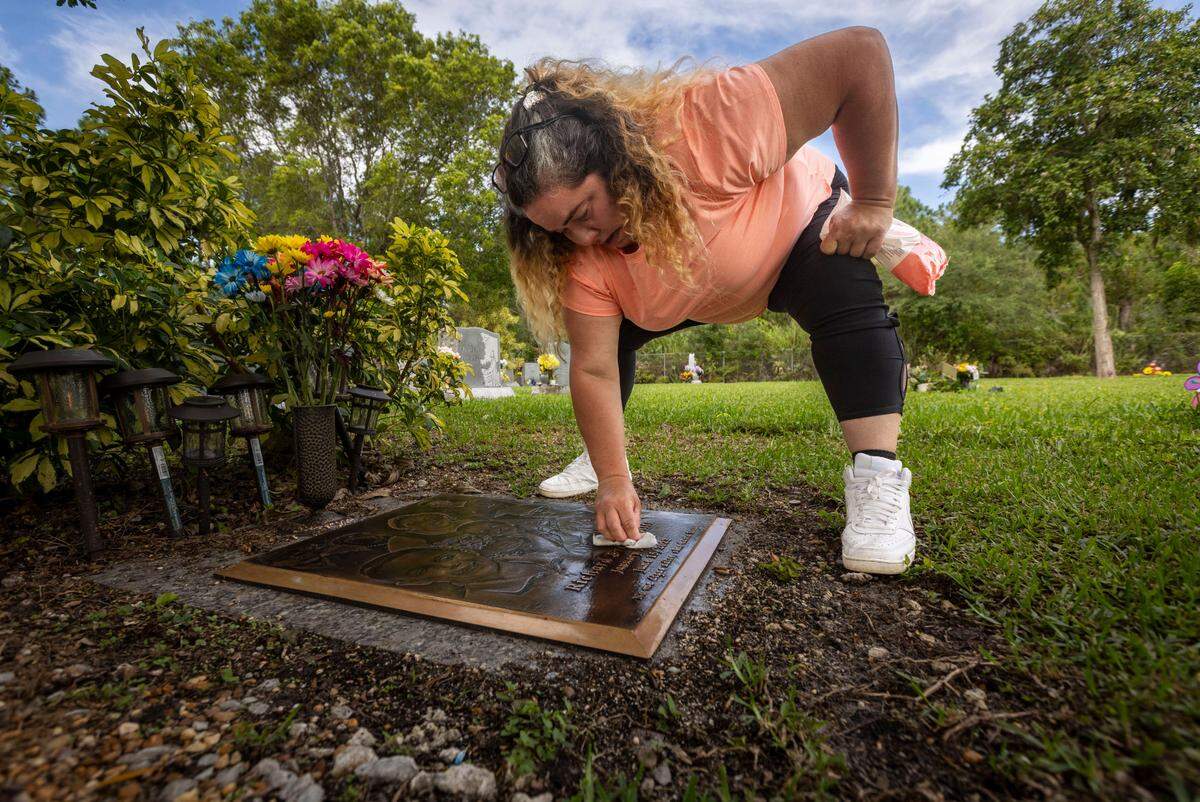
She swears she will never end her quest for what she considers justice, her determination to be heard, to let everyone know what Officer Jaime Pino did to Richard, to tell anyone who will listen how people with mental illness are mistreated by the police, and why a broken system fails to heal them.
“I cannot get my son back. Can God give him back?” she says, showing a photo on her phone from the Medical Examiner’s office of Richard’s pale naked body and the black bullet holes in his arm, thighs and stomach.
“I challenge the police, I fight the system because I have the right to tell the truth about the premeditated assassination of my son,” she says. “Richard has a right to justice. What happens if they put me away like trash and shut me up? Everyone will forget.”
Drizzle turns into downpour. Hollis doesn’t seek cover. Rain is nothing. She was hit, harangued and betrayed by a son who couldn’t help himself. She witnessed his death, mopped his blood off her kitchen floor. She was denounced as a terrible mother, vilified as a threat to the community, and jailed for nearly a year for making Facebook posts about the cop who shot her only child.
What is left? Richard’s grave. And her message, the only means to fill her desolated heart.
“Pino didn’t murder a cockroach,” she says. “He murdered my son. Like he was at his shooting range, shooting at a target.”
This story was originally published November 14, 2024 at 5:00 AM.