Not just DeSantis: Florida’s local politicians are also hands-on with vaccine rollout
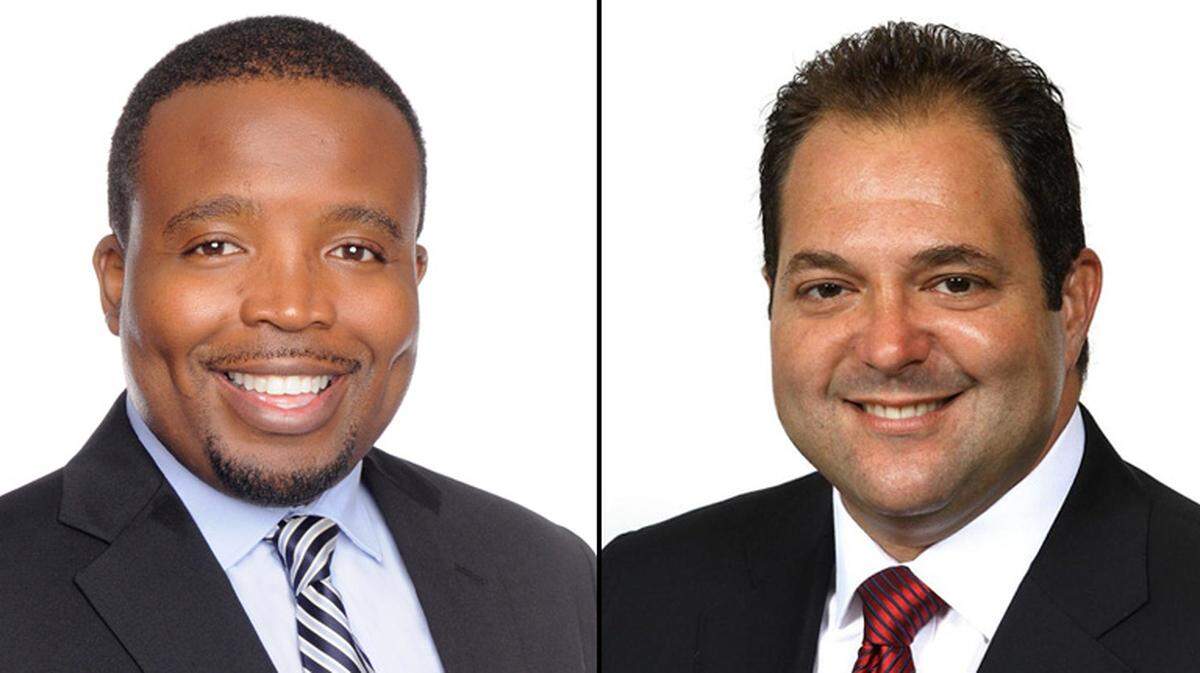
When a new federally supported COVID-19 vaccine site opened last week in North Miami Beach, the city’s vice mayor, Michael Joseph, touted his role in making it happen.
City-issued fliers featured Joseph’s face and credited him and a state representative for helping bring the site to the city. And when it opened, Joseph was there to greet people in line — though how much of a role he played in bringing the site to the city is in dispute.
“Why is somebody trying to take credit for something that the city is doing together with FEMA?” said North Miami Beach Mayor Anthony DeFillipo, a political opponent of Joseph.
With increased vaccine supply flowing into Florida in recent weeks, local politicians have increasingly played a role in advocating for shots in their communities. In several cases, they have helped arrange vaccines for low-income and majority-Black populations, whose vaccination rates have lagged in South Florida.
As part of a pilot program to address those disparities, state officials say they’re counting on local leaders to “augment messaging efforts and encourage individuals in their communities to receive the vaccine.”
But politics can also complicate public health efforts. Amid the vaccine rollout, elected officials have jockeyed for credit for vaccine events and walked fine lines between public service and political opportunism.
“If we say no, our constituents will get mad,” Miami-Dade Commissioner Rebecca Sosa said when Jackson Health offered each of the county’s 13 commissioners 100 vaccine slots to fill in late January. “If we say yes, everybody is going to get mad and say, ‘You’re trying to take advantage of this situation to benefit your friends.’ The more we do, the more criticized we are.”
Some commissioners rejected the offer, including Raquel Regalado, who tweeted that “having elected officials involved in distributing vaccine appointments ... raises issues of transparency and may not be in the best interest of the county’s effort to vaccinate all of our residents.”
Another Miami-Dade commissioner, Kionne McGhee, disagrees. He accepted the appointments from Jackson, and last weekend partnered with Community Health of South Florida to sign up another 100 people for shots. McGhee said attaching himself to an event is a way to promote vaccine access to constituents who know him and often turn to local officeholders for help securing services.
“If your definition of politics is skewed, then you see it as someone taking advantage of an opportunity,” said McGhee, a former Democratic Party leader in the Florida House of Representatives. “My definition of politics is taking action to get done what needs to be done.”
Questions of political influence on Florida’s vaccination rollout have been widespread.
In Manatee County, the local sheriff’s office is investigating whether a county commissioner broke state laws by helping organize an exclusive vaccine event with a list of people to receive shots that included herself and a local developer. In text messages obtained by the Bradenton Herald, the commissioner talked about how great the site would be for the reelection campaign of Republican Gov. Ron DeSantis.
And in Lauderhill, a majority-Black city in Broward County, Democratic state Rep. Anika Omphroy told city commissioners they could submit 10 names apiece for vaccine slots at an event she coordinated at a church in late January, drawing criticism from a local conservative blog.
Omphroy has not yet responded to a request by the Miami Herald to release the names provided to her office by Lauderhill commissioners. The city released emails that included commissioners’ lists, but redacted the names of the people they chose to get vaccinated. City Attorney Earl Hall told the Miami Herald the city would not release the names “absent a court order.”
Meanwhile, Florida Democrats have called for an investigation into whether political contributions to DeSantis — the state’s ultimate shot-caller on vaccine distribution — have played a role in who gets doses first, claims the governor has vehemently denied.
“If this isn’t public corruption, I don’t know what is,’’ Florida Agriculture Commissioner Nikki Fried said of a Herald report that the wealthy residents of the Ocean Reef Club in Key Largo — including a former Republican governor of Illinois who later donated $250,000 to the Friends of Ron DeSantis PAC — were offered vaccines before much of the state.
Politicians compete for vaccines
In some cases, the scramble for vaccines has added fuel to political rivalries — like the one between two representatives of Little Havana: County Commissioner Eileen Higgins and Miami Commissioner Joe Carollo.
On Feb. 6, Carollo held a press conference outside a vaccination event coordinated by Higgins and her staff at Little Havana’s St. John Bosco Catholic Church. The city commissioner said he had hoped to organize the church event, but that the state instead “ended up giving the vaccines to the county.”
Higgins said the one hiccup came when older people arrived without appointments, saying Carollo had sent them. Carollo denied telling anyone that walk-up appointments were available, and complained that a county police officer barred him from entering the vaccination center to learn more.
“I don’t know what went on there,” Carollo said during a recent commission meeting, “because we were not allowed to go in.”
In North Miami Beach, a site that popped up from March 11 to 17 has also caused friction between Joseph and DeFillipo, who suggested Joseph was claiming undue credit.
In an email to the Miami Herald, Joseph said he was part of a several week advocacy effort to secure the site. “I collaborated with the offices of Congresswoman Frederica Wilson and State Rep. Christopher Benjamin as well [as] representatives from Jared Moskowitz’ Division of Emergency Management and NMB’s lobbyist Ron Book,” he said.
Regardless, Joseph’s advertisement of the site — which was underutilized in the time it was open — somewhat muddled things. He sent an email to constituents Monday evening that incorrectly said the city’s site had lowered its age requirement to 50. The next morning, about a half hour before the vaccine site reopened, Joseph sent another email with the correct information, explaining that people must be 60, but several people in their 50s were already waiting in line. Police turned them away.
‘You’re hoping that you get on a list’
The push for vaccines has also meant politicians competing for the attention of Moskowitz, the director of Florida’s Division of Emergency Management, the agency primarily responsible for directing vaccine supply.
Miami Mayor Francis Suarez said Wednesday that he has spoken with Moskowitz multiple times about how direct support from the state could help the city address disparities. For months, Suarez has advocated for the city to receive doses directly, arguing that elected officials know their communities best and should coordinate vaccination sites at senior centers.
“I definitely had multiple conversations with [Moskowitz] about the disproportionate vaccination rates among African Americans,” Suarez said. “We brainstormed about setting up vaccination sites. We talked about the Liberty City site. We talked about the Overtown site.”
When the city of Miami received vaccines from the state, each of the city’s five commissioners coordinated senior events and homebound vaccinations in their districts. Upon commissioners’ requests, the city dispatched fire rescue workers to senior residential buildings, and each district office fielded requests for people to receive their shots at home.
The state’s exact process for picking vaccine sites isn’t clear, though officials have outlined the general requirements to qualify. A spokesman for Florida’s Division of Emergency Management, Jason Mahon, didn’t directly address that process or the impact of advocacy by elected officials when pressed by the Herald.
Asked, for example, whether public cries for more vaccine supply by Hialeah Mayor Carlos Hernandez had helped the city land a new state-run vaccination center this week, Mahon instead pointed to demographics.
“According to the U.S. Census Bureau, Hialeah is the sixth-largest city by population in Florida,” he said in an email. “The city also has a 22% poverty rate and more than 93% of the population speaks a language other than English at home. We brought a site to Hialeah to reach the underserved population there.”
Book, the prominent lobbyist who helped North Miami Beach officials push for their federal vaccine site, said the process isn’t so different than it is for individuals trying to score vaccines: “You’re hoping that you get on a list,” he said.
Book said he encourages city officials to contact the Division of Emergency Management and Florida’s Department of Health “to let them know they have a community that has a desire to get shots in arms.”
Miami-Dade County has also contacted local officials directly, asking them to provide details of potential vaccination sites in their communities. That’s how Sweetwater landed a FEMA-supported pop-up site earlier this month at the city’s Ronselli Park Youth Center.
“The city of Sweetwater simply responded to an email sent by Miami-Dade County’s Emergency Management Office requesting any city willing to provide a city facility for a federally funded COVID-19 vaccination site,” said Mayor Orlando Lopez, who is Sweetwater’s top administrator.
On March 6, Lopez, a registered Republican in a nonpartisan post, held a press conference at the site with Lt. Gov. Jeanette Nuñez, a Republican who previously represented parts of Miami-Dade in the Florida House of Representatives.
While the site was up and running, Lopez acted as something of a field general, manning the door to the youth center, instructing city and county police officers on how many shots were left as afternoons wore on and shaking hands with constituents along the way.
“I am proud that our city was chosen for this opportunity and that our center operated in an exemplary fashion without incidents, unlike other sites,” Lopez said, referring to other federal sites in Florida City and Miami that briefly deviated from state eligibility rules, drawing huge crowds.
Benjamin, the state representative from Miami-Dade who advocated for a vaccine site in North Miami Beach, said he simply put in a word with the Division of Emergency Management. After that, he hoped for the best.
“I don’t know how the process played out,” he said. “I know I made my request to them, and they called me back and let me know arrangements had been made.”
Miami Herald staff writer Samantha Gross contributed to this report.
This story was originally published March 19, 2021 at 8:04 AM.