The FRM can lead to a great career, but only if you know exactly what you’re getting into.
That sounds obvious, yet plenty of people start because they want a “good finance certification” without knowing what FRM jobs are actually like. Then they spend months preparing for exams with pass rates around 50%, only to realize the credential barely matters for their dream career.
In this career breakdown, I’m focusing on the career itself: the jobs, salary potential, career progression, and who will benefit most. Here’s how to tell whether the FRM fits your future.
Key Takeaways
- Designed for Risk Careers: The FRM is specifically geared toward financial risk management roles.
- Recognized by Major Employers: Banks, consulting firms, and asset managers value the credential.
- Offers Strong Earning Potential: Experienced risk specialists can earn six-figure salaries.
- Requires Significant Study Time: Preparing for the FRM is a serious time commitment.
- Consider Your Career Goals: The FRM may offer limited value for finance careers outside risk management.
Understanding the FRM Basics
The Financial Risk Manager certification is offered by GARP. Our FRM exam overview covers format, cost, and difficulty. It prepares you to identify financial threats, estimate possible losses, and help companies avoid taking more risk than they can handle. The credential is most closely connected to market, credit, liquidity, operational, and investment risk.
Becoming certified requires passing two exams and completing two years of relevant full-time experience. You can take the exams without experience, but you cannot use “FRM” after your name until GARP approves your work history.
FRM Education, Exam Difficulty, and Cost
You do not need a degree to take the FRM exams. However, most financial risk jobs prefer a bachelor’s degree in finance, economics, accounting, mathematics, statistics, or a related field.
To become fully certified, you must also complete two years of relevant full-time work experience.
FRM Exam Costs
| Main Expense | 2026 Cost |
|---|---|
| Enrollment fee | $400 |
| Part I | $600 early or $800 standard |
| Part II | $600 early or $800 standard |
| Basic total | $1,600 to $2,000 |
Study materials, retakes, and prep courses may raise the total, but they are not required for everyone.
How Difficult Is It?
The FRM includes two four-hour exams. Part I has 100 multiple-choice questions, while Part II has 80.
The November 2025 pass rates were 47% for Part I and 50% for Part II. Candidates study for around 240 hours on average, so the biggest challenge is usually balancing preparation with work, school, and everything else.
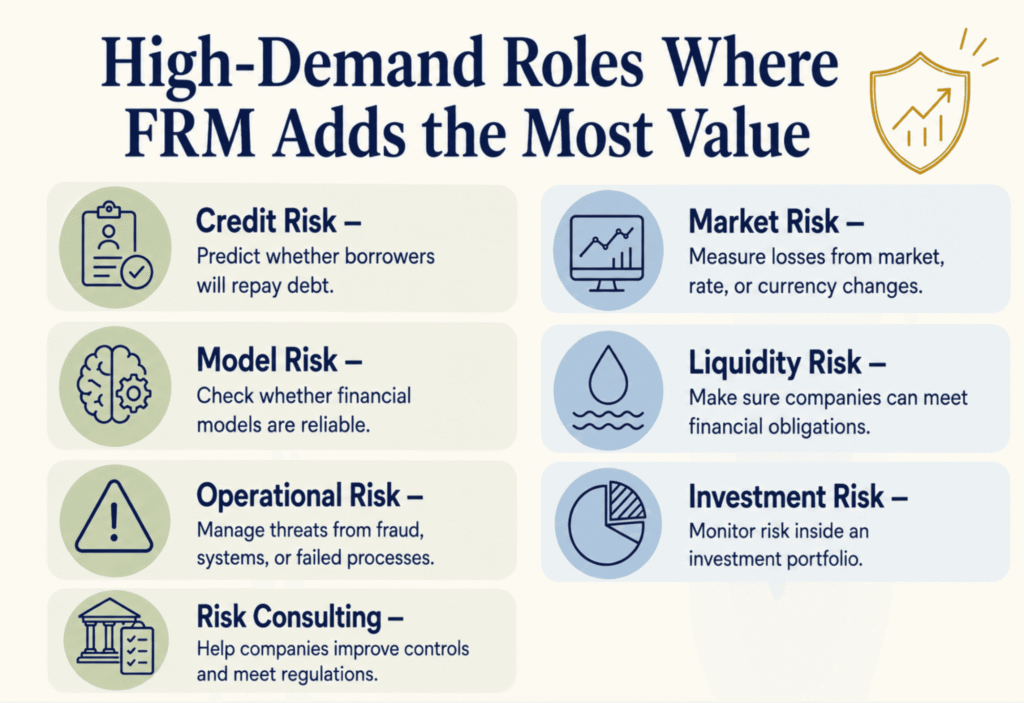
High-Demand Roles Where FRM Adds the Most Value
This is where the FRM starts looking genuinely useful. Companies need people who can understand financial threats before those threats turn into expensive disasters.
The credential fits especially well with:
- Credit risk: Predicting whether borrowers will repay their debt.
- Market risk: Measuring possible losses from changing markets, rates, or currencies.
- Model risk: Checking whether financial models are accurate and safe to use.
- Liquidity risk: Making sure a company can meet its financial obligations.
- Operational risk: Managing threats involving fraud, systems, employees, or failed processes.
- Investment risk: Monitoring how much risk exists inside a portfolio.
- Risk consulting: Helping companies improve controls and meet regulations.
The career options are not limited to banks. FRM knowledge can also be applied in consulting firms, fintech companies, insurance providers, asset managers, energy companies, and regulatory agencies.
Risk professionals are needed because businesses cannot simply stop worrying about loan defaults, market crashes, cyberattacks, broken models, or new regulations. Someone has to measure those threats and explain what the company should do next.
The ROI of FRM
The FRM can support a high-paying career, but it does not come with an automatic raise. Our FRM salaries guide shows how pay changes by role and employer.
Financial risk specialists earned a median U.S. salary of $106,000 in May 2024. Those working in securities and investments had a median of $132,520, according to the U.S. Bureau of Labor Statistics. The actual salary you have will depend on your role, location, employer, and experience. The FRM mainly improves your ROI by helping you qualify for more specialized work.
A common career path may look like:
Risk analyst → senior risk analyst → risk manager → director or head of risk → chief risk officer
The certification can help you move along that path, but it cannot carry you by itself. Employers still want technical skills, relevant experience, and proof that you can turn risk data into useful decisions.
FRM Pros & Cons
Beyond the salary, jobs, and exam difficulty we already covered, a few less obvious trade-offs matter too.
Pros
✅ Globally Recognized: The credential can travel with you if you change markets or countries.
✅ Several Career Directions: You can specialize in credit, market, model, liquidity, or operational risk.
✅ Pairs Well with Technical Skills: FRM knowledge becomes even more valuable alongside SQL, Python, or financial modeling.
Cons
❌ No Recruiting Pipeline: Passing does not connect you directly with employers.
❌ Some Material May Not Apply: Your job may only use one part of the broad curriculum.
❌ Less Useful Outside Risk: The credential will not carry the same weight in every area of finance.
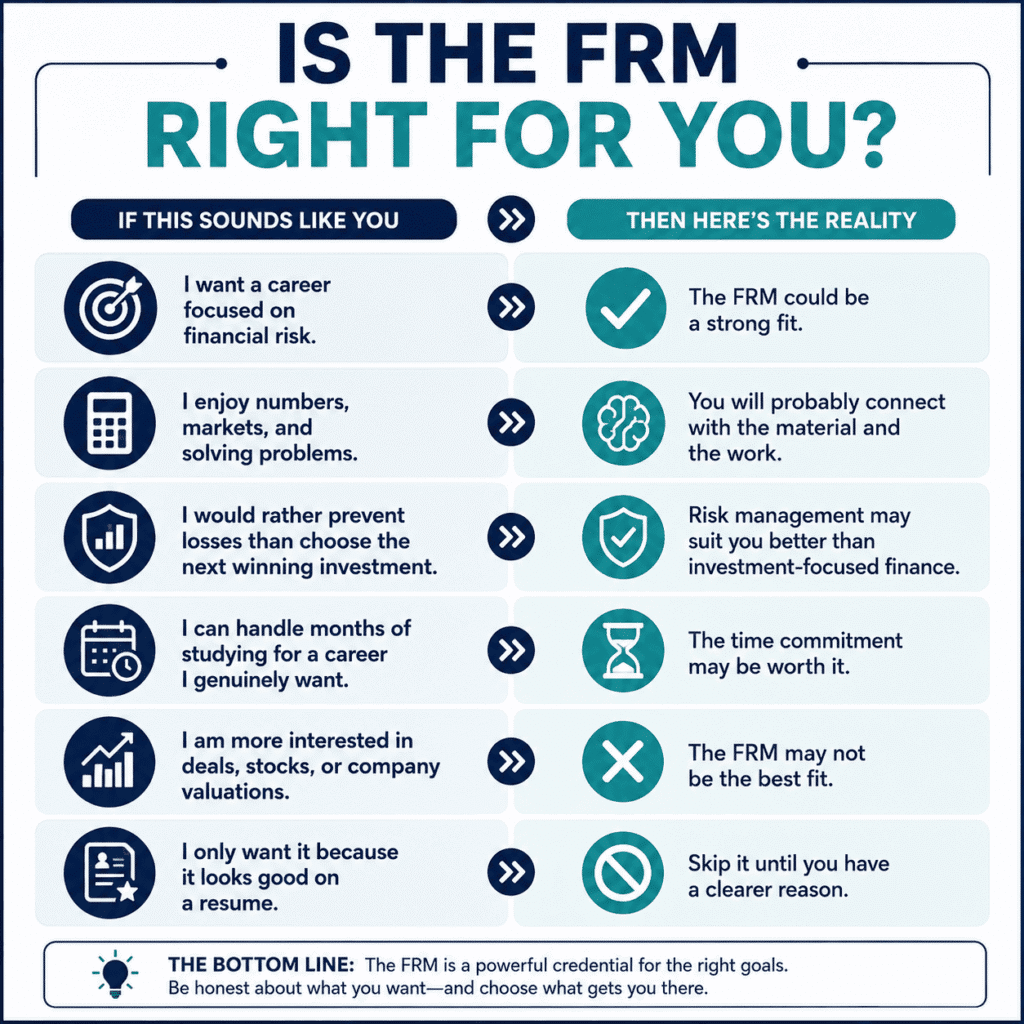
Is the FRM Right for You?
- I want a career focused on financial risk. The FRM could be a strong fit.
- I enjoy numbers, markets, and solving problems. You will probably connect with the material and the work.
- I would rather prevent losses than choose the next winning investment. Risk management may suit you better than investment-focused finance.
- I can handle months of studying for a career I genuinely want. The time commitment may be worth it.
- I am more interested in deals, stocks, or company valuations. The FRM may not be the best fit.
- I only want it because it looks good on a resume. Skip it until you have a clearer reason.
So, Is the FRM Worth It?
Yes, the FRM is worth it if you genuinely want a career in financial risk. It can help you build specialized knowledge, stand out for risk roles, and move toward higher-level positions.
It is not worth earning just because you want another line on your resume. The studying only makes sense when the jobs on the other side actually interest you.
Choose the career first. If that career involves understanding what could go wrong and preventing major financial losses, the FRM is a strong next step.
If you decide to sit the exams, start with our best FRM study materials.
FAQs
Can the FRM help you get a job without experience?
It can show employers that you are serious about risk. However, you will still need relevant skills, projects, internships, or other experience.
Do you need a finance degree for the FRM?
No. GARP does not require a specific degree or professional background to register.
Can you use FRM after passing both exams?
Not immediately. You must also complete two years of qualifying full-time experience and have it approved by GARP.
Is the FRM useful outside banking?
Yes. It can be relevant in consulting, asset management, insurance, fintech, energy, and regulatory work.
Is the FRM better than the CFA?
It depends on your career. FRM fits financial risk, while CFA is usually better for investment analysis and portfolio management.

![ESG Institute Coupon [Verified Discounts]](https://www.miamiherald.com/careers-education/wp-content/uploads/sites/2/2026/09/esg-institute-discount-code-mh-1024x768.jpg)