So, how many candidates actually pass FRM Part I?
The short answer is less than half.
The more useful answer is that the pass rate has stayed surprisingly consistent, even as the exam and curriculum have changed.
That tells us something important: FRM Part I is difficult, but it is not randomly impossible. Certain parts of the exam keep catching candidates off guard.
In this guide, I’ll explain the latest FRM Part I pass rate, what historical results reveal, why the rate stays so low, and what you can do differently when preparing.
Key Takeaways
- Fewer Than Half Passed: The latest official FRM Part I pass rate was 47%.
- A Consistently Tough Test: Part I pass rates have generally stayed between 40% and 50%.
- Every Question Carries Equal Weight: The exam includes 100 equally weighted multiple-choice questions.
- Know the When, Not Just the Formula: Candidates must understand formulas and recognize when to apply them.
- Practice Beats Another Reread: Consistent problem-solving is more useful than repeatedly reading the curriculum.
Most Recent Official FRM Part I Pass Rate
The latest official FRM Part I pass rate is 47% for the November 2025 exam.
That means fewer than half of the candidates who took Part I passed. GARP reports results as pass or fail and also provides quartile results comparing your performance with other candidates. Our FRM exam overview explains the format behind those results.
GARP does not publish a fixed passing score. You should not assume that answering a certain percentage of questions correctly will guarantee a pass.
Historical FRM Part I Pass Rate Trends
FRM Part I pass rates move slightly between exam windows, but they have usually stayed somewhere in the 40% to 50% range.
The rate reached 51% during the combined May and August 2022 administrations. It then dropped to 45% in November 2023 before reaching 47% in November 2025.
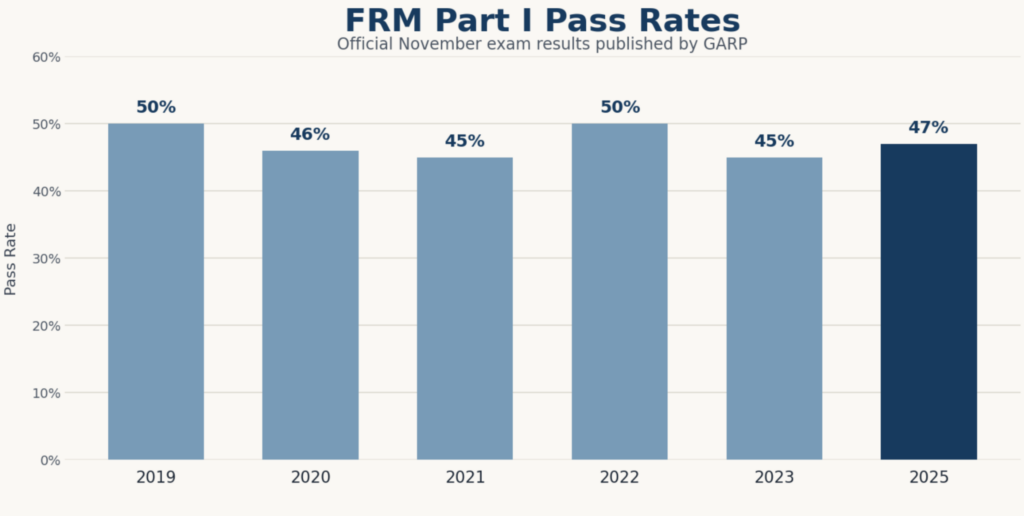
The main takeaway is simple: Part I is consistently difficult. There has not been a recent period when passing became easy.
Why Is the FRM Part I Pass Rate So Low?
Several parts of the exam make Part I difficult:
- Broad Curriculum: You must learn risk foundations, quantitative analysis, financial markets and products, and valuation and risk models.
- Quantitative Material: The exam requires statistics, probability, valuation, and other calculations.
- No Formula Sheet: You must remember important formulas and know when to use them.
- Time Pressure: You have four hours to answer 100 questions.
- Conceptual Questions: Memorizing formulas is not enough if you do not understand what they measure.
- No Entry Requirements: GARP does not require a specific degree or professional background before registration.
Part I is not impossible, but passive studying can make it feel that way. Reading a solution and understanding it is different from solving the question alone.
Which Is Harder: FRM Part I or Part II?
Part I often has the lower pass rate, but that does not automatically mean its content is harder.
Part I tests technical foundations, formulas, and calculations. Part II focuses more on applying those tools to real risk situations.
Part II candidates have already passed Part I, so they are a more prepared group. That helps explain why comparing the two pass rates is not completely fair.
For someone without a strong math or finance background, Part I may feel harder because it requires building those foundations from the beginning.
How to Increase Your Chances of Passing FRM Part I
Focus on the areas that actually affect your score:
Our guide to how long to study for the FRM exam can help you set a realistic schedule.
- Follow the Topic Weights: Give more time to Financial Markets and Products and Valuation and Risk Models because each represents 30% of Part I.
- Practice After Every Reading: Do not wait until you finish the entire curriculum.
- Learn Formula Use: Know what each formula measures and when it applies.
- Mix the Topics: Practice without being told which chapter or formula you need.
- Review Every Mistake: Include wrong answers and correct guesses.
- Take Timed Mock Exams: GARP provides two full-length Part I practice exams with registration.
- Plan Enough Time: GARP reports that candidates study for an average of approximately 240 hours.
Your practice scores should guide your final weeks. If Quantitative Analysis keeps lowering your score, it needs more time, even though it is not one of the two largest sections.
Final Thoughts
A 47% FRM Part I pass rate sounds intimidating, but it does not predict your personal result.
Treat it as a reminder that casual preparation is risky. Learn the concepts, practice applying the formulas, and leave enough time for timed mock exams.
You do not need a perfect score. You need a study plan that prepares you to handle questions from every major topic without relying on recognition or luck.
If you want a prep course next, start with our best FRM study material.
FAQs
What Is the Current FRM Part I Pass Rate?
The latest official FRM Part I pass rate is 47% for the November 2025 administration.
Is FRM Part I Hard to Pass?
Yes. Its pass rate generally remains below 50%, and the exam combines quantitative calculations with conceptual questions across four major topics.
What Score Do You Need to Pass FRM Part I?
GARP does not publish a fixed passing score. Candidates receive a pass or fail result rather than a traditional percentage score.
How Many Questions Are on FRM Part I?
FRM Part I contains 100 equally weighted multiple-choice questions. Candidates have four hours to complete the exam.
How Long Should You Study for FRM Part I?
GARP reports that candidates study for an average of approximately 240 hours. Your total may be higher or lower depending on your finance, math, and risk background.
What Are the FRM Part I Topics?
The four topics are Foundations of Risk Management, Quantitative Analysis, Financial Markets and Products, and Valuation and Risk Models.

![ESG Institute Coupon [Verified Discounts]](https://www.miamiherald.com/careers-education/wp-content/uploads/sites/2/2026/09/esg-institute-discount-code-mh-1024x768.jpg)