Risk is everywhere in finance.
Markets drop, borrowers miss payments, and even one bad decision can cost a company millions.
But how do financial professionals prepare for what could go wrong?
That is where the FRM exam comes in. It covers the tools and ideas used to measure financial risk, understand where it comes from, and make smarter decisions before a problem grows. And it is not an easy exam. Historical pass rates make that pretty clear.
Today, I’ll break down what the FRM exam is, what is covered on each part, how scoring works, and whether earning the certification makes sense for your career.
Key Takeaways
- GARP runs the FRM certification.
- There are two exams with 180 questions total.
- Each part lasts four hours.
- Anyone can register for Part I.
- You need two years of relevant work experience for certification.
- Recent pass rates landed below or around 50%.
So, What Is the FRM Certification?
FRM stands for Financial Risk Manager. The certification comes from the Global Association of Risk Professionals and focuses on the financial problems companies need to prepare for. Think bad investments, unpaid debt, cash-flow trouble, market swings, and internal mistakes that could get expensive fast.
It can fit careers involving:
- Risk analysis
- Banking
- Trading
- Investments
- Treasury
- Auditing
- Consulting
- Model validation
Passing the exams alone does not make you FRM certified. You also need two years of qualifying work experience before you can use the designation.
FRM Exam Format, Cost, and Requirements
- Format: Part I has 100 multiple-choice questions, while Part II has 80. Each exam lasts four hours.
- Testing Windows: GARP offers both parts in May, August, and November.
- Who Can Register: You do not need a degree, a finance job, previous experience, or GARP membership.
- Certification: You must pass both parts and complete two years of relevant full-time risk experience. Internships and part-time work do not count.
FRM Exam Fee Table
| Exam Fee 2026 | Cost |
|---|---|
| Early Registration | $600 per part |
| Standard Registration | $800 per part |
| New Candidate Enrollment Fee | $400 one-time |
FRM Part I vs. Part II
Part I covers the tools behind financial risk, while Part II gets into specific types of risk and how they are handled.
Part I Topics
- Risk management basics
- Math and statistics
- Financial markets and products
- Valuation and risk models
Most of Part I focuses on Financial Markets and Products plus Valuation and Risk Models, which cover roughly 60% of the exam.
Part II Topics
- Market risk
- Credit risk
- Operational risk
- Liquidity and treasury risk
- Investment risk
- Current financial issues
Part II focuses more on using what you know in actual situations. You must pass Part I first and then pass Part II within four years.
How Do Scoring and Pass Rates Work?
GARP does not publish a set passing score. There is no official rule saying that a 70% will automatically get you through.
Your final result only says pass or fail. You also receive quartile rankings that compare your performance with other candidates in each topic.
The November 2025 pass rates were:
- Part I: 47%
- Part II: 50%
So yes, the FRM exam is hard. More than half of Part I candidates did not pass that sitting. For a longer view, see our FRM pass rate breakdown.
Studying is Crucial for the FRM Exam
There is a lot to cover, so trying to wing it probably will not end well. Give yourself enough time and follow a plan that keeps you moving without cramming everything at the end.
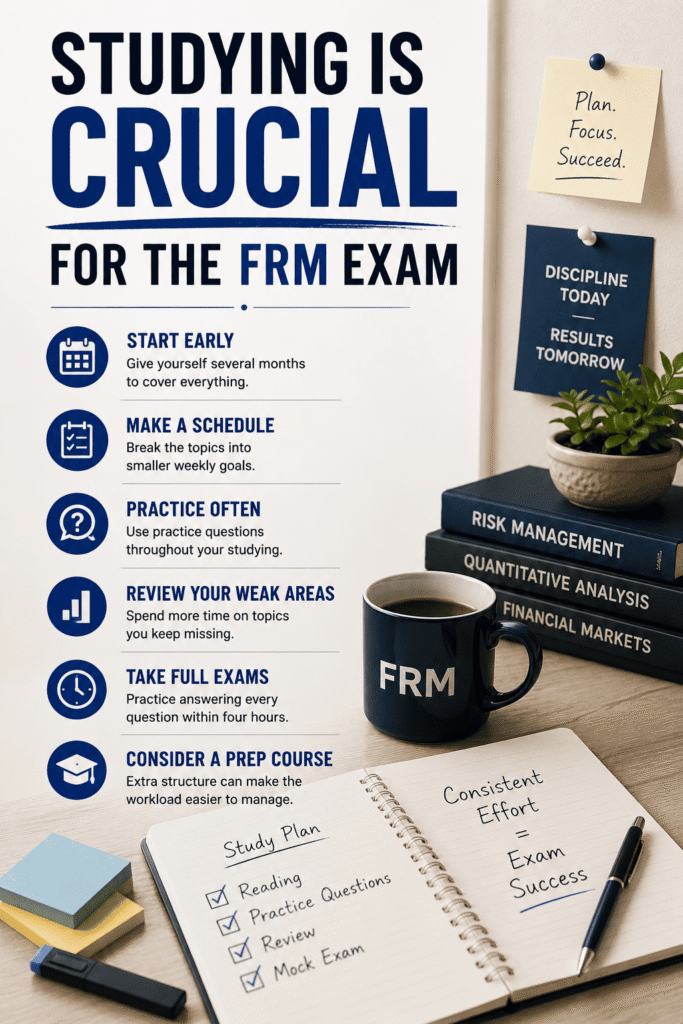
- Start Early: Give yourself several months to cover everything.
- Make a Schedule: Break the topics into smaller weekly goals.
- Practice Often: Use practice questions throughout your studying.
- Review Your Weak Areas: Spend more time on topics you keep missing.
- Take Full Exams: Practice answering every question within four hours.
- Consider a Prep Course: Extra structure can make the workload easier to manage. Compare the best FRM study materials if you want help choosing one.
Candidates typically study for around 240 hours. The actual time can change based on your finance background and how comfortable you are with math.
My Final Take on the FRM Exam
The FRM exam is a serious commitment, so it is not something I would register for just to add another line to a resume.
It makes the most sense if you actually want to work with financial risk. You will need to get through two difficult exam parts, a lot of math, and months of studying. Passing both parts is also not the final step because GARP requires relevant work experience before you can earn the certification.
If that still sounds worth it, the FRM can be a solid way to build deeper risk knowledge and show employers that this is the direction you want your finance career to take.
When you are ready to start studying, use our roundup of the best FRM study materials to compare prep options and build a realistic study plan.
FAQs
Is the FRM exam harder than the CFA exam?
Neither is automatically harder. The FRM focuses more heavily on financial risk, while the CFA covers a broader mix of investment and portfolio topics.
Can you take the FRM exam without a finance degree?
Yes. You do not need a finance degree or a specific college major to register.
Do you need work experience before taking the FRM exam?
No. You can take both exam parts before completing the work experience required for certification.
What jobs can the FRM certification help with?
It may support careers in market risk, credit risk, operational risk, compliance, treasury, consulting, and portfolio risk.
Does passing the FRM exam make you FRM certified?
Not immediately. You must pass both parts and meet GARP’s professional work experience requirement before earning the certification.



![ESG Institute Coupon [Verified Discounts]](https://www.miamiherald.com/careers-education/wp-content/uploads/sites/2/2026/09/esg-institute-discount-code-mh-1024x768.jpg)