Actuaries help businesses estimate what financial risks could cost. That might mean figuring out how much an insurer should charge for coverage or whether a pension fund can meet its future obligations. The work combines math, statistics, and business judgment, and the median annual wage was $125,770 in 2024.
Getting into the field takes more than being good with numbers. You’ll typically need a bachelor’s degree and a series of professional exams, many of which you can complete while working.
This guide explains how to become an actuary, including what to study, when to start taking exams, and how to prepare for your first job.
Key Takeaways
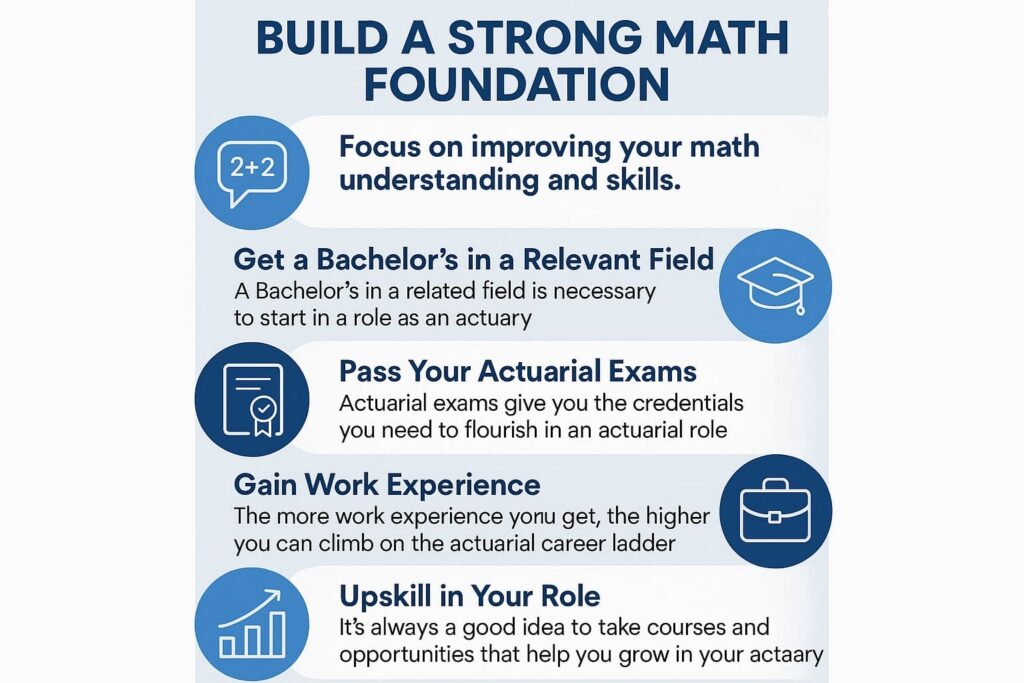
- Build a Strong Math Foundation. Focus on improving your math understanding and skills.
- Get a Bachelor’s in a Relevant Field. A Bachelor’s in a related field is necessary to start in a role as an actuary.
- Pass Your Actuarial Exams. Actuarial exams give you the credentials you need to flourish in an actuarial role.
- Gain Work Experience. The more work experience you get, the higher you can climb on the actuarial career ladder.
- Upskill in Your Role. It’s always a good idea to take courses and opportunities that help you grow in your role as an actuary.
What Does an Actuary Do?
An actuary studies data to estimate the chances of future events. They answer questions like:
- How likely is someone to file an insurance claim?
- How much money should an insurance company set aside for future payments?
- What risks could affect a business over the next 10 or 20 years?
Think of an actuary as someone who solves giant puzzles using numbers. Instead of guessing, they use facts and math to make informed predictions.
Many actuaries work in insurance, but they also find jobs in healthcare, finance, consulting, pensions, and government.
Step 1: Build a Strong Math Foundation
The first step is getting comfortable with math.
You don’t have to be a math genius, but you should enjoy solving problems and thinking logically. Skills that help include:
- Algebra
- Calculus
- Probability
- Statistics
Strong computer skills also matter because actuaries spend a lot of time working with spreadsheets, databases, and data analysis software.
If math feels like solving a puzzle instead of doing chores, you’re probably on the right track.
Step 2: Earn a Bachelor’s Degree
Most employers expect an actuary to have a bachelor’s degree. The good news is that it can be in a related field, not just actuarial science.
Common majors include:
- Mathematics
- Actuarial science
- Statistics
- Finance
- Economics
- Data science
Many successful actuaries earn degrees in related fields as long as they complete the required math courses.
While you’re in school, try to maintain good grades in relevant subjects and look for actuarial internships. Real-world experience can make it much easier to land your first job.
Step 3: Pass Your First Actuarial Exams
Professional exams are one of the biggest parts of becoming a fully qualified actuary. Taking exams is a necessary component of becoming an accredited member of certain organizations.
In the United States, aspiring actuaries usually begin taking exams before or shortly after graduating from university. Passing even one or two exams can make you a much stronger job candidate with much better job opportunities.
The exams cover topics such as:
- Probability
- Financial mathematics
- Statistics
- Risk assessment
- Financial modeling
I’ll be honest, these exams are known for being difficult. Many candidates spend hundreds of hours studying for each one.
The good news is that you don’t have to finish every exam before starting your career. Many employers hire entry-level actuarial analysts who continue taking exams while working.
You can also prepare for your actuarial exams to increase your chances of passing the first time. We have a list of the best actuarial exam prep courses for you.
Step 4: Gain Work Experience
Once you’ve passed some actuarial exams, it’s time to gain experience.
Many new professionals start as actuarial analysts. In this role, you’ll help experienced actuaries by:
- Analyzing data
- Building reports
- Creating financial models
- Reviewing insurance trends
- Supporting business decisions
Most employers also provide study time and financial support for future exams. That can be a huge benefit because the exam process can last several years and cost a lot of money.
Step 5: Earn Professional Credentials
Passing actuarial exams leads to professional credentials. In the United States, actuaries typically earn credentials through major professional organizations, depending on their career path.
Actuaries typically earn professional credentials through organizations such as the Society of Actuaries (SOA) or the Casualty Actuarial Society (CAS). The American Academy of Actuaries (AAA) supports the profession through professionalism standards and public policy work.
As you complete additional exams and education requirements, you’ll move toward full professional status. This process takes commitment, but it also helps increase your career opportunities and earning potential.
Many actuaries continue learning throughout their careers because industries, regulations, and technology continue to change.
Skills That Help You Succeed
Being good at math is only part of the job.
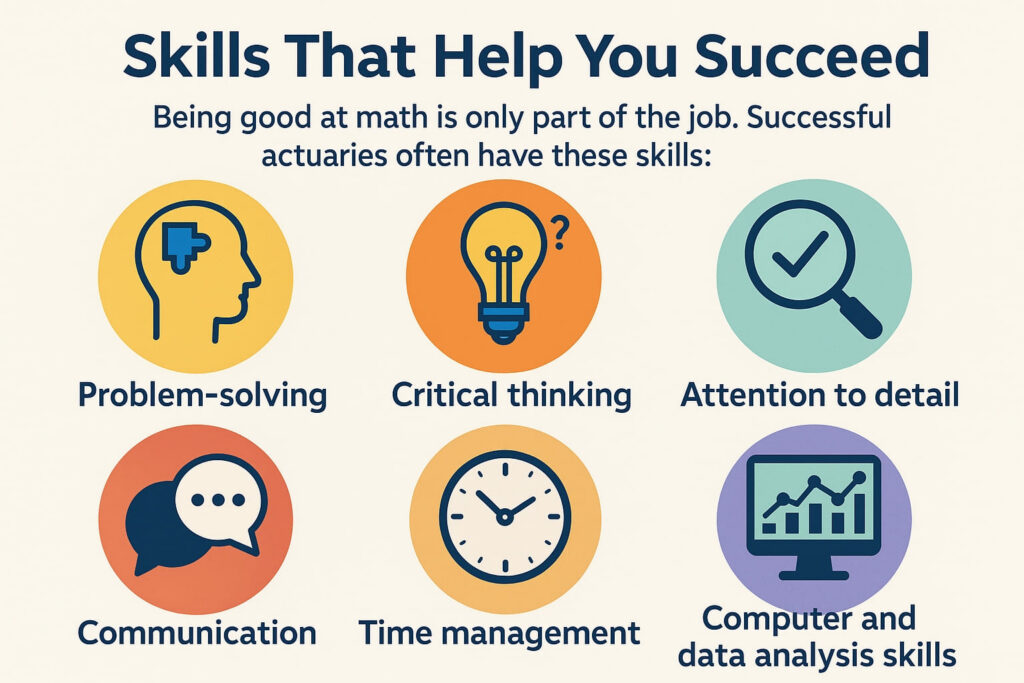
Successful actuaries often have these skills:
- Problem-solving
- Critical thinking
- Attention to detail
- Communication
- Time management
- Computer and data analysis skills
Communication may surprise some people. Even if your calculations are perfect, you’ll still need to explain your findings to coworkers, managers, or clients who may not have a math background.
Tips for Future Actuaries
If you’re serious about becoming an actuary, these tips can help:
- Focus on math courses early.
- Learn Excel and data analysis tools.
- Look for actuarial internships while in college.
- Start preparing for actuarial exams before graduation.
- Stay organized and build a consistent study schedule.
Don’t get discouraged if an exam takes more than one attempt. Many successful actuaries have failed an exam before passing it later. Persistence matters.
Final Thoughts
Becoming an actuary takes time, but each step builds toward a rewarding career. You’ll need a strong math background, a bachelor’s degree, professional exams, and practical work experience.
The path isn’t easy, but it doesn’t have to be overwhelming either. If you enjoy solving problems, working with data, and helping businesses make smart decisions, becoming an actuary could be an excellent fit. Take it one step at a time, keep learning, and celebrate each milestone along the way.
If you’d like, I can also create a matching SEO meta description (under 155 characters) and FAQ section for this article.
If you want a related next step, start with our guide to what an actuarial exam covers.
FAQs
How long does it take to become an actuary?
The answer depends on your pace. Many people earn a bachelor’s degree in about four years. After that, they continue taking professional exams while working full-time. Becoming a fully credentialed actuary often takes several more years. That may sound like a long time, but each passed exam can open new career opportunities along the way.
Is becoming an actuary difficult?
Yes, it can be challenging. The exams require discipline, and you’ll spend plenty of time studying. Still, many people find the effort worthwhile. If you enjoy math, solving problems, and learning new skills, the work can be both interesting and rewarding. I also like that you’re constantly building knowledge instead of feeling stuck in the same routine every day.
What degree do you need to become an actuary?
Most actuaries earn a bachelor’s degree in related fields like mathematics, actuarial science, statistics, finance, or economics. A specific degree is not always required, but strong math skills are important.
What skills does an actuary need?
Actuaries need strong math skills, problem-solving abilities, attention to detail, communication skills, and the ability to work with data and technology.
Where do actuaries work?
Actuaries commonly work in insurance, finance, consulting, healthcare, pensions, and government roles. Their skills are useful anywhere organizations need help understanding risk.


![ESG Institute Coupon [Verified Discounts]](https://www.miamiherald.com/careers-education/wp-content/uploads/sites/2/2026/09/esg-institute-discount-code-mh-1024x768.jpg)