78%.
That’s how many Americans had either never heard of ESG or were not sure what it meant, according to the ESG Monitor. So, if you are part of that group, do not worry.
The title sounds complicated, but the job is mostly about research. ESG analysts collect information, compare companies, identify risks, and explain their findings.
In this career guide, I’ll break down what the role involves, how people enter the field, and what the career is really like. Here is what you should know.
Key Takeaways
- Researches ESG Issues: ESG analysts study environmental, social, and governance factors.
- Helps Identify Possible Risks: Their research helps companies and investors make informed decisions.
- Usually Requires a Bachelor’s Degree: Most ESG analyst positions expect applicants to have a four-year degree.
- Exam or License Not Required: No mandatory credential is required to become an ESG analyst.
- Uses Several Core Skills: Finance, research, data analysis, and writing are all important in this role.
ESG Analysts Explained: What They Really Do
An ESG analyst studies parts of a company that traditional financial reports may not fully explain.
For example, a factory may be profitable but have repeated safety violations. Another company may advertise itself as environmentally friendly without providing data to support that claim. An ESG analyst looks into those issues and explains why they matter.
The job is not about giving every company a simple good or bad label. It is about understanding the risks behind how a business operates.
The work is divided into three areas:
- Environmental: Pollution, emissions, energy, waste, water use, and climate risks
- Social: Employee treatment, workplace safety, human rights, customer privacy, and product safety
- Governance: Company leadership, board decisions, executive pay, audits, and business ethics
The analyst uses this information to identify issues that could hurt the company, its investors, or its reputation.
Daily Responsibilities
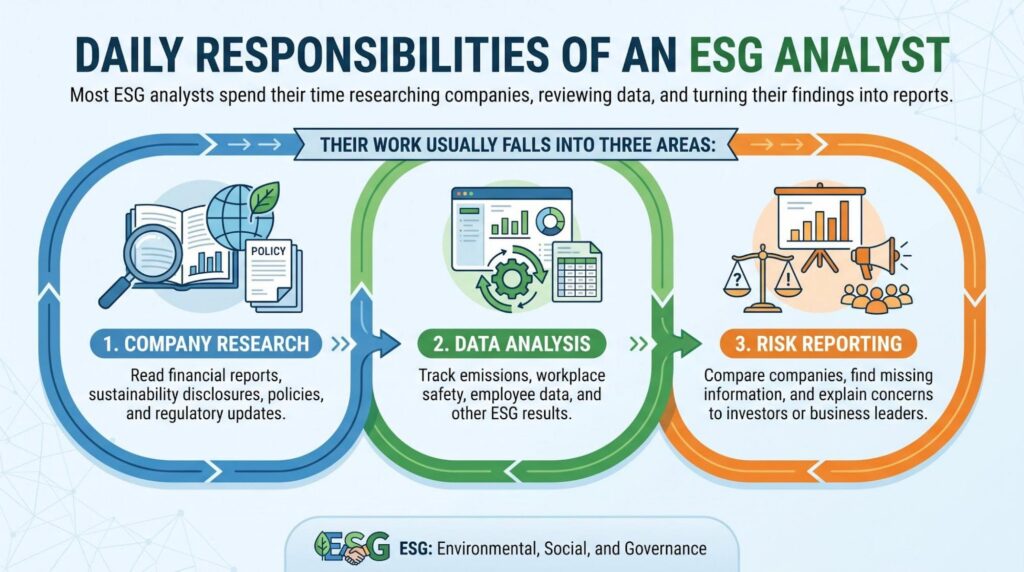
Most ESG analysts spend their time researching companies, reviewing data, and turning their findings into reports.
Their work usually falls into three areas:
- Company Research: Read financial reports, sustainability disclosures, policies, and regulatory updates.
- Data Analysis: Track emissions, workplace safety, employee data, and other ESG results.
- Risk Reporting: Compare companies, find missing information, and explain concerns to investors or business leaders.
The exact work depends on the employer. Investment firms focus more on financial risk, while corporations track their own ESG goals and reporting. Consultants usually research several companies or advise clients.
Common ESG Analyst Workplaces
ESG analysts work for investment firms, banks, corporations, consulting firms, research companies, government agencies, and nonprofits.
Where you work usually decides what you analyze:
| Role | Main Focus |
|---|---|
| Investment ESG Analyst | How ESG issues could affect investments |
| Corporate ESG Analyst | Company goals, data, and public reports |
| ESG Research Analyst | Companies, industries, and ESG performance |
| ESG Risk Analyst | Environmental, social, and governance risks |
| ESG Consultant | Client policies, reporting, and improvements |
Similar jobs may be listed as sustainability analyst, climate risk analyst, responsible investment analyst, or corporate responsibility analyst.
How to Become an ESG Analyst
Most people start with a bachelor’s degree in finance, accounting, economics, business, environmental science, public policy, or data analytics.
From there, the usual path includes:
- Build ESG and Financial Skills: Learn company research, financial statements, spreadsheets, ESG risks, and report writing.
- Take an ESG-Focused Exam: Many aspiring analysts take the Sustainable Investing Certificate exam, formerly called the Certificate in ESG Investing. It has 100 multiple-choice questions and a time limit of two hours and 20 minutes. The exam is optional, but it can show employers that you understand ESG factors and sustainable investing.
- Get Related Experience: Common starting roles include financial analyst, sustainability coordinator, ESG research assistant, risk analyst, and reporting analyst.
- Apply for ESG Roles: Search for ESG analyst, sustainability analyst, climate risk analyst, and responsible investment analyst positions.
There is no legal license required to become an ESG analyst. However, certain investment positions may require separate securities exams based on the work involved.
Career Benefits and Drawbacks
ESG analysis can be a good career if you enjoy research, business, data, and sustainability.
The role can also lead to other areas, including investment research, risk management, compliance, consulting, and corporate sustainability.
| Benefits | Drawbacks |
|---|---|
| Work can affect real business decisions | Company data may be incomplete |
| Several industries hire ESG professionals | Job duties are not consistent |
| Skills transfer into other careers | Reporting standards keep changing |
| Combines business and sustainability | Some company claims are hard to verify |
| Several degree backgrounds can qualify | The job involves heavy research |
The job is not a good fit for everyone. ESG analysts spend a lot of time reading, checking details, and working with information that may not be complete.
My honest take is that the career makes the most sense for someone who likes investigating companies and explaining what the information actually means. It may feel frustrating if you prefer simple questions with one definite answer.
My Final Thoughts
An ESG analyst researches how environmental, social, and governance issues could affect a company or investment.
It is a flexible career because people enter from finance, science, business, policy, and data. There is also no mandatory ESG exam standing between you and the job.
The most important skills are research, analysis, and clear communication. If you can understand a company, question its claims, and explain the real risks behind the data, you already understand the main purpose of ESG analysis.
If you want optional credentials, start with our best ESG certification courses.
FAQs
What Does ESG Stand For?
ESG stands for environmental, social, and governance. The term covers business issues involving the environment, people, and company leadership.
What Does an ESG Analyst Do?
An ESG analyst researches companies, reviews data, identifies risks, compares performance, and writes reports for investors or business leaders.
What Degree Is Best for an ESG Analyst?
Most employers prefer a bachelor’s degree, but there is no required major. Relevant options include finance, accounting, economics, business, environmental science, public policy, and data analytics.
Do ESG Analysts Need an Exam?
No. There is no required exam for the ESG analyst title. Some investment positions may require securities exams based on their specific duties.
Do ESG Analysts Need a Certification?
Certification is usually optional. It may help you learn ESG concepts, but it is not required for every job.
Where Do ESG Analysts Work?
They work at investment firms, banks, corporations, consulting companies, research providers, government agencies, and nonprofits.
Is ESG Analysis a Good Career?
It can be a good career for someone interested in research, business, sustainability, and data. The work can be challenging because ESG information is not always complete or consistent.
Can You Become an ESG Analyst Without a Finance Degree?
Yes. People enter ESG from several backgrounds. However, you may need to learn basic finance if you want to work in investment analysis.

![ESG Institute Coupon [Verified Discounts]](https://www.miamiherald.com/careers-education/wp-content/uploads/sites/2/2026/09/esg-institute-discount-code-mh-1024x768.jpg)