Weeks, months, a full year…
FRM exam study time is always explained in calendars, but what amount of study time do you really need to pass the test?
Around 240 hours is the usual benchmark, but you will also need the right time for each topic, consistent question practice, and enough room for review and mock exams.
In this guide, I’ll break down exactly how long FRM preparation takes and how to use that time.
Key Takeaways
- Plan for about 240 study hours per FRM exam part.
- Most candidates need four to six months per part.
- Part I may require extra time for math-heavy topics.
- Your weekly study hours determine your actual timeline.
- Save the final month for review and mock exams.
How Many Study Hours Do You Need Per Part?
GARP reports that candidates study an average of 240 hours per exam part, although some study fewer than 100 hours and others need more than 400. Our FRM exam overview covers format, cost, and difficulty if you want that context first.
I recommend planning for:
- 250 to 300 hours for Part I
- 240 to 300 hours for Part II
Part I may require more time if you struggle with math, statistics, derivatives, or valuation. Part II has fewer questions, but it requires you to apply concepts across several risk areas.
Here is how long 250 study hours may take:
| Weekly Study Time | Time Needed for 250 Hours |
|---|---|
| 8 hours | About 7 to 8 months |
| 10 hours | About 6 months |
| 15 hours | About 4 months |
| 20 hours | About 3 months |
These should be productive hours spent learning concepts, answering questions, reviewing mistakes, and completing mock exams.
Choose a weekly goal you can actually maintain. Ten consistent hours will help more than planning for 20 and constantly falling behind.
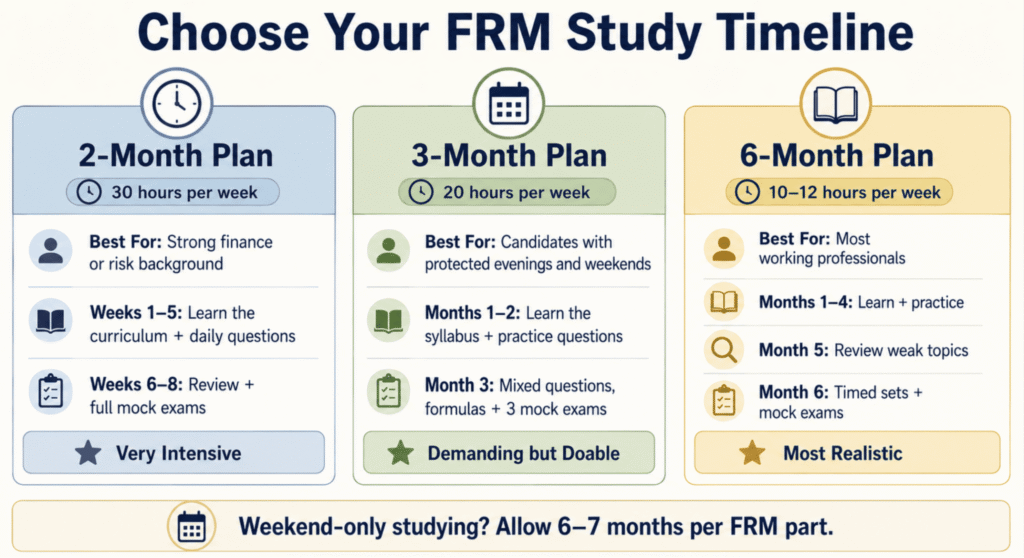
Two-Month FRM Study Plan
A two-month plan requires about 30 study hours each week to reach 240 hours.
I would only recommend this timeline if you:
- Have a strong quantitative or risk background
- Recently studied the material
- Have a flexible schedule
- Can protect most evenings and weekends
Use the first five weeks to cover the curriculum and complete daily questions. Save the final three weeks for review and full mock exams.
This plan is possible, but it is definitely not the normal route.
Three-Month FRM Study Plan
A three-month plan requires about 20 study hours each week.
During the first two months, work through the syllabus and complete questions after every reading.
Use the final month for:
- Mixed-topic question sets
- Formula reviews
- Weak-area repair
- At least three full-length mock exams
It is demanding, but it can work if your evenings and weekends are protected.
Six-Month FRM Study Plan
A six-month plan is the safest option for most working professionals.
Studying 10 to 12 hours each week gives you enough time for reading, practice, review, and normal life interruptions.
I would divide the six months like this:
- Months one through four: Learn the material and complete practice questions.
- Month five: Review weak topics and mix questions from different sections.
- Month six: Complete timed sets, full mock exams, and final reviews.
Candidates comparing finance credentials may notice that the recommended CFA study timeline also focuses on steady preparation.
If you only study on weekends, allow six to seven months per FRM part. With 10 to 15 hours per week and immediate Part II preparation after Part I, completing both within 12 months is realistic.
What Affects Your FRM Preparation Time?
No single number works for everyone because candidates start in completely different places.
I’d adjust the 240-hour benchmark based on these five factors:
- Quantitative background: Comfort with probability, regression, and financial math can shorten Part I preparation.
- Risk experience: Experience in market, credit, treasury, or operational risk can help with Part II.
- Time since school: Concepts may take longer to relearn if you have not taken an exam in years.
- Weekly consistency: Ten dependable hours usually beat an ambitious 20-hour goal that constantly falls apart.
- Study materials: The official curriculum is thorough, while third-party courses may organize it more quickly.
Your other commitments matter just as much as your academic ability.
Someone with predictable work hours may manage 12 to 15 hours each week. An investment banker or consultant might only have eight reliable weekend hours. In that case, taking six or seven months per part is sensible, not slow.
How to Use Your FRM Study Time
- Plan by Topic: Divide your weekly hours across the curriculum instead of just aiming for one big total.
- Prioritize Hard Areas: Part I may require more time for Quantitative Analysis and Valuation and Risk Models. For Part II, focus on whichever risk topics feel least familiar.
- Practice as You Go: Answer questions after each topic instead of saving them all for the end.
- Review Your Mistakes: Spend extra time on the formulas, calculations, or concepts you repeatedly miss.
- Protect the Final Month: Use it for mixed practice, weak-topic review, formula recall, and at least three timed mock exams.
Conclusion: Choosing Your FRM Study Timeline
For most candidates, I’d choose four to six months and 250 to 300 hours per part.
A three-month schedule can work with disciplined 20-hour weeks. Two months is an intense exception, not the default.
Pick the timeline you can actually maintain. Start answering questions early and protect the final month for mocks and review.
Consistent, focused practice gives you a much better chance of passing than choosing the fastest possible timeline.
When you are ready to pick a course, start with our best FRM study material.
FAQs
How Many Hours Should I Study for Each FRM Exam Part?
Most candidates should plan for 200 to 300 hours per part, with 240 hours serving as a good starting benchmark.
That gives you time to learn the material, complete practice questions, review mistakes, and take mock exams.
How Long Does It Take to Prepare for Both FRM Parts?
A realistic timeline for most working professionals is around 12 months total.
That allows four to six months per part while studying about 10 to 15 hours each week.
Can I Complete Both FRM Exams in Less Than 12 Months?
Yes. If you have a strong quantitative background and can study around 20 hours each week, you may register for both parts and potentially finish within six months.
However, Part II is only graded if you pass Part I.
What Affects How Long I Need to Study?
Your timeline depends on your finance and math background, work experience, reading speed, weekly availability, and consistency.
Someone with recent schooling or professional risk experience may need less preparation time.
How Should I Structure My FRM Study Schedule?
Start with a diagnostic test to find your weak areas. Then, divide the syllabus into weekly goals, answer practice questions throughout your preparation, review every mistake, and complete at least three full mock exams during the final month.

![ESG Institute Coupon [Verified Discounts]](https://www.miamiherald.com/careers-education/wp-content/uploads/sites/2/2026/09/esg-institute-discount-code-mh-1024x768.jpg)