A finance degree can help you enter the industry, but how do you prove you understand investments at a higher level?
The credential most people mean by “financial analyst certification” is the Chartered Financial Analyst® (CFA®) designation. It is designed for people interested in investment research, asset management, portfolio management, and similar careers.
But earning the CFA® charter takes several years. You must pass exams, complete practical modules, gain approved work experience, and become a CFA Institute member.
The sections below cover each part of the process so you can decide whether the charter is worth the effort.
Key Takeaways
- Complete Three Exam Levels: You must pass exam Levels I, II, and III.
- Plan for a Long Process: Most candidates need about three to four years to finish.
- Gain Relevant Experience: The charter requires 4,000 hours of approved work completed over at least 36 months.
- Expect Difficulty: Recent five-year average pass rates range from about 41% to 49%, depending on the level.
- Match It to Your Career: The CFA® is most useful for investment-focused finance careers.
Understanding the Basics
There is no required certification for every financial analyst. The CFA® is mainly for people who research investments, value companies, or manage portfolios.
To become a CFA® charterholder, you must pass three exams, gain relevant experience, and meet the membership requirements.
Earning the CFA® Certification
You cannot earn the CFA® charter by passing one test. The complete process includes education, exams, experience, and membership.
Meet the Entry Requirements
You need a bachelor’s degree, qualifying professional experience and education, or an exam date within 23 months of your expected graduation.
Register for Level I
Create a CFA Institute account, select an exam window, and schedule your test.
Pass All Three Exams
Complete Level I, Level II, and Level III in order.
Complete the Practical Modules
You must finish one Practical Skills Module at each level before receiving that exam result. Each module takes about 10 to 20 hours.
Gain Qualifying Work Experience
Complete at least 4,000 hours of relevant experience over a minimum of 36 months. The experience may be earned before, during, or after the exams.
Submit Your References
You generally need two or three professional references when applying for charterholder membership.
Become a CFA Institute Member
Apply for membership through CFA Institute after you meet the exam and experience requirements. Once approved, you can use the CFA® designation.
What Is on the CFA® Exam?
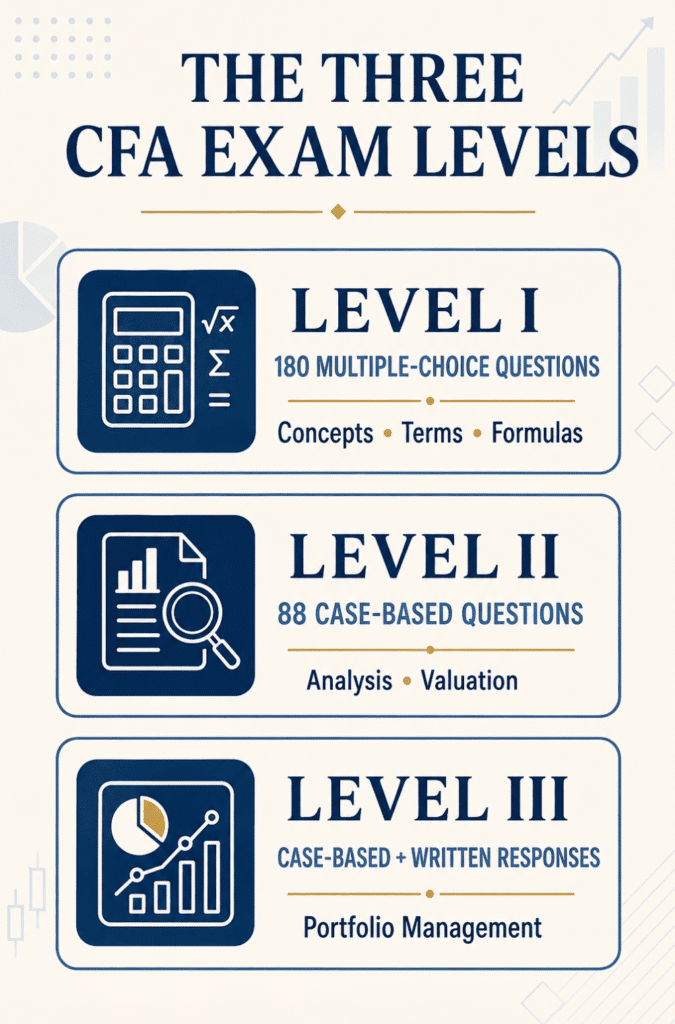
The CFA® Program includes three exams that become more advanced as you continue. Each exam takes about four and a half hours, and most candidates study for more than 300 hours per level.
- Level I: 180 multiple-choice questions covering basic concepts, terms, and formulas.
- Level II: 88 case-based questions focused on financial analysis and valuation.
- Level III: Case-based questions and written responses about managing portfolios.
The exams cover ethics, economics, financial statements, stocks, bonds, derivatives, alternative investments, and portfolio management. At Level III, you also choose a pathway in Portfolio Management, Private Markets, or Private Wealth.
Recent average pass rates range from about 41% to 49%, depending on the level. CFA Institute does not use one permanent passing score.
Read my CFA® pass rate guide to see the latest pass rate for each exam level.
How to Pass the CFA® Exams
Trying to memorize everything during the final few weeks is unlikely to work. The curriculum is too large, and later exams test whether you can apply what you learned.
Use these strategies to prepare:
Start Several Months Early
Build enough time for learning, practice, and review.
Create Weekly Goals
Divide the curriculum into smaller sections instead of studying without a plan.
Practice After Every Topic
Answer questions as soon as you finish a reading.
Review Your Mistakes
Write down why you missed each question and study that concept again.
Take Timed Mock Exams
Practice working through questions under the real time limit.
Study Ethics Carefully
Ethics appears at all three exam levels and should not be ignored.
Know Your Calculator
Practice using an approved calculator before exam day.
Answer Every Question
There is no penalty for incorrect multiple-choice answers.
Finish Your Practical Module
Complete it before the results deadline so your exam result is not delayed or voided.
Is the Financial Analyst Certification Really Worth It?
The CFA® can be worth it if you want to work in investing, research, portfolio management, or wealth management. It can strengthen your resume and show employers that you are serious about the field.
However, it takes hundreds of study hours and does not guarantee a job or raise. It may not be useful for accounting, bookkeeping, budgeting, or financial planning roles.
Before registering, check job listings for the careers you want. If the CFA® keeps appearing, it may be worth earning.
My guide on how much a CFA® makes breaks down salaries, bonuses, and pay across different finance roles.
Related Guide
When you are ready to pick a Level I provider, the best CFA® prep courses comparison shows which materials match the exam format and how much study time each one assumes.
Final Thoughts
The CFA® charter is one of the most challenging financial analyst credentials to earn. You must pass three exams, complete practical modules, gain relevant experience, and apply for CFA Institute membership.
I would choose it if I wanted a long-term career involving investments, asset valuation, or portfolio decisions. I would not begin simply because it looks impressive. The time commitment is too large unless the designation matches your actual career plans.
Start by checking the jobs you want. That will tell you whether the CFA® is truly worth your time.
FAQs
Do I Need a Degree to Take the CFA® Level I Exam?
Not always. You may qualify through a completed bachelor’s degree, your expected graduation date, or a combination of higher education and professional work experience.
How Long Does It Take to Earn the CFA® Charter?
Most candidates need around three to four years. Your timeline may be longer if you retake an exam or still need qualifying work experience.
How Difficult Are the CFA® Exams?
The exams are considered difficult because they cover a large curriculum and require more than memorization. Levels II and III focus heavily on applying financial concepts.
Can I Use CFA® After My Name Once I Pass Level I?
No. You may state that you passed Level I, but you cannot use the CFA® designation until you complete every requirement and receive the charter.
Is the CFA® a Financial Analyst License?
No. There is no general license required for every financial analyst. The CFA® is a voluntary professional designation.
Does My Work Experience Have to Come After the Exams?
No. Qualifying experience may be completed before, during, or after the CFA® Program.
Can the CFA® Help Me Without a Finance Degree?
Yes. The program can help you build investment knowledge and show your commitment to the field. However, you must still meet the enrollment and charterholder requirements.



![ESG Institute Coupon [Verified Discounts]](https://www.miamiherald.com/careers-education/wp-content/uploads/sites/2/2026/09/esg-institute-discount-code-mh-1024x768.jpg)