The education needed to become an interior designer depends on your goals, the type of work you want to do, and the rules in your state.
7,800. That’s the average number of interior design openings expected each year through 2034.
The field is growing steadily as homes and businesses undertake renovation projects and require spaces that meet modern building and accessibility codes. But the education needed to become an interior designer can look very different depending on whether you want to work in residential design, at a design firm, or on spaces like offices, hotels, and hospitals.
In this guide, I’ll break down the education, experience, and certifications that can shape your path before you spend money on a program. Let’s get started!
Key Takeaways
- Multiple paths: There’s more than one way to start a career in interior design.
- Education matters: Your degree choice can influence the roles and opportunities available to you.
- Check accreditation: Research program accreditation before choosing a school or degree.
- Build your portfolio: A strong portfolio is an important complement to your education.
- Know your state’s rules: Licensing, registration, and other requirements vary by state.
Do You Actually Need a Degree to Become an Interior Designer?
For most professional interior design careers, a bachelor’s degree in interior design is the standard route, according to the Bureau of Labor Statistics.
It is not the only option, but it gives you the most direct path into design firms, commercial projects, state registration, and the NCIDQ exam. An associate degree or certificate may help you get started, but you may need additional education or more supervised work experience later.
| Education Level | What It Usually Leads To |
|---|---|
| Certificate | Basic design training or a starting point before a degree |
| Associate Degree | Entry-level interior design roles and portfolio building |
| Bachelor’s Degree | Professional interior design jobs, commercial work, and easier NCIDQ eligibility |
| Master’s Degree | Career changers or advanced interior design study |
You can start in entry-level roles or smaller residential projects without a bachelor’s degree.
But for design firms, commercial work, or registration, a degree in interior design or interior architecture is usually the better path.
Does Your Interior Design Program Need to Be Accredited?
Not always, but it is worth checking. Accreditation shows that a program meets professional education standards. It can be especially helpful if you want a bachelor’s or master’s degree that supports commercial design, registration, or the NCIDQ path later.
A certificate can still be a good way to build skills and explore interior design. Just look closely at what it teaches and where it can lead.
Before choosing a program, ask:
- Is this an interior design degree or certificate?
- Who accredits the program and the school?
- Does the coursework support NCIDQ eligibility?
- Can I build a portfolio and get real-world experience?
- Does it fit the type of design work I want to do?
Check out my guide to the best interior design courses for a closer look at online and flexible programs.
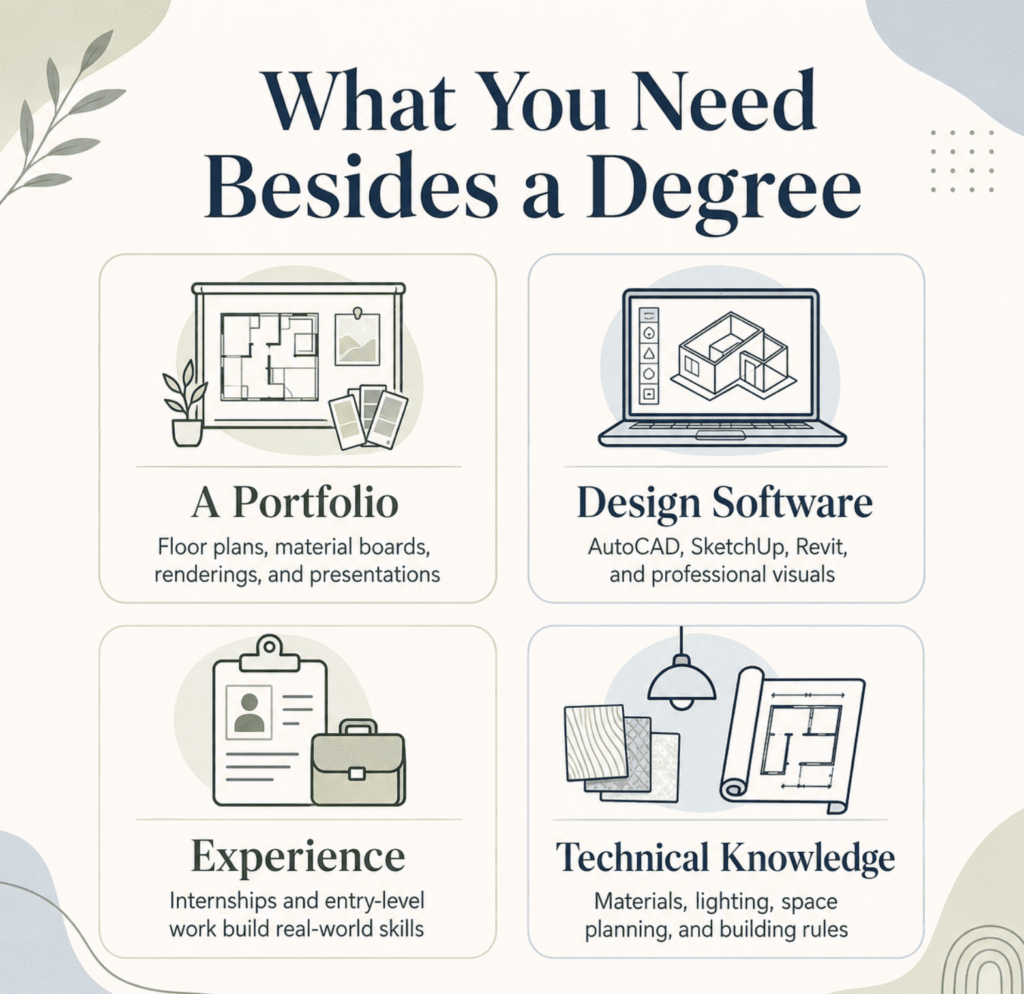
What Else Do You Need Besides a Degree?
A degree is the foundation, but it is not the only thing employers look for. You also need proof that you can turn a design idea into a real space.
- A portfolio: Your best floor plans, material boards, renderings, and project presentations.
- Design software skills: Programs like AutoCAD, SketchUp, or Revit help you create professional plans and visuals.
- Experience: Internships and entry-level roles teach you how to work with clients, vendors, contractors, and budgets.
- Technical knowledge: You need to understand materials, lighting, space planning, and the building rules that affect a project.
Most students build these skills during their degree program. The goal is to graduate with more than a diploma. You want a portfolio and practical experience that help you get hired.
State Rules Change What You Can Do
This is the part people miss.
Some states let anyone call themselves an interior designer. Other states protect titles like “registered interior designer” or “certified interior designer.”
That can affect:
- The title you can use
- Whether you need the NCIDQ exam
- Whether you need a degree
- Whether you can submit certain plans
- The types of commercial work you can do independently
You may be able to work in residential decorating without professional registration. Commercial design, permitting, and protected titles can come with more rules.
If you plan to pursue professional registration, our guide to interior design certification explains when credentials matter and which paths employers take seriously.
How to Choose Your Interior Design Education Path
Before you commit to a program, it helps to understand what an interior design career actually involves day to day.
- Do you only want basic interior design training before deciding on a degree?
→ A certificate program is a lower-commitment way to explore the field and learn the basics before choosing a longer program. - Do you want to become a professional interior designer at a firm or work on commercial spaces?
→ Start with a bachelor’s degree in interior design. It gives you the strongest foundation for technical design work, the NCIDQ path, and future registration. - Do you want to enter the field sooner before committing to four years of school?
→ An associate degree helps you build a portfolio and qualify for entry-level interior design roles. Just check whether you may need more education later. - Do you already have a bachelor’s degree in another subject?
→ Look into a master’s degree in interior design. It can give career changers the professional design education they are missing. - Do you want to pursue the NCIDQ exam or state registration one day?
→ Choose a program that clearly supports that path. Check its accreditation, coursework, internship opportunities, and whether it meets the requirements where you plan to work.
My Final Thoughts
Interior design is a creative career, but the education side is more important than many people realize. You are learning how to make spaces look good, but also how to plan them safely, clearly, and in a way that can actually be built.
There is more than one route into the field. An associate degree, bachelor’s degree, master’s degree, or certificate can all make sense depending on your goal. The main thing is knowing what each path leads to. Once you do, choosing an education path feels a lot less confusing.
FAQs
What degree is best for interior design?
A bachelor’s degree is the most common choice for professional interior design careers.
Can you become an interior designer with an associate degree?
Yes, an associate degree can help you qualify for entry-level roles. You may need more education or experience later for some commercial or registration paths.
Do you need a degree to work as an interior designer?
Many employers prefer one, especially design firms. State rules and the type of work can also affect what education you need.
How long does it take to become an interior designer?
It can take two years with an associate degree or about four years with a bachelor’s degree, plus work experience for some professional paths.
Do you need to be good at drawing to become an interior designer?
Not necessarily. Interior designers use sketches and design software to explain ideas, but technical planning and problem-solving are just as important.

![At Your Pace Online Coupon Code [Verified Discounts]](https://www.miamiherald.com/careers-education/wp-content/uploads/sites/2/2026/10/aypo-promo-code-mh-1024x768.jpg)