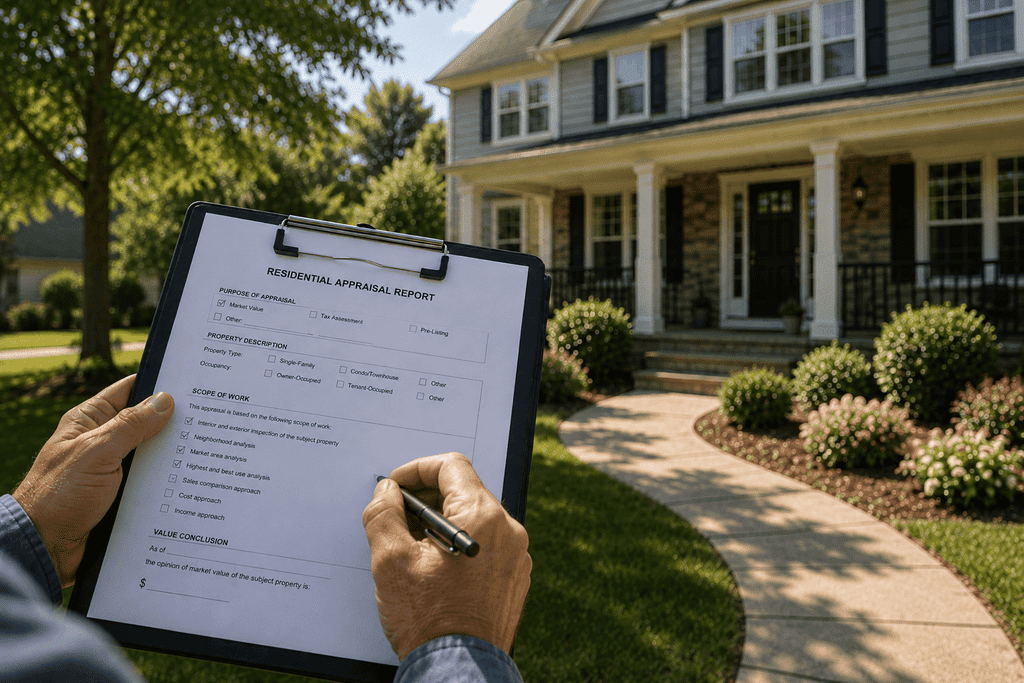
More than four million existing homes were sold in the U.S. in 2024, according to the National Association of Realtors. With that many properties changing hands, it’s easy to see why appraisers play an important role in the real estate industry.
If you’re thinking about becoming a real estate appraiser, you might assume you need a real estate license first. After all, both careers center heavily on home values. But they’re actually two separate professions with different rules.
So, does an appraiser need a real estate license? No. An appraiser needs the appropriate real estate appraiser license or certification, depending on the type of appraisal work they want to perform and their state’s requirements.
Key Takeaways
- Separate credentials: A real estate sales license does not automatically authorize someone to perform appraisals.
- Appraisers have their own requirements: Education, experience, examination, and licensing or certification requirements apply.
- Credential levels matter: Residential and general appraisers may have different scopes of practice.
- Realtors can become appraisers: A real estate background can be useful, but it doesn’t replace appraisal requirements.
- State rules matter: Appraiser requirements vary by state.
You Don’t Need a Real Estate License to Become an Appraiser
Now that we know an appraiser doesn’t need a real estate license, let’s look at what they actually need to work in the field. Instead, appraisers must meet the licensing or certification requirements established by their state.
The U.S. Bureau of Labor Statistics notes that real estate appraisers must meet state licensure or certification requirements. So if you’re searching for a real estate appraisal license, don’t assume you need to start by getting a traditional real estate sales license. Your state’s appraiser licensing authority is the better place to start.
Real Estate License vs. Appraiser License
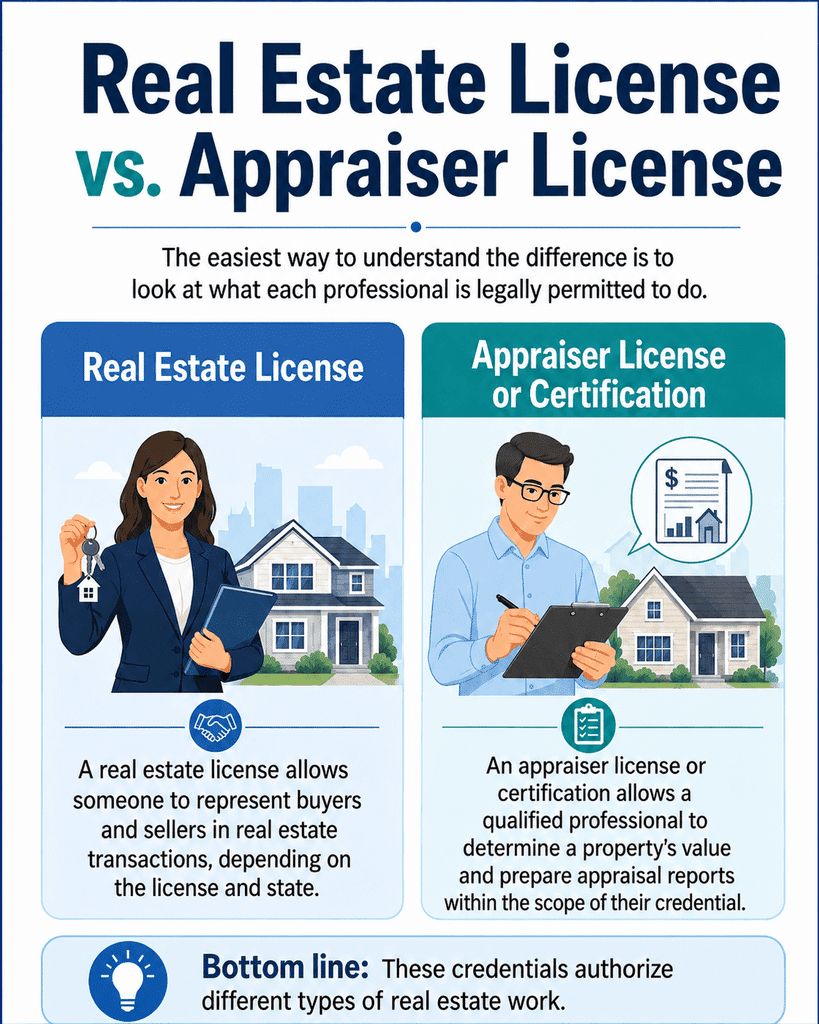
The easiest way to understand the difference is to look at what each professional is legally permitted to do.
A real estate license allows someone to represent buyers and sellers in real estate transactions, depending on the license and state.
An appraiser license or certification allows a qualified professional to determine a property’s value and prepare appraisal reports within the scope of their credential.
Here’s a real-life example. I’m a licensed real estate agent myself, but my license only allows me to participate in the buying, selling, and renting of properties.
It doesn’t give me the authority to appraise a property. That’s because knowing how to help someone purchase a home and knowing how to develop a credible opinion of its market value are two separate skill sets.
And that’s usually a good thing, because for the most part, you wouldn’t want the person negotiating the purchase price to also be the person determining the property’s value.
What Does a Real Estate Appraiser License Allow You to Do?
The answer depends on the credential and the state where the appraiser is licensed.
Appraisers can hold different credentials, such as:
- Licensed residential appraiser
- Certified residential appraiser
- Certified general appraiser
These credentials determine the type and scope of appraisal work the professional is qualified to do.
For example, a certified residential appraiser is qualified to perform residential appraisal work within the limits established by the applicable state rules. A certified general appraiser has a broader scope that can include different types of real property.
Specific requirements and scopes vary by state, so don’t assume an appraiser credential works the same way everywhere.
What Are the Real Estate Appraiser Requirements?
If you’re considering an appraisal career, the next question is what you’ll actually need to get started.
Although the details vary by state, becoming an appraiser usually involves some combination of:
The Appraisal Qualifications Board (AQB) establishes qualification criteria that state regulatory agencies use when developing their appraiser licensing and certification requirements. States can impose additional requirements.
In other words, you don’t just take a real estate licensing course, pass a real estate exam, and automatically become qualified to appraise homes. The appraisal path is its own career track.
Do Appraisers Need a License or Certification?
Yes, in states that regulate real estate appraisal, appraisers need the appropriate credential before independently performing appraisal work.
The exact terminology can get a little confusing because people sometimes use certain phrases interchangeably, like:
- Real estate appraiser license
- Real estate appraisal license
- Certified real estate appraiser
They don’t necessarily refer to the same credential.
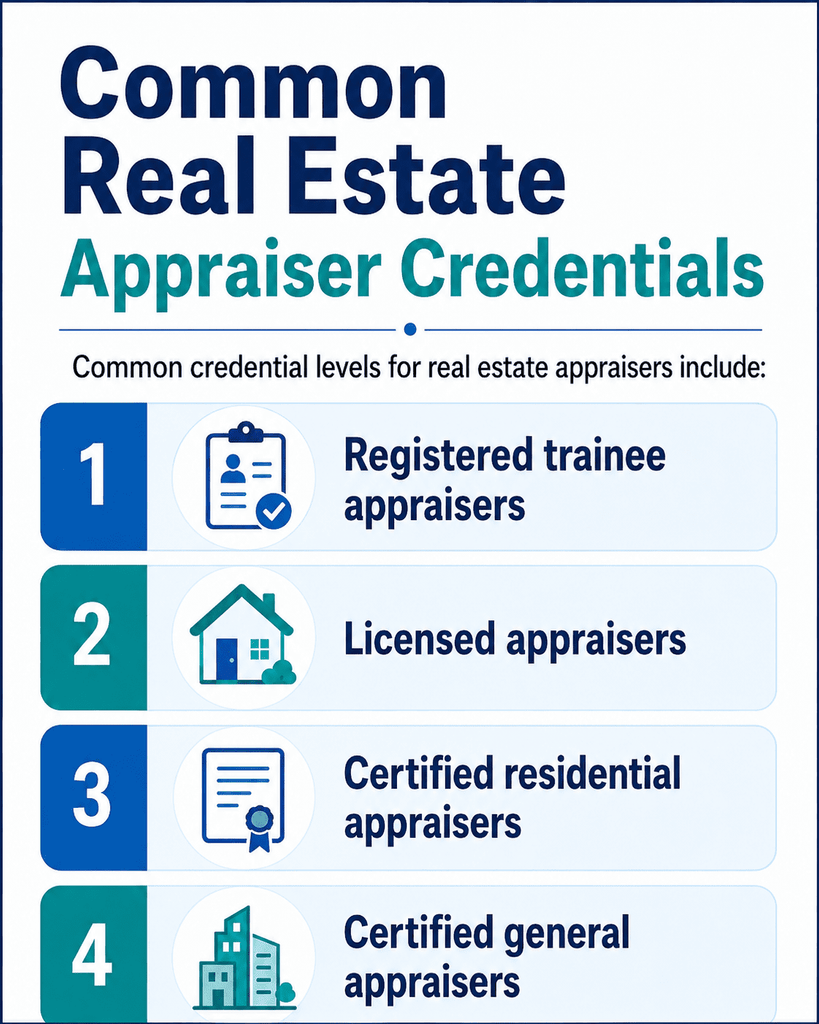
For example, Florida recognizes:
- Registered trainee appraisers
- Licensed appraisers
- Certified residential appraisers
- Certified general appraisers
Florida law also prohibits someone from using titles such as “certified real estate appraiser” or “licensed real estate appraiser,” or issuing an appraisal report, unless the person has the appropriate credential or is working under the supervision allowed by law.
Can a Realtor Become an Appraiser?
Yes, a Realtor can become an appraiser.
Being a Realtor doesn’t prevent you from pursuing an appraisal credential. In fact, your real estate experience may give you useful familiarity with property transactions, neighborhoods, market conditions, and the terminology used in the industry.
Think of it as adding another profession to your toolbox instead of upgrading your existing real estate license. Someone who already works in real estate may also better understand how an appraisal fits into a transaction. But an appraiser’s role is different from that of the agent representing a buyer or seller.
That’s why my real estate license doesn’t allow me to appraise a property. If I wanted to add appraisal work to what I do, I’d need to meet my state’s appraiser license requirements separately.
Do You Need a Residential Appraiser License to Appraise Homes?
The credential you need depends on the type and scope of residential appraisal work you’re performing and the rules in your state.
Some states offer a licensed residential appraiser credential, while others distinguish between licensed and certified residential classifications. For example, Florida has separate credential levels and specific requirements for certified residential appraisers.
That’s why it’s better to look at the exact credential offered by your state’s appraiser regulatory board rather than searching for one universal “residential appraiser license.”
Do Appraisers Have to Take Continuing Education?
Yes, maintaining an appraiser credential generally involves continuing education.
The specific requirements depend on the state and credential. In Florida, for example, registered trainee, licensed, and certified appraisers must complete 30 hours of continuing education, including a seven-hour USPAP update course.
This ongoing education helps appraisers stay current with professional standards, laws, and appraisal practices. Like many professional credentials, it comes with ongoing responsibilities.
Can You Be a Real Estate Agent and an Appraiser at the Same Time?
Yes, you can be both a real estate agent and an appraiser. However, holding both credentials doesn’t mean you can perform both roles on the same transaction without restrictions.
Situations can arise where the two roles create conflicts of interest. An appraiser is expected to provide an independent, unbiased opinion of value. Hence, an appraiser needs to be careful about accepting an assignment when they have an interest in the property or transaction.
In other words, you can hold both credentials, but you still have to follow the rules that apply to each role.
Final Thoughts
A real estate appraiser needs a separate appraiser license or certification, not a traditional real estate sales license.
The two careers overlap in their focus on property, but they serve different purposes. A real estate agent helps facilitate a transaction, while an appraiser provides an independent opinion of value.
And if you’re already a Realtor, you don’t have to choose between your existing experience and an appraisal career. You can pursue an appraiser credential.
If you’re seriously considering the career, take a close look at your state’s requirements before enrolling in courses. And when you do start studying, using reputable prep courses or study materials can make it easier to organize everything you’re expected to know.
If residential certification is the target, follow how to become a certified residential appraiser for hours, college paths, and the national exam.
FAQs
Does an appraiser need a real estate license?
An appraiser generally does not need a traditional real estate sales license to perform appraisals. Instead, appraisers must meet the licensing or certification requirements established by the state where they practice.
Can a Realtor become an appraiser?
Yes, a Realtor can become an appraiser. A real estate license does not automatically qualify someone to perform appraisals, but a Realtor can pursue the requirements for an appraiser license or certification.
What is the difference between a real estate license and an appraiser license?
A real estate license allows a professional to perform activities like representing clients in real estate transactions. An appraiser credential authorizes qualified professionals to perform appraisal work within the scope of their credential.
Do you need a residential appraiser license to appraise residential property?
You may need a residential appraiser credential to appraise residential property. Still, the exact credential depends on your state’s licensing system and the type of appraisal work you plan to perform.
What are the requirements to become a certified real estate appraiser?
Requirements to become a certified real estate appraiser vary by state but generally include appraisal education, qualifying experience, an examination, and an application for the appropriate credential.

![At Your Pace Online Coupon Code [Verified Discounts]](https://www.miamiherald.com/careers-education/wp-content/uploads/sites/2/2026/10/aypo-promo-code-mh-1024x768.jpg)