One website says you need a certificate. A job listing asks for NCIDQ Certification. Then an online program promises to certify you in just a few weeks.
They all sound official, but they do not lead to the same place. So, which interior design certifications actually count? Do you even need one to get hired? Can becoming certified help you earn more or move into higher-level roles?
The good news is that certification can open real doors, but you do not have to choose one blindly.
Today, I’ll explain when certification matters and how to find a path that fits your career. Let’s dive in!
Key Takeaways
- Certification Has a Purpose: It shows you understand the professional side of design.
- You May Not Need It: Your job, specialty, and location decide.
- The Wording Matters: Certificates, certifications, and licenses are different.
- Some Credentials Are Specialized: They may only help with certain projects.
- Check Before Enrolling: Make sure the program leads where you expect.
What Is Interior Design Certification Actually For?
Interior design certification shows that you understand more than how to make a room look good.
Certification also sits on top of formal training, so check the degree and credit-hour side before you spend money on an exam bundle.
Professional designers may also work with building codes, accessible layouts, construction documents, materials, and public safety. This becomes especially important in spaces such as hospitals, hotels, schools, offices, and restaurants.
Certification verifies that you have met specific education, experience, or testing standards. Your portfolio still shows your personal style and past work. The credential adds proof that you understand the professional side of bringing those designs to life.
Basically, one shows what you can create. The other shows what you are qualified to handle.
Certificate, Certification, and License: What’s the Difference?
These words are constantly mixed together, but they do not mean the same thing.
| Term | What It Means |
|---|---|
| Certificate | Proof that you completed a course or school program |
| Certification | A professional credential earned through set requirements |
| Registration | State recognition that may protect a professional title |
| License | Legal permission to perform services regulated by the state |
A certificate program can teach you interior design and help you build skills. However, it may not lead to professional certification or state recognition.
Before enrolling, check exactly what you receive after finishing. “Certification course” could mean training for an outside exam, a full certification path, or simply a certificate from that school.
Do You Legally Need Interior Design Certification?
Here is the good news: you do not automatically need certification just because you want to become an interior designer.
You may need it when you want to:
- Use a professional title protected by your state
- Submit certain permit or construction documents when your state requires registration
- Handle technical or code-related design work
- Apply for a job that specifically requires it
You may not need it when you:
- Focus on furniture, colors, styling, and finishes
- Are still building experience or a portfolio
- Work in a state that does not regulate your services
- Apply for jobs that value experience over certification
Your state decides what you legally need, while employers decide what they expect for a job. Check both before choosing a certification program.
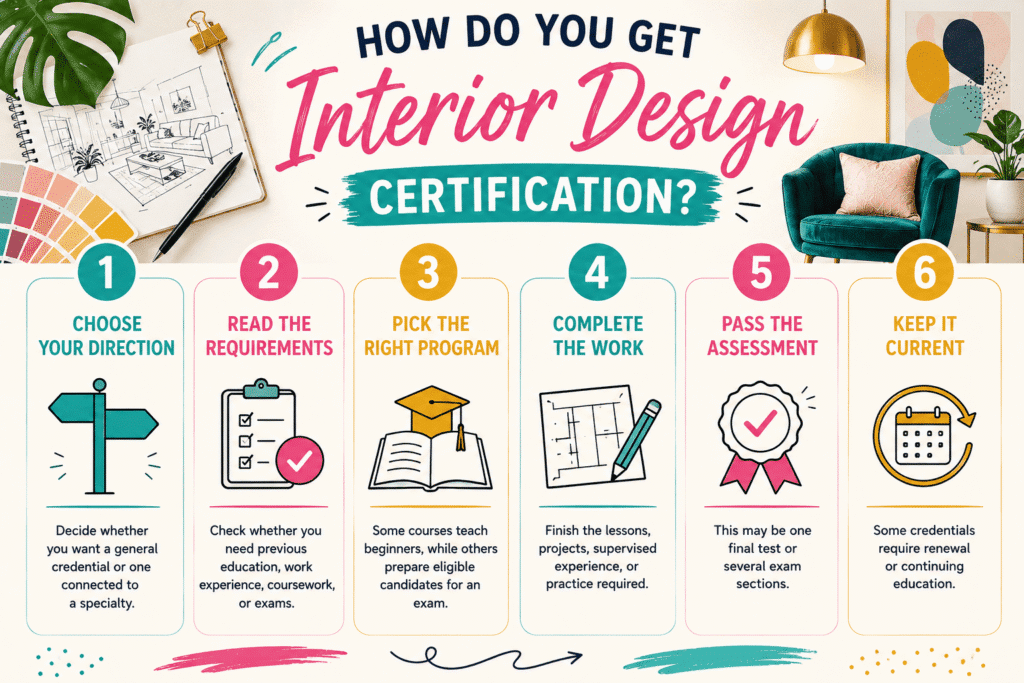
How Do You Get Interior Design Certification?
The steps depend on the credential, but most paths follow a similar pattern.
- Choose Your Direction: Decide whether you want a general credential or one connected to a specialty.
- Read the Requirements: Check whether you need previous education, work experience, coursework, or exams.
- Pick the Right Program: Some interior design courses teach beginners, while others prepare eligible candidates for a certification exam.
- Complete the Work: Finish the lessons, projects, supervised experience, or practice required.
- Pass the Assessment: This may be one final test or several exam sections.
- Keep It Current: Some credentials require renewal or continuing education.
This is where reading the small print helps. Find out whether the program awards its own certificate, guides you through a certification path, or only prepares you for an exam offered somewhere else.
Which Interior Design Certifications Actually Matter?
You do not need to collect every credential you find. Choose one that connects to your career.
- NCIDQ: A widely recognized professional certification administered by CIDQ. It may matter for technical roles, state registration, or certain employers.
- CHID: A specialized credential for experienced healthcare interior designers.
- WELL Credentials: Helpful for projects focused on health and well-being.
- LEED Credentials: Useful when you want to work with sustainable buildings.
WELL and LEED are broader building-industry credentials, not replacements for an interior design certification.
Some designers may not need any of these yet. Look at real job listings in your preferred specialty. If employers keep requesting the same credential, it is probably worth a closer look. If they care more about experience, software skills, and a portfolio, focus there first.
Will Certification Help Your Interior Design Career?
Yes, certification can create real career advantages.
It may help you:
- Qualify for more interior design jobs
- Compete for higher-paying positions
- Increase your long-term earning potential
- Take on larger or more technical projects
- Move into senior or leadership roles
- Support state registration
- Build trust with clients and employers
- Enter specialties with stricter standards
Certification does not guarantee a certain salary. Pay still depends on your experience, location, specialty, employer, and responsibilities. However, having a recognized credential can give you access to opportunities that may not be available without one.
My Final Take
Interior design certification can support your career, but only when you choose it for a clear reason.
Maybe you need it for a future job. Maybe it helps you enter a specialty you love. Or maybe your next move is simply gaining experience and building a better portfolio.
There is no prize for collecting the most credentials. Look at the work you want, check your local rules, and choose a path that moves you closer to it. Once you know your direction, the difference between a helpful certification and an unnecessary one becomes much easier to spot.
When you know whether certification fits your goals, read our interior design career guide for the skills, paths, and day-to-day work that come next.
FAQs
What Certification Do You Need to Become an Interior Designer?
There is no single certification required everywhere. NCIDQ is widely recognized, but the right credential depends on your location, specialty, and employer.
Can You Become an Interior Designer Without Certification?
Yes. Many people enter residential design or decorating without professional certification. Commercial, technical, and regulated roles are more likely to require or prefer it.
Can You Take the NCIDQ Examination Without a Degree?
Some diploma and certificate pathways may qualify, but the required coursework and work experience can differ. Eligibility depends on your complete education and professional background.
Is an Online Interior Design Certificate Worth It?
It can be useful for learning skills or building a portfolio. Before enrolling, confirm whether it awards a course certificate, leads to professional certification, or prepares you for a separate exam.
How Long Does Interior Design Certification Take?
It depends on the credential. A course certificate may take weeks or months, while professional certification can take several years when education and work experience are required.

![At Your Pace Online Coupon Code [Verified Discounts]](https://www.miamiherald.com/careers-education/wp-content/uploads/sites/2/2026/10/aypo-promo-code-mh-1024x768.jpg)