A home can look like a million-dollar property in person, but the numbers on paper can tell a different story. Certified residential appraisers are the professionals who turn that question into a defensible opinion of value. Getting there takes some commitment. The national qualification criteria call for 1,500 hours of appraisal experience over at least 12 months.
If you’re wondering how to become a certified residential appraiser, here’s what the education, experience, and exam process looks like.
Key Takeaways
- Credential scope: A certified residential appraiser can appraise one- to four-unit residential properties without regard to value or complexity.
- Education: The credential requires at least 200 hours of approved coursework, along with a qualifying college-level education path.
- Experience: Candidates need qualifying appraisal experience before earning the credential.
- Exam: Candidates must complete their required education and experience before taking the Certified Residential examination.
- Professional standards: Certified residential appraisers must understand and follow USPAP when developing and communicating appraisal results.
What Is a Certified Residential Appraiser?
A certified residential appraiser is a state-licensed professional who specializes in valuing residential properties. The credential is established through qualification standards developed by the Appraiser Qualifications Board (AQB) and implemented by state regulatory agencies.
Unlike entry-level appraiser licenses that limit property value or structure type, certified residential appraisers hold a top-tier credential. Obtaining it requires rigorous national education, exam, and experience standards established by the Appraiser Qualifications Board (AQB) and administered by state licensing boards.
That last part is important.
This credential gives an appraiser a broader scope of residential assignments than a more limited residential credential.
Certified Residential Appraiser Requirements
The basic path to certification has four major pieces:
Complete the required appraisal education
Meet the college-level education requirement or another approved pathway
Complete the required appraisal experience
Pass the Certified Residential examination and satisfy your state’s application requirements
While the requirements are based on national AQB criteria, your state ultimately controls the licensing and certification process.
Here’s where the process gets more interesting.
Residential appraiser education requirements
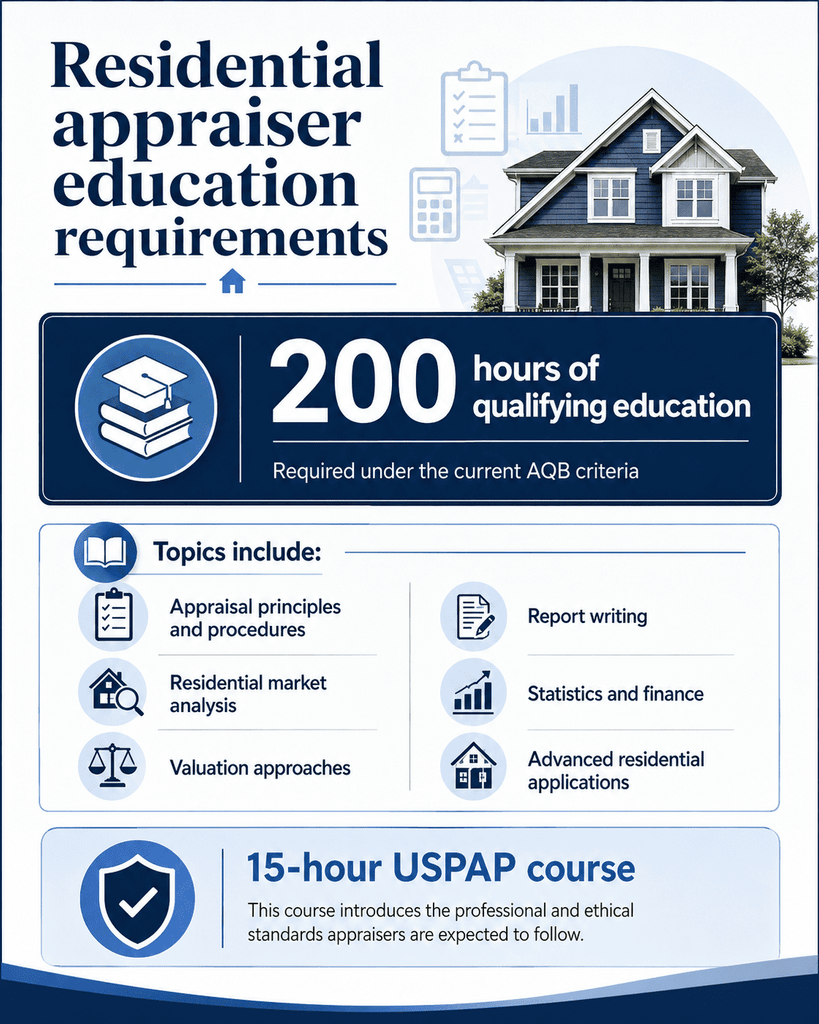
The certified residential credential requires 200 hours of qualifying education under the current AQB criteria. The coursework is designed specifically around the knowledge an appraiser needs to analyze and value residential property.
Topics include:
Appraisal principles and procedures
Residential market analysis
Valuation approaches
Report writing
Statistics and finance
Advanced residential applications
The education also includes the 15-hour Uniform Standards of Professional Appraisal Practice (USPAP) course, which introduces the professional and ethical standards appraisers are expected to follow.
If you’re preparing for this career, don’t treat the coursework as something to rush through to check a box. Appraisal has its own terminology, valuation methods, and analytical framework.
Strong study materials and an appraisal exam-prep course can make the material much easier to absorb before you get to the testing stage.
The college requirement is separate. Depending on the jurisdiction, qualifying applicants can meet it through options such as:
- A bachelor’s degree
- An associate degree in an approved field
- Specified college-level coursework
Florida, for example, lists several qualifying pathways, including a bachelor’s or associate degree and specific 30-semester-hour coursework options.
Residential Appraisal Experience Requirements
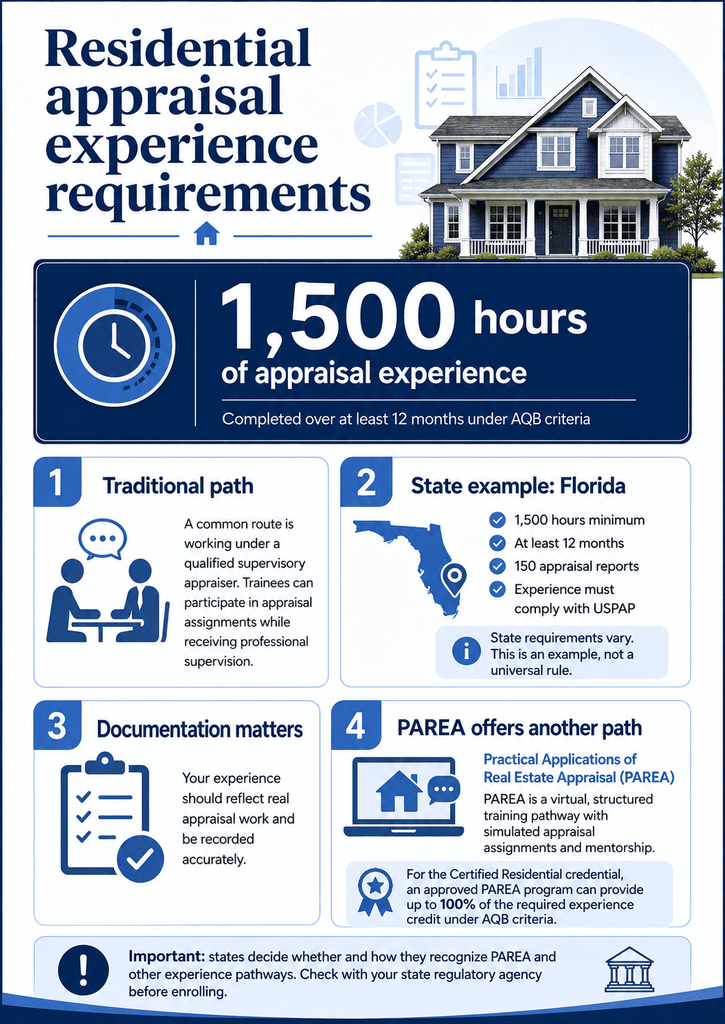
Under the AQB criteria, the certified residential credential requires 1,500 hours of appraisal experience over at least 12 months.
One traditional route is working under a qualified supervisory appraiser. That allows a trainee to participate in appraisal assignments while getting professional supervision.
But keep in mind, it can vary by state. For example, Florida’s requirements are more specific. Applicants must document at least 1,500 hours over a minimum of 12 months and at least 150 appraisal reports. The state also requires the experience to be compliant with USPAP.
Proper documentation is important. Your work must show real appraisal experience and be recorded correctly.
Parea Gives Aspiring Appraisers Another Option
There’s a newer option for those who don’t want to depend only on the traditional supervisor-trainee model: Practical Applications of Real Estate Appraisal, or PAREA.
PAREA is a virtual, structured training pathway that lets aspiring appraisers earn experience credit through simulated appraisal assignments and mentorship. For the Certified Residential credential, an approved PAREA program can provide up to 100% of the required experience credit under AQB criteria.
That can be a big deal for someone who has struggled to find a supervisory appraiser.
There is one catch: states decide whether and how they recognize these pathways. Before enrolling, check with your state’s regulatory agency to make sure the program satisfies the requirement.
What Does a Residential Appraiser Actually Analyze?
An appraiser:
- Researches comparable properties
- Studies the local market
- Analyzes the subject property’s characteristics
- Applies recognized valuation methods to develop an opinion of value
That analytical side is one reason the profession can appeal to people who already enjoy real estate but aren’t necessarily interested in sales. As a real estate agent, I see how much information can go into understanding a property’s market position. Appraisal takes that analytical process in a different direction, emphasizing the development and support of a credible value conclusion.
What Is the Certified Residential Appraiser Exam Like?
The Certified Residential Appraiser exam is the national examination associated with the credential.
The current Certified Residential exam is made up of:
- 125 questions
- 110 of them are scored
- 15 are unscored
Candidates have four hours to complete the exam.
An important timing detail: candidates must complete their required qualifying education and experience before taking the national exam.
That’s useful to know when planning your study schedule. You’re building toward the exam throughout the education and experience portions of the process, rather than starting from scratch once you become eligible to test.
If you’re preparing for the exam, use the current AQB exam content outline and practice questions or a reputable appraisal exam-prep course. Exam requirements can change, so older study materials aren’t always a safe bet.
What Can a Certified Residential Appraiser Appraise?
A certified residential appraiser can appraise one- to four-unit residential properties, regardless of transaction value or complexity.
That gives the credential a broader scope than a more limited residential appraisal credential.
It also distinguishes certified residential work from the Certified General Appraiser credential, which covers all types of real property and requires additional education and experience, including nonresidential experience.
So if your interest is primarily residential real estate, the certified residential credential may offer the scope you need without requiring you to pursue the broader Certified General credential.
Certified Residential Appraiser Salary
There’s no single salary number that applies specifically to certified residential appraisers. Income can vary depending on experience, location, workload, business structure, and whether you work independently or for an employer.
For context, the Bureau of Labor Statistics reported a $75,770 mean annual wage for property appraisers and assessors nationally in May 2025.
That’s an occupation-wide figure, however, and shouldn’t be interpreted as the typical salary of every certified residential appraiser. Someone researching the profession should consider it a broad benchmark rather than a promise of what the credential will pay.
Is Residential Appraiser Certification Right for You?
Residential appraisal can be a good fit if you enjoy real estate but prefer analysis, research, and valuation over sales.
You need to be comfortable with:
- Digging through market data
- Studying comparable properties
- Documenting your reasoning
- Paying close attention to professional standards.
Final Thoughts
Learning how to become a certified residential appraiser is really about understanding what this credential allows you to do , and what it takes to earn that responsibility.
You’ll need the education, experience, and certification, but the payoff is a professional credential specifically designed for residential valuation. And with options like PAREA giving aspiring appraisers another way to complete their experience, the path is becoming more accessible to people who may not have an easy route into traditional supervision.
Still deciding whether you need a sales license first? Does an appraiser need a real estate license separates the two credentials.
FAQs
How long does it take to become a certified residential appraiser?
How long it takes to become a certified residential appraiser varies depending on how quickly you complete your education and experience. State requirements can also affect the overall timeline.
Do you need a bachelor’s degree to become a certified residential appraiser?
No, you don’t need a bachelor’s degree to become a certified residential appraiser. The AQB offers several pathways to satisfy the college-level education requirement. Florida, for example, accepts a bachelor’s degree, an associate degree, or certain combinations of specified college-level coursework and CLEP examinations.
Can PAREA replace traditional appraisal experience?
PAREA can replace traditional appraisal experience. Under the AQB criteria, an approved Certified Residential PAREA program can provide up to 100% of the required experience credit. However, state regulators determine whether they recognize the pathway, so candidates should verify their state’s rules before enrolling.
What is the difference between a licensed residential appraiser and a certified residential appraiser?
The difference is that a certified residential credential provides a broader scope of residential appraisal work. The requirements and scope for a licensed residential appraiser are more limited.
Does a certified residential appraiser need to follow USPAP?
A certified residential appraiser must follow USPAP. It establishes the profession’s recognized ethical and performance standards.

![At Your Pace Online Coupon Code [Verified Discounts]](https://www.miamiherald.com/careers-education/wp-content/uploads/sites/2/2026/10/aypo-promo-code-mh-1024x768.jpg)