Selling a building takes skill, but knowing how to dissect its numbers takes mastery. If you’re ready to move from facilitating transactions to structuring multi-million-dollar investments, financial modeling is your golden ticket.
The demand for sharp analysts is growing, with median earnings pushing six figures. Take the next step in your career with a real estate financial modeling certification, and master the advanced Excel, underwriting, and valuation skills that drive institutional decisions.
Key Takeaways
- What it covers: A real estate financial modeling certification teaches you how to evaluate deals using financial models.
- Certification options: There isn’t a single universal certification that everyone in real estate finance needs.
- What you’ll learn: Strong programs typically cover Excel, cash flow modeling, valuation, debt, and investment returns.
- What it takes: Hands-on practice matters because employers want people who can build, analyze, and explain financial models, not just complete a certification.
- Choosing a program: The best option depends on whether you’re pursuing real estate finance, investment analysis, or another specialty.
What Is a Real Estate Financial Modeling Certification?
A real estate financial modeling certification is a program that teaches you how to build and analyze financial models for real estate investments.
You’ll typically work in Excel and learn concepts like:
- Discounted cash flow (DCF) analysis
- Net operating income (NOI)
- Internal rate of return (IRR)
- Equity multiples
- Debt and loan amortization
- Property valuation
- Sensitivity and scenario analysis
- Investment returns
- Capital structures
- Equity waterfalls
Some programs also incorporate ARGUS Enterprise, a commercial real estate software platform used for property valuation and cash-flow analysis.
Is Real Estate Financial Modeling the Same as Real Estate Finance?
Not exactly.
Real estate finance is the broader subject. It covers how real estate is funded, valued, and financed. This includes:
- Mortgages
- Debt
- Equity
- Interest rates
- Investment returns
Financial modeling is one tool for analyzing those decisions.
That’s why you’ll find plenty of real estate finance courses that include financial modeling and specialized programs that focus almost entirely on modeling.
If you’re new to the industry, a broader finance program may make more sense. If you already understand real estate finance and want to sharpen your Excel and underwriting skills, a modeling-focused program may be the better fit.
What Do You Learn in a Real Estate Financial Modeling Program?
The exact curriculum varies, but good programs should go beyond teaching you where to put numbers in an Excel spreadsheet.
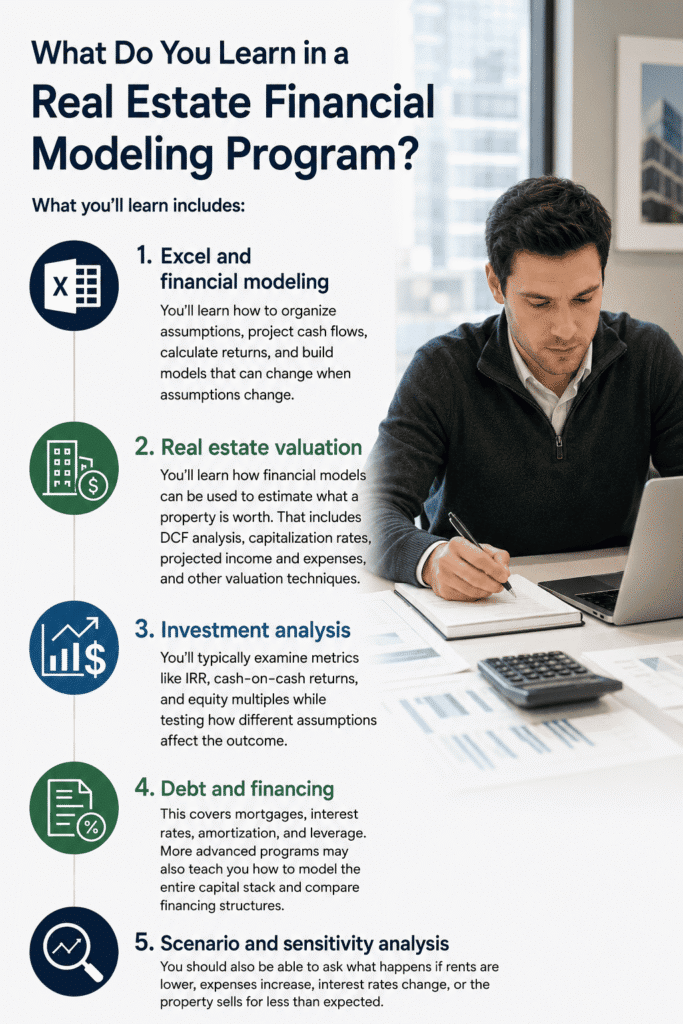
What You’ll Learn Includes:
You’ll learn how to organize assumptions, project cash flows, calculate returns, and build models that can change when assumptions change.
You’ll learn how financial models can be used to estimate what a property is worth. That includes DCF analysis, capitalization rates, projected income and expenses, and other valuation techniques.
You’ll typically examine metrics such as IRR, cash-on-cash returns, and equity multiples, and test how different assumptions affect the outcome.
This covers mortgages, interest rates, amortization, and leverage. More advanced programs may also teach you how to model the entire capital stack and compare financing structures.
You should also be able to ask what happens if rents are lower, expenses increase, interest rates change, or the property sells for less than expected. This is a major part of commercial real estate underwriting.
What Should You Look for in a Real Estate Financial Modeling Certification?
Before enrolling, look beyond the certificate itself and focus on how the program teaches. Look for courses that offer:
- Hands-on assignments
- Realistic investment scenarios
- Instructor support
- Opportunities to build complete models from start to finish.
Most importantly, choose a program that requires you to apply what you’re learning rather than memorize formulas or complete quizzes.
How Much Does Real Estate Financial Modeling Training Cost?
There’s a pretty wide range. The cost of real estate financial modeling training varies by program.
Online self-paced courses can be relatively inexpensive, while university certificates and specialized professional programs can cost considerably more.
Should You Take Real Estate Finance Courses First?
That depends on your background.
If you already understand concepts such as NOI, property valuation, and basic investment returns, you may be ready to move on to financial modeling.
If those terms are new to you, starting with real estate finance courses could save you some frustration. A basic understanding of real estate finance and markets can make it much easier to focus on the modeling itself rather than learning the underlying concepts at the same time. You don’t want to spend the first few weeks of a modeling course trying to figure out what the numbers actually mean.
Is a Real Estate Investing Certification Worth It?
A real estate investing certification can be worthwhile if it teaches practical skills you can use.
Look for programs that teach you how to:
- Build an investment model from scratch
- Underwrite an acquisition
- Analyze financing
- Calculate investment returns
- Perform sensitivity analysis
- Explain your assumptions
- Present an investment recommendation
Those skills are much more valuable than just having another credential on your résumé.
What About a Real Estate Private Equity Course?
If your goal is real estate private equity, you’ll want training that goes beyond basic Excel formulas.
A real estate private equity course should ideally expose you to:
- Acquisitions
- Underwriting
- Debt and equity structures
- Investment returns
- Partnership structures
- Exit strategies
That’s because private equity analysts aren’t just calculating whether a property makes money. They’re evaluating whether a deal makes sense given its risk, financing structure, and expected return.
Programs that teach equity waterfalls and capital-stack modeling can help with this career path.
How to Choose a Real Estate Financial Modeling Certification
Once you know what to look for in a program, the next step is figuring out which type of training best fits your career goals.
One thing I’ve learned from studying for professional licenses is that memorizing formulas only gets you so far. You really need to understand what the numbers mean, and that’s especially important when you’re using a financial model to evaluate an investment.
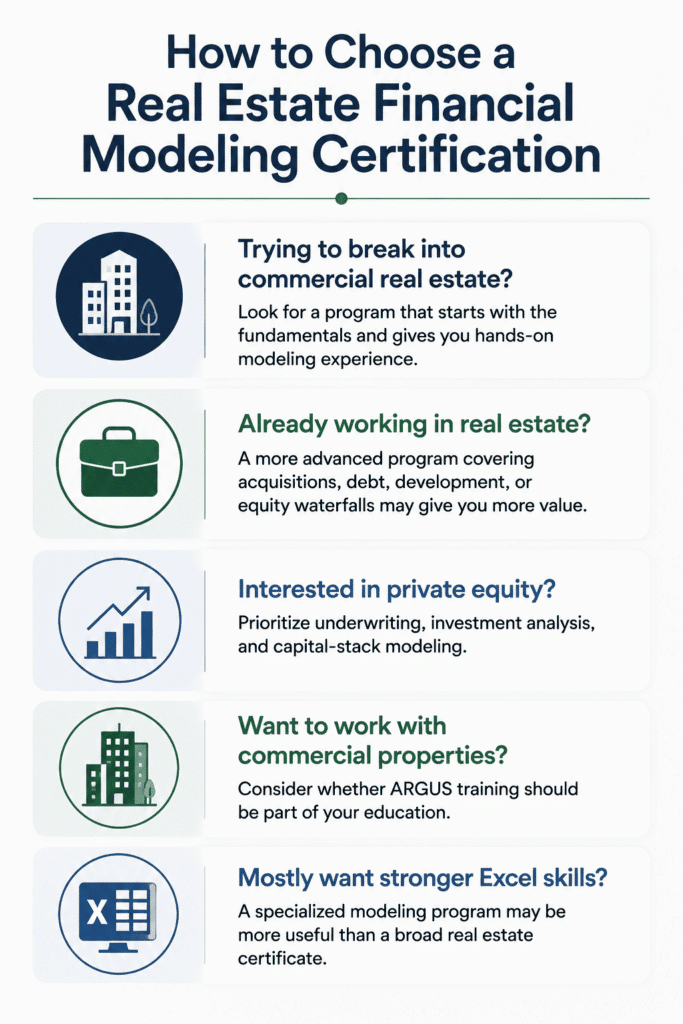
Trying to break into commercial real estate?
Look for a program that starts with the fundamentals and gives you hands-on modeling experience.
Already working in real estate?
A more advanced program covering acquisitions, debt, development, or equity waterfalls may give you more value.
Interested in private equity?
Prioritize underwriting, investment analysis, and capital-stack modeling.
Want to work with commercial properties?
Consider whether ARGUS training should be part of your education.
Mostly want stronger Excel skills?
A specialized modeling program may be more useful than a broad real estate certificate.
And don’t overlook the humble practice model. Even the best real estate investment training won’t help much if you never sit down and build something yourself.
Can You Learn Real Estate Financial Modeling Without a Certification?
Absolutely.
Once you’ve built a few models and know that this is the direction you want to take your career, you can decide whether a formal certification is worth the investment.
Career Paths You Can Take With Real Estate Financial Modeling
Real estate financial modeling skills can be useful across several areas of the industry. Depending on your experience and interests, you might use these skills in roles such as:
- Real estate financial analyst
- Acquisitions analyst
- Asset management analyst
- Investment analyst
- Development analyst
- Commercial real estate analyst
Responsibilities vary by role, but many involve evaluating properties, analyzing potential investments, or assessing financing options.
Related Guide
Before you pay for a certificate, the financial modeling guide explains how these models are built so you can tell whether a program teaches real underwriting work or just Excel shortcuts.
Final Thoughts
Real estate financial modeling may seem intimidating at first. If you still need the basics, start with what financial modeling is. There are a lot of formulas, unfamiliar terminology, and very large numbers floating around in those spreadsheets.
But the basic idea is fairly straightforward: take the assumptions behind a real estate investment and build a model that helps you understand what could happen to the money.
A good real estate financial modeling certification can give you a structured way to learn that process. Just don’t choose a program because the certificate sounds impressive. Choose one that makes you sit down, build models, analyze deals, and explain why an investment does, or doesn’t, make sense.
FAQs
What is a real estate financial modeling certification?
A real estate financial modeling certification is a credential earned through training in financial modeling for real estate investments. Programs commonly cover Excel, cash flow projections, property valuation, and sensitivity analysis.
Is a real estate financial modeling certification worth it?
A real estate financial modeling certification can be worth it if you need structured training or want to demonstrate your modeling skills to potential employers. However, the value depends heavily on the program’s curriculum and whether you gain hands-on experience.
What is the best certification for real estate financial modeling?
There isn’t one best certification for everyone. The right program depends on your career goals, existing knowledge, and the skills you want to develop.
Do I need a finance degree to learn real estate financial modeling?
You do not need a finance degree to learn real estate financial modeling. However, understanding basic real estate finance, valuation, and Excel can make the learning process much easier. Some advanced programs recommend having that background before enrolling.
What jobs can you get with real estate financial modeling skills?
With real estate financial modeling skills, you can get jobs such as real estate financial analyst, acquisitions analyst, and investment analyst.

![At Your Pace Online Coupon Code [Verified Discounts]](https://www.miamiherald.com/careers-education/wp-content/uploads/sites/2/2026/10/aypo-promo-code-mh-1024x768.jpg)