If you’re considering a career in real estate appraisal, demand remains strong. For the full career path, see how to become an appraiser. On average, the U.S. Bureau of Labor Statistics projects about 6,300 openings for property appraisers and assessors each year through 2034.
Stepping into the field means navigating a multi-step licensing path. Because criteria vary by state and property class, setting a clear plan early on is the key to getting started.
Let’s take a look at how to get a real estate appraiser license step by step.
Key Takeaways
- How licensing works: Individual states handle real estate appraiser licensing, while the AQB sets minimum qualification standards.
- Know your credentials: There are four main credential levels: trainee, licensed residential, certified residential, and certified general.
- Requirements vary: The education and experience you’ll need depend on the credential you’re pursuing.
- Experience options: PAREA can offer an alternative way to gain qualifying appraisal experience for certain credentials, depending on your state.
- Prepare for the exam: A solid study plan, practice questions, and exam prep materials can help you feel more prepared for the licensing exam.
What Does It Take to Get an Appraiser License?
The first thing to know is that individual states handle appraiser licensing. The Appraiser Qualifications Board (AQB) sets minimum education, experience, and exam criteria, while state regulatory agencies oversee licensing and may impose additional requirements.
From there, the general process looks something like this:
- Choose the type of appraiser credential you want
- Complete the required education
- Gain qualifying appraisal experience
- Apply through your state regulatory agency
- Pass the required examination
- Receive your license or certification
What Types of Real Estate Appraiser Licenses Are There?
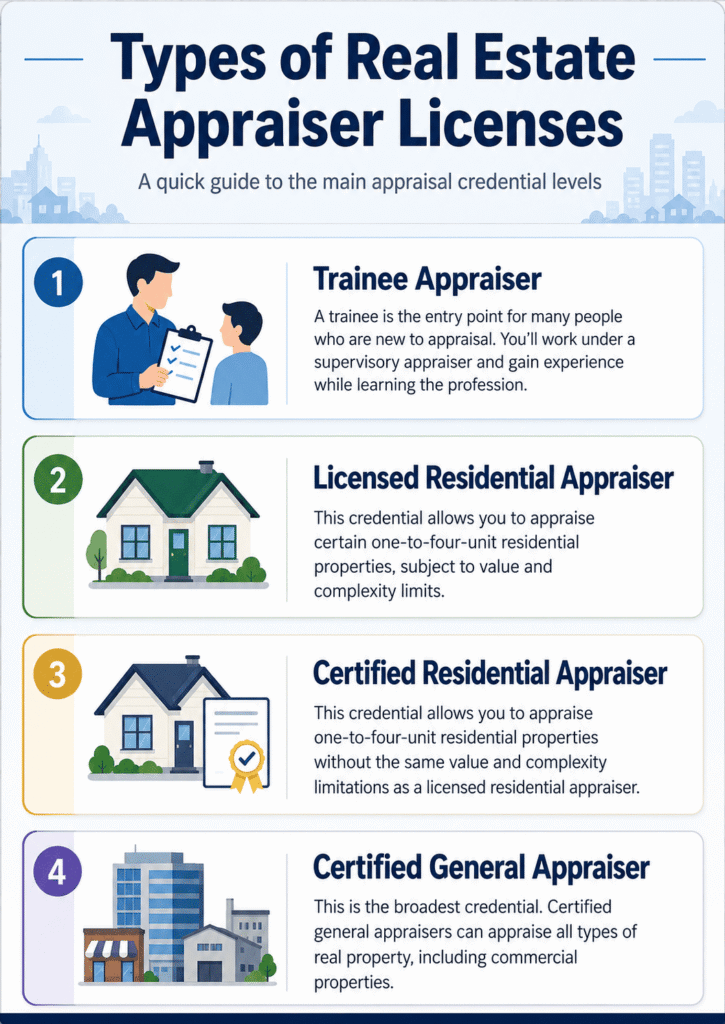
Trainee Appraiser
A trainee is the entry point for many people who are new to appraisal. You’ll work under a supervisory appraiser and gain experience while learning the profession.
Licensed Residential Appraiser
This credential allows you to appraise certain one-to-four-unit residential properties, subject to value and complexity limits.
Certified Residential Appraiser
This credential allows you to appraise one-to-four-unit residential properties without the same value and complexity limitations as a licensed residential appraiser.
Certified General Appraiser
This is the broadest credential. Certified general appraisers can appraise all types of real property, including commercial properties.
What Are the Appraiser License Requirements?
The exact appraiser license requirements depend on your state and credential, but you’ll generally need some combination of:
- Qualifying appraisal education
- Supervised or otherwise approved appraisal experience
- A licensing or certification exam
- An application
- Background checks or fingerprints
- Application and licensing fees
The AQB sets national minimum standards, but certain states may have extra requirements. So, meeting AQB criteria alone may not be enough to apply for a license in your state.
How Much Education Do You Need to Become a Real Estate Appraiser?
Under the 2026 AQB criteria, the qualifying education minimums are:
| Credential | Qualifying Education | Experience |
|---|---|---|
| Trainee | 75 hours | None |
| Licensed residential | 150 hours | 1,000 hours/6+ months |
| Certified residential | 200 hours | 1,500 hours/12+ months |
| Certified general | 300 hours | 3,000 hours/18+ months |
The qualifying education covers subjects such as real estate markets, appraisal principles and procedures, and valuation methods. The 2026 criteria also include education addressing valuation bias and fair housing laws and regulations.
Some credentials also require a college education. For example, certified general appraisers need a bachelor’s degree, while certified residential appraisers have several options for meeting the college-level education requirement.
And yes, that means you don’t necessarily need a real estate degree to become an appraiser.
How Do You Get Appraisal Experience?
Education is only half the equation. You’ll also need actual appraisal experience for most credentials.
Traditionally, aspiring appraisers gain experience by working under a supervisory appraiser. You complete qualifying appraisal work and document your hours as you work toward the next credential.
But there’s another option: PAREA, or Practical Applications of Real Estate Appraisal, from the Appraisal Foundation.
PAREA is a structured program designed to provide practical appraisal experience in a virtual environment. Depending on the credential and state, it can satisfy some or all of the experience requirements.
This is helpful if you are having trouble finding a supervisory appraiser.
Your state decides how it accepts these experience options, so check its rules before choosing a program.
Do You Have to Take a Real Estate Appraiser Exam?
For licensed residential, certified residential, and certified general credentials, yes.
The National Uniform Licensing and Certification Examination tests whether candidates can apply appraisal knowledge to real appraisal work. The current exams each contain 125 questions, 110 of which are scored, and candidates have four hours for the Licensed Residential and Certified Residential exams.
The exam isn’t the first step, though. Generally, you’ll complete the required education and experience before you’re eligible to take it.
How Should You Study for the Appraiser Exam?
This is where it pays to have a real study plan instead of hoping the information will stick. Having gone through professional exam prep myself, I know there’s a big difference between having access to study material and having a clear plan for using it.
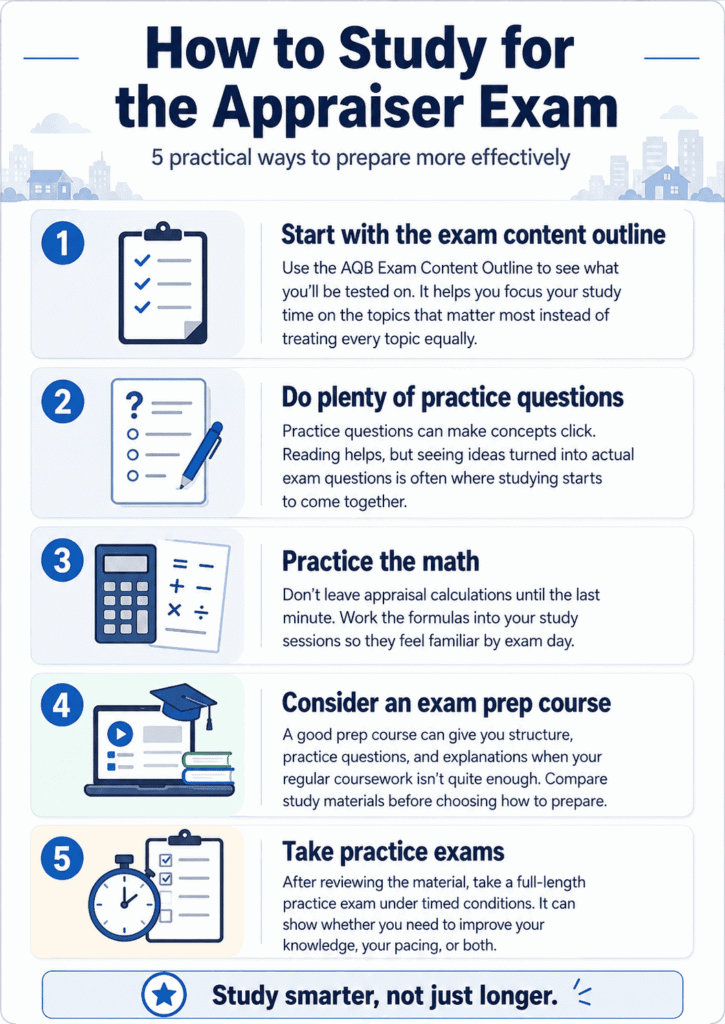
The AQB publishes an Exam Content Outline showing what you’ll be tested on. Use it to figure out where to spend your study time instead of treating every topic as equally important.
I’ve found that practice questions are often where studying starts to click. You can read the same concept several times, but seeing it turned into an actual exam question makes a big difference.
Don’t save appraisal calculations for the night before the exam. Work them into some study sessions so the formulas become familiar.
A good real estate appraiser exam prep course can give you structure, practice questions, and explanations when your regular coursework isn’t quite doing the job. It’s worth comparing review courses and study materials before you decide how to prepare.
Once you’ve reviewed the material, take a full-length practice exam under timed conditions. It can help you figure out whether you need to work on your knowledge, your pacing, or both.
How Long Does It Take to Become a Real Estate Appraiser?
There’s no single answer because it depends on the credential you pursue.
When estimating your timeline, account for your education, experience, application, and exam preparation.
If you are starting from the beginning, the process will likely take several months. The good news is you don’t need to aim for the highest credential right away; you can start at the entry level and progress over time.
How Much Does a Real Estate Appraiser License Cost?
There isn’t one national price for a real estate appraisal license.
- Education
- Exam prep materials or courses
- Examination fees
- Application fees
- Fingerprinting or background checks
- Licensing or certification fees
Since each state sets its own fees, check with your state regulator for the current amounts before budgeting for the process.
Can You Use Your Appraiser License in Another State?
Not necessarily.
States issue real estate appraiser credentials, so getting licensed in one state doesn’t automatically permit you to practice in another.
Some states have reciprocity or other options for appraisers who already hold credentials elsewhere. If you’re planning to move, check the new state’s requirements before assuming your license will transfer.
Related Guide
If you still need qualifying hours before the exam, the best online appraisal schools comparison shows which programs cover USPAP and the classroom time your state will actually count.
Final Thoughts
While becoming a licensed appraiser requires a real commitment, taking it one milestone at a time keeps the goal well within reach.
Start by deciding what kind of appraisal work you want to do. Then check your state’s requirements, choose the appropriate credential, and work through the education and experience requirements one step at a time.
And when it’s time for the exam, don’t wing it. A little preparation goes a long way.
FAQs
Do you need a college degree to become a real estate appraiser?
No, you don’t necessarily need a college degree to become a real estate appraiser. The education requirements depend on the credential.
Can you become a real estate appraiser with no experience?
Yes, you can become a real estate appraiser without prior experience. You can start at the trainee level and gain qualifying experience as you work toward a higher credential.
Is a licensed appraiser different from a certified appraiser?
Yes, a licensed appraiser has a different scope of practice than a certified appraiser. A licensed residential appraiser has a more limited scope of residential work. A certified general appraiser can appraise all types of real property.
Is the real estate appraiser exam hard?
Yes, the real estate appraiser exam can be challenging. It may be particularly difficult if you’re unfamiliar with appraisal concepts and calculations. Studying from the current exam content outline and using practice questions can help.
Can you get a real estate appraiser license online?
Yes, you can complete some real estate appraiser licensing requirements online. Depending on your state and credentials, you can complete qualifying education and certain experience programs online.

![At Your Pace Online Coupon Code [Verified Discounts]](https://www.miamiherald.com/careers-education/wp-content/uploads/sites/2/2026/10/aypo-promo-code-mh-1024x768.jpg)