How many repeat test-takers in one study reported high emotional exhaustion?
While I suspect this number may be even higher, most agree that cramming for the Series 7 can leave you burned out before exam day. Planning ahead spreads out the pressure and gives the material more time to stick. The Series 7 can get overwhelming fast once suitability, options, regulations, and product details start appearing in the same question. Reading the textbook from beginning to end is not always enough.
As a test prep reviewer who has seen both the good and bad sides of exam prep, I’ll break down what to study, how to practice, and how to improve your chances of passing the Series 7 on your first try.
Key Takeaways
- You need a score of 72% to pass the Series 7.
- The exam includes 125 scored questions.
- Most questions focus on recommendations and customer accounts.
- Suitability, options, regulations, and investment products need extra attention.
- A Series 7 prep course can organize the entire process.
Understand Series 7 Eligibility and Sponsorship
You cannot register for the Series 7 on your own. A FINRA member firm or another eligible organization must sponsor you.
The SIE is also a corequisite. You must pass both exams to earn the General Securities Representative registration, although you can take them in either order.
If you are still exploring the registration, this Series 7 exam guide explains what it covers and what passing allows you to do.
Know the Exam Format, Topics, and Passing Score
The Series 7 includes 125 scored multiple-choice questions, plus 10 unidentified pretest questions that do not affect your score. You get 225 minutes (3 hours and 45 minutes) and need 72% to pass. That works out to roughly 90 of the 125 scored questions, although you will not know which questions are unscored.
FINRA organizes the scored questions around four job functions:
- Seeking business from customers: 9 questions
- Opening accounts after evaluating customer objectives: 11 questions
- Providing information, making recommendations, transferring assets, and maintaining records: 91 questions
- Obtaining and verifying purchase and sale instructions: 14 questions
That 91-question function deserves most of your attention. It includes suitability, customer profiles, taxation, product characteristics, options, packaged products, municipal securities, and regulatory obligations.
The real Series 7 challenge is the amount of material, not advanced math.
Build a Realistic Series 7 Study Plan
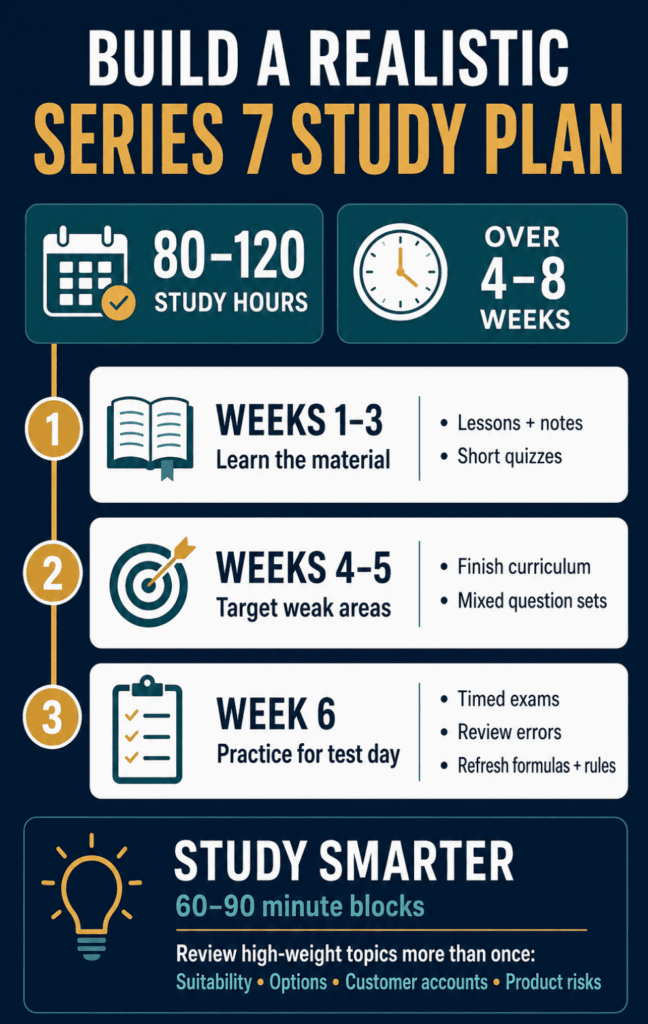
I’d plan for roughly 80 to 120 study hours over four to eight weeks. Someone with investment-industry experience may need less, while a newcomer may need more. The number isn’t sacred. What matters is scheduling enough time to learn, practice, forget a few things, and relearn them before test day.
Start by choosing an exam date, or at least a target week, then work backward. A six-week plan might look like this:
- Weeks 1–3: Read or watch lessons, take notes, and complete short quizzes.
- Weeks 4–5: Finish the curriculum and attack weak topics with mixed question sets.
- Week 6: Take timed exams, review errors, and refresh formulas and regulations.
I’d study in 60- to 90-minute blocks rather than relying on weekend marathons. Consistency makes dense rules easier to retain. Put heavier-weight subjects on the calendar more than once, especially suitability, options, customer accounts, and product risks.
Focus on Suitability, Options, and Regulations
These topics often overlap, so study them as decisions you may need to make within one question.
- Suitability
Start with the customer, not the investment.
Look for:
- Goals and time horizon
- Risk tolerance
- Income and tax bracket
- Liquidity needs
- Investment experience
Choose the product that fits the full profile, not the one with the highest return.
- Options
Know what the position is designed to do.
Focus on:
- Market outlook
- Maximum gain and loss
- Breakeven points
- Spreads and straddles
- Exercise, assignment, and taxation
Draw complicated positions instead of trying to track every contract mentally.
- Regulations
Group rules by the action being taken.
Ask:
- Who must approve it?
- Which document is required?
- When must it happen?
- Does it need to be in writing?
- Is the action prohibited?
Small words like before, after, and promptly can change the answer.
Turn Missed Questions Into Study Material
Taking more questions does not automatically lead to a higher score. The improvement happens during the review.
Sort each mistake into one of four categories:
| Mistake Type | What to Do Next |
|---|---|
| Content gap | Return to the lesson and relearn the topic. |
| Missed detail | Identify the word or fact you overlooked. |
| Calculation error | Redo the problem without viewing the answer. |
| Rule confusion | Write the rule in one clear sentence. |
Also review the questions you guessed correctly. A lucky answer can hide a topic that still needs work.
Keep a short running list of repeated mistakes. If suitability, options spreads, municipal taxes, or account rules appear several times, move that topic back into your study schedule.
Full-length exams should test your readiness, not teach every topic from the beginning. Save them until you can complete mixed quizzes without constantly returning to your notes.
For structured prep, compare our best Series 7 study materials to find lessons, question banks, and full exams that match your timeline.
How a Series 7 Prep Course Can Help
A good Series 7 prep course gives you a clear order for learning a very crowded exam.
Look for:
- A diagnostic or benchmark exam
- Lessons organized around the current exam outline
- Customizable quizzes
- Detailed explanations for every answer
- Options and calculation practice
- Performance reports by topic
- Realistic full-length exams
- Instructor support when explanations are not enough
The question bank should let you isolate weak topics and later combine them into mixed quizzes. The explanations should also cover why the other answer choices are wrong.
💡 Pro tip: Pay attention to how the course teaches suitability. Memorizing product facts is not enough when the exam asks you to choose between several investments that could all sound reasonable.
What to Do on Exam Day
The Series 7 exam gives you about 1 minute and 40 seconds per question, but you do not need to divide your time evenly.
Some questions take seconds. Others require a calculation or a careful review of the customer profile.
Use these strategies:
- Read the final sentence before sorting through every detail.
- Identify the customer’s goal before comparing investments.
- Eliminate clearly incorrect choices first.
- Mark time-consuming questions and return later.
- Write out option positions when needed.
- Avoid changing an answer without a clear reason.
- Answer every question before submitting.
Unscheduled restroom breaks are permitted, but the timer continues running. You must also complete another security check before returning to the exam. FINRA exam-day rules
Do not spend five minutes fighting one calculation. Make your best choice, mark it, and protect the time you need for the rest of the exam.
My Final Thoughts on Passing the Series 7
The Series 7 is not passed by reading the same textbook chapter until it finally sticks.
You need to compare products, read customer profiles carefully, and recognize which rule controls the situation. Build those skills with mixed questions, review every weak spot, and take full exams once you are ready to work under a clock.
The goal is not to know every tiny fact. It is to make enough correct decisions across all 125 scored questions.
Before you lock in a study timeline, read our Series 7 pass rate guide for difficulty context and how much prep time successful candidates typically need.
FAQs
What is the format and passing score for the Series 7 exam?
The Series 7 includes 125 scored multiple-choice questions and 10 unidentified pretest questions. You get 225 minutes and need a score of 72% to pass, which works out to roughly 90 scored questions. The breadth of suitability, options, and product rules makes it one of the heavier FINRA qualification exams.
How many study hours should I plan for the Series 7?
A common recommendation is 80 to 120 hours over four to eight weeks. Your timeline should depend on your experience, starting score, and weekly availability.
Do I need sponsorship to register for the Series 7?
Yes. A FINRA member firm or another eligible organization must sponsor you and submit Form U4. You cannot register independently.
Which Series 7 topics deserve the most attention?
Focus on customer accounts, investment products, suitability, options, trading rules, and regulations. The largest function covers providing investment information, making recommendations, transferring assets, and maintaining records.
How should I use Series 7 practice questions?
Use topic quizzes while learning, then move into mixed sets and timed exams. Review every missed or guessed question to find content gaps, calculation errors, and overlooked details.
Which test-taking strategies can help with the Series 7?
Allow about one minute and 40 seconds per question, including the 10 unscored questions. Watch for qualifiers, eliminate incorrect choices, answer everything, and mark slow questions for review.


![ESG Institute Coupon [Verified Discounts]](https://www.miamiherald.com/careers-education/wp-content/uploads/sites/2/2026/09/esg-institute-discount-code-mh-1024x768.jpg)