The CFA Institute renamed the Certificate in ESG Investing to the Sustainable Investing Certificate.
New name, same issue: Finding the best ESG course that will actually make the material make sense. So, which one will actually help?
I tested the main courses to see which ones actually helped me understand the material and which ones just threw content at me. Some made it easy to stay on track. Others felt like I had to build my own plan.
If you’re trying to pick one without wasting time or money, this breaks it down clearly:
Top 5 ESG Prep Courses
Here’s the quick version before the full reviews.
- Best Overall: AnalystPrep
→ Full ESG prep with lessons, practice, mocks, and tracking. - Best for Structure: Kaplan Schweser
→ Guided study flow with videos, quizzes, and full mocks. - Best for Broad ESG: The ESG Institute
→ Wider ESG training across finance, climate risk, and reporting. - Best for Flexibility: Corporate Finance Institute (CFI)
→ Short ESG lessons inside a larger finance course library. - Best for Instructor Support: Fitch Learning
→ ESG prep with virtual classes, instructor help, and unlimited access.
| Best ESG Prep Course Comparison Chart | ||
 |
| LEARN MORE |
 |
| LEARN MORE |
 |
| LEARN MORE |
 |
| LEARN MORE |
 |
| LEARN MORE |
1. AnalystPrep: Best Overall

AnalystPrep was the easiest course for me to settle into because it felt like a real prep setup without making me build my own plan. I could move from lessons to notes to practice without the course feeling scattered. It worked best when I treated it like a full study flow, not just a place to knock out random questions. Below, I’m breaking down the dashboard, QBank, and Ask-a-Tutor support.
Performance Tracking Dashboard
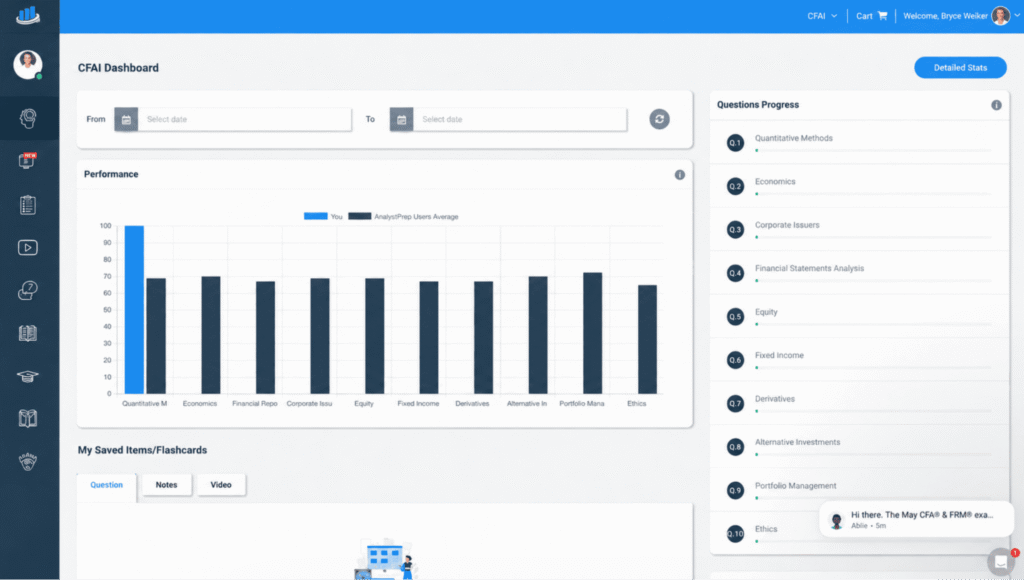
The dashboard showed the main tools on the left, my performance in the middle, and topic progress on the right. I liked that because I didn’t have that annoying “okay, where am I supposed to go?” moment when I opened it.
I’d go through the lessons, review the notes, test myself with questions, then check what I missed. Compared with some of the other dashboards I tested, AnalystPrep felt less buried. My progress was right there, so reviewing weak spots felt more obvious and less like I was hunting for the right tab.
Ask-a-Tutor Support
Ask-a-Tutor gave me a place to send confusing questions when I wanted a clearer reason for the answer choice. I would not use it for every missed question, but it helped when the explanation still felt too thin. For ESG, that works because some questions come down to wording and context, not just knowing the definition. It gave the course extra support without making it feel like I had to wait for a live class.
Topic-Drilling QBank
The QBank was useful because I could choose specific ESG topics instead of getting thrown into one big mixed set. That made the review feel more controlled. If I wanted to focus on one area, I could stay there, answer questions, check the explanations, and see if I actually understood it.
That helped because ESG questions can look basic until the answer choices start sounding similar. The QBank made me slow down and pay attention to the difference between knowing a definition and knowing how to apply it. I liked using it right after lessons because it showed pretty fast whether the material stuck or if I needed to go back.
AnalystPrep Course Packages
| Package | What’s Included | Best For | Price |
|---|---|---|---|
| Learn + Practice Package | Study notes, videos, QBank, CBT mocks, tracking tools, Ask-a-Tutor | Full self-paced ESG prep | $349 |
AnalystPrep Course Ratings
| Aspect | Rating |
|---|---|
| ESG Content | 9.4 / 10 |
| Finance Relevance | 9.3 / 10 |
| Course Structure | 9.5 / 10 |
| Practice & Application | 9.5 / 10 |
| Support & Access | 9.2 / 10 |
| Overall Average | 9.38 / 10 |
Pros
✅ Topic Tracking: I could see which ESG areas needed more work.
✅ Custom Quizzes: I could drill one topic instead of a huge mixed set.
✅ Organized Study Flow: The lessons, notes, and questions worked well together.
✅ CBT Mocks: The mocks made pacing feel more real
Cons
❌ Dense at Times: Some ESG sections needed slower review, not a quick skim.
❌ Limited Packages: There aren’t many package options.
❌ Not a Quick Cram: It works better for full prep than fast review.
Should You Try Analyst Prep?
AnalystPrep is best if you want a full ESG prep course with clear and strong practice tools. It may be more than you need for a quick review, but it works well if you want everything in one place.
2. Kaplan Schweser: Best for Structured ESG Prep

Kaplan felt more like a guided ESG course than a click-around study library. I didn’t have to build the order myself, which made it easier to stay in a rhythm. The course works best when you actually sit down and follow the flow instead of trying to rush through pieces randomly. The main things I focused on were the Performance Tracker, On-Demand videos, and SchweserPro™ QBank with mocks.
Performance Tracker
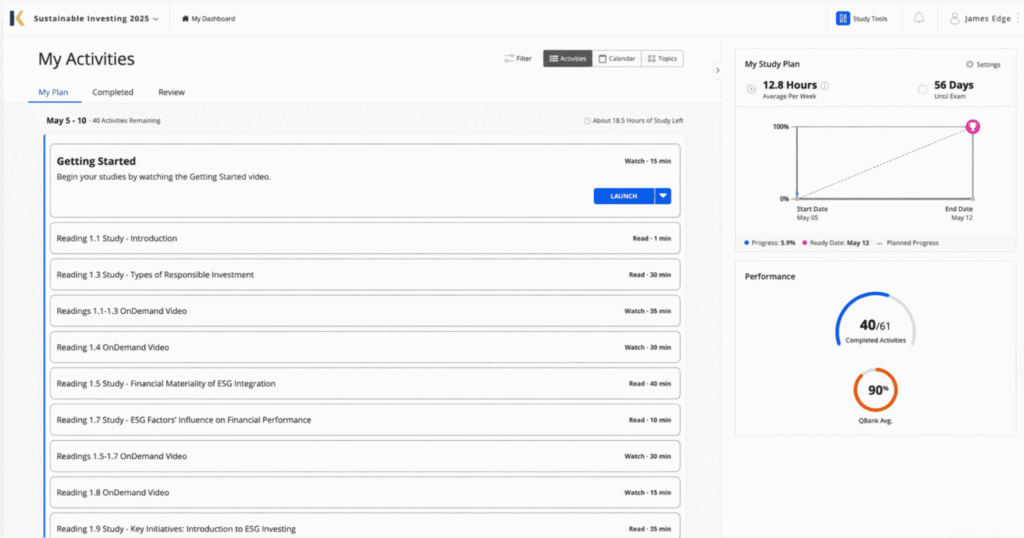
Kaplan’s Performance Tracker was the best in the game, showing where I stood after practice. I liked that because the ESG exam can trick you. A topic can feel fine during the video, then the questions show what you actually missed.
Compared with courses that made me piece together my own review, this tracker gave me a clearer next step. I could see which areas needed more work without trying to remember what felt hard earlier. That made the review feel more direct, especially after quizzes, because I knew what to clean up before moving into the next topic.
On-Demand Video Lessons
Kaplan’s On-Demand videos were the strongest part of the course experience for slowing the material down. The lessons gave more context before practice, which helped with ESG topics that can start sounding way too similar on the page.
I also noticed the lesson lengths were mixed. Some were quick enough to move through fast, while others needed more focus. Kaplan works best during focused study sessions where you can take your time to watch the lesson, absorb the explanation, and then move on to practice.
SchweserPro™ QBank and Exam Sim Mocks
The SchweserPro™ QBank gave me practice after the lessons, and I liked that I could use it to check if the topic actually stuck. It felt more guided than just jumping into random questions. The two 100-question Exam Sim mocks were more serious. They helped me see how the exam could feel when I had to keep answering without taking long breaks. That helped things flow because ESG questions can be easy to overthink when the wording gets close.
Kaplan Schweser Course Packages
| Package | What’s Included | Best For | Price |
|---|---|---|---|
| Sustainable Investing Certificate Course Package | 15+ hours of videos, QBank, custom quizzes, two mocks, tracking, InstructorLink, community, PassProtection | Guided ESG study | $399 |
Kaplan Schweser Ratings
| Aspect | Rating |
|---|---|
| ESG Content | 9.4 / 10 |
| Finance Relevance | 9.3 / 10 |
| Course Structure | 9.5 / 10 |
| Practice & Application | 9.5 / 10 |
| Support & Access | 9.2 / 10 |
| Overall Average | 9.38 / 10 |
Pros
✅ Clear Next Step: The Activity Feed told me what to do next.
✅ Helpful Videos: The lessons made similar ESG topics easier to separate.
✅ Full Mocks: The two 100-question mocks felt more realistic than regular quizzes.
✅ Custom Quizzes: I could test a topic right after a lesson.
Cons
❌ Needs Focus: Some lessons take a real study block.
❌ Slower to Jump Around: It is not the fastest for quick topic review.
❌ Not A Cram Course: Kaplan works better for steady prep.
My Final Take On Kaplan Schweser
Kaplan is a good fit if you want ESG prep with more direction. It helped me slow down, separate similar topics, and study in a cleaner order. I liked it more for planned study sessions than quick review.
3. The ESG Institute: Best for Broad ESG Learning

The ESG Institute was the broadest course in my review. Its Diploma in Sustainable Finance covered ESG from more angles than the exam-prep courses, including finance, climate risk, reporting, investing, carbon markets, and a capstone project. It did not feel like a tight test-prep tool. It felt more like a wider ESG training course for someone who wants the bigger picture.
Sustainable Finance Curriculum
The curriculum started with sustainable finance basics, then moved into ESG factors, climate change, regulations (including U.S. SEC climate disclosure rules), reporting frameworks such as ISSB standards, taxonomies, and investing principles aligned with the UN Principles for Responsible Investment. It covered a wider lane than the prep courses, so the focus was less on test-style review and more on how ESG shows up in finance work.
I liked that it did not keep recycling the same basic ESG definition. It gave more context around financial services, investment analysis, and risk. The tradeoff is that it felt less direct than the top prep courses because there was more background and less drill-style practice.
Capstone Project
The capstone was the part that made the course feel less passive. Instead of just moving through ESG lessons, it asked me to pull the ideas together and think through how they would actually work in a finance setting. I liked that because the course covers a lot: climate risk, reporting, investing, and carbon markets. Without the project, it could feel like a long topic list. The capstone gave it more of a “use this now” ending.
Final Test
The final test was more of a course wrap-up than serious exam prep. It gave me a way to check the main ideas, but it was not trying to replace a QBank or mock exam setup. That’s fine for this course because it is broader training, not a strict test-prep tool. I liked having a finish line, though. It made the course feel closed off instead of ending with one last lesson and no real check.
The ESG Institute Course Packages
| Package | What’s Included | Best For | Price |
|---|---|---|---|
| Diploma in Sustainable Finance | ESG principles, sustainable finance, climate risk, investing, reporting, carbon markets, capstone, final test | Broader sustainable finance training | $299 |
The ESG Institute Rating
| Aspect | Rating |
|---|---|
| ESG Content | 8.9 / 10 |
| Finance Relevance | 8.7 / 10 |
| Course Structure | 8.5 / 10 |
| Practice & Application | 8.4 / 10 |
| Support & Access | 8.2 / 10 |
| Overall Average | 8.54 / 10 |
Pros
✅ Wide ESG Coverage: I got finance, climate, investing, and reporting topics.
✅ Finance Angle: The course tied ESG to real finance work.
✅ Applied Capstone: The project made the course feel more practical.
✅ Stronger Context: It went deeper than basic ESG definitions.
Cons
❌ Not Pure Exam Prep: It is broader than a certificate review course.
❌ No Big QBank: I did not get the same drill-style practice setup.
❌ Can Feel Wide: Some sections may be more than exam-focused students need.
Where The ESG Institute Fits
The ESG Institute fits better for broad ESG learning than pure exam prep. The course gives more context around finance, climate risk, reporting, and investing, but it does not have the same practice-heavy setup as the top two courses.
4. Corporate Finance Institute (CFI): Best for Flexible ESG Learning

CFI was the least “single course” option in my testing. It felt more like a finance training library with ESG courses built into it. That can be useful, but it also means you have to know what you’re looking for. I focused on the ESG course library, the short lesson setup, and the extra Full-Immersion features.
Interactive Practice Questions
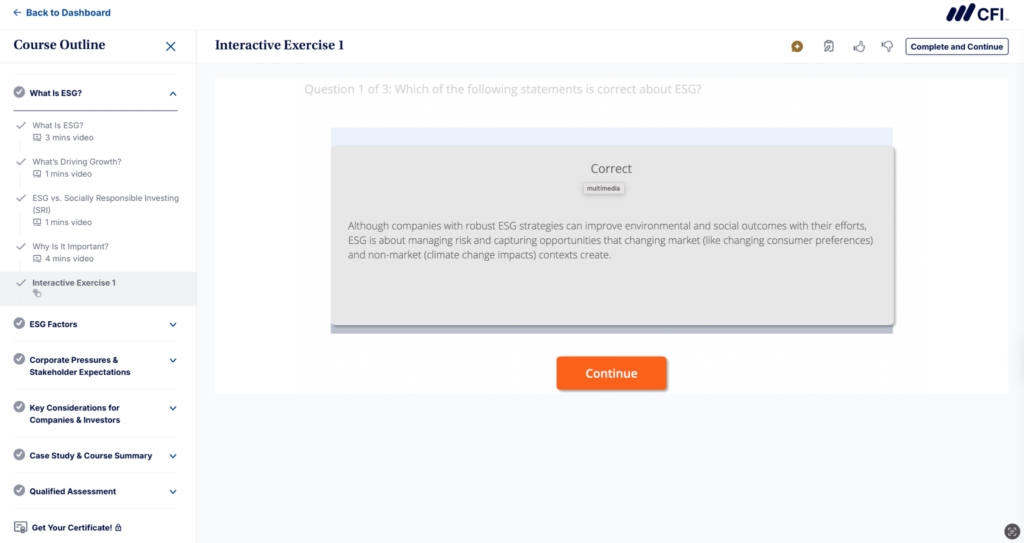
CFI’s practice questions were built into the lessons, so they felt more like quick checkpoints than a huge exam-style QBank. I liked that after I answered, the course showed an explanation instead of just marking it right or wrong and moving on. That made the questions more useful because I could see the reasoning right away. The setup worked well for checking ESG basics while going through the course, but it did not feel as deep or exam-heavy as the bigger prep platforms.
Personalized Financial Model Review & Feedback
The Personalized Financial Model Review & Feedback stood out because it was not really an ESG study feature. It felt more tied to CFI’s bigger finance training setup. When I looked at it in the Full-Immersion plan, it made sense for someone working on finance models, not someone only trying to review ESG terms. I’d treat it as a bonus if you want broader finance help.
Curated Finance Job Board
When I opened the Curated Finance Job Board, it felt separate from the ESG lessons but still easy to use. I could browse finance roles inside the same platform instead of leaving CFI completely. That made the subscription feel more connected to career use, not just course completion. It fit with the rest of CFI’s setup because the platform mixes ESG learning with broader finance skills, templates, and credentials.
CFI Course Packages
| Package | What’s Included | Best For | Price |
|---|---|---|---|
| Self-Study | 250+ courses, certifications, specializations, CPE/CPD credits, quizzes, templates, models | Independent learners | $347.90/yr |
| Full-Immersion | Self-Study features plus AI Tutor, expert guidance, model feedback, and career tools | Learners who want support | $592.90/yr |
CFI Ratings
| Aspect | Rating |
|---|---|
| ESG Content | 8.5 / 10 |
| Finance Relevance | 8.8 / 10 |
| Course Structure | 8.2 / 10 |
| Practice & Application | 8.3 / 10 |
| Support & Access | 8.4 / 10 |
| Overall Average | 8.44 / 10 |
Pros
✅ Short Lessons: I could finish focused ESG topics without a huge time block.
✅ Course Library: ESG was part of a bigger finance learning setup.
✅ Specific Topics: I could pick lessons on ESG disclosure, risk, policy, or analysis.
✅ Flexible Access: It worked better for ongoing learning than a one-time cram.
Cons
❌ No Single Path: I had to build my own ESG study flow.
❌ Less Direct: It was not as focused on one exam-style prep track.
❌ Easy to Overbrowse: I could see students jumping around too much.
Where CFI Fits Best
CFI works best if you want short ESG lessons inside a bigger finance course library. It is flexible and easy to fit around other work, but less direct if you want one clear ESG prep path from start to finish.
5. Fitch Learning: Best for Instructor-Led ESG Prep

Fitch Learning felt more formal than the other ESG courses I tested, but in a way that made sense for this kind of exam. It supports the CFA Institute Sustainable Investing Certificate, formerly called the Certificate in ESG Investing, with virtual classroom options, online learning, question practice, instructor support, and access until you pass. This is best for students who want ESG prep with more instructor backup, not just a solo course library.
Chapter Questions
Fitch’s chapter questions made the course feel more tied to the exam instead of just the lessons. I liked that they were built into the study package because they gave me a way to check each section before moving on. That works better for ESG than only reading slides, since the topics can sound clear until they show up in question form. It also made the review feel more section-by-section instead of random.
Diagnostic Tools
The diagnostic tools helped make practice feel more focused. Instead of only answering questions and moving on, I could see where performance looked weaker and use that to guide the review. That matters for ESG because reading definitions is not enough. You have to see how topics show up in actual questions. It did not feel as casual as some platforms, but it did feel built for a more structured review process.
Instructor Helpdesk
The instructor’s helpdesk gave students somewhere to post questions when the material got unclear. I liked that because ESG explanations can get wordy fast, and sometimes you need a more direct answer. It also made the course feel less isolated than a basic self-paced setup. I would not call it casual, but it does add real support for people who want expert backup while working through the ESG material.
Fitch Learning Course Packages
| Package | What’s Included | Best For | Price |
|---|---|---|---|
| Virtual Classroom + Online Learning | 4 half-day virtual classes, portal, materials, questions, support, guarantee | Students who want instructor-led ESG prep | $1,785 |
| Online Learning | Portal, study resources, questions, support, guarantee | Students who want flexible ESG prep | $645 |
Fitch Learning Ratings
| Aspect | Rating |
|---|---|
| ESG Content | 8.4 / 10 |
| Finance Relevance | 8.6 / 10 |
| Course Structure | 8.3 / 10 |
| Practice & Application | 8.4 / 10 |
| Support & Access | 8.6 / 10 |
| Overall Average | 8.46 / 10 |
Pros
✅ Virtual Class Option: There are live-online options, not just self-paced.
✅ Portal Resources: I got a mix of notes, question practice, and mock exam materials.
✅ Instructor Help: Daily questions and the helpdesk add real support.
✅ Access Until Pass: Students keep portal access until they pass.
Cons
❌ Most Expensive Option: Costs more than the other ESG courses I reviewed.
❌ More Formal Setup: It feels less casual than the self-paced platforms.
❌ Investment Background Helps: Fitch recommends a solid grounding in the investment process.
Who Fitch Learning Works Best For
Fitch Learning works best if you want ESG prep with instructor support, question practice, and a more traditional classroom setup. It is less casual and higher priced than some other courses, but it gives the prep a more guided feel.
Other ESG Prep Options That Didn’t Make the Top List
These ESG prep tools still have value, but they made more sense as extra study materials than main picks.
- Bloomberg: The interactive ESG modules were useful, but it felt more like a certificate add-on than a full prep course.
- Brainie Group: Great for task tracking and question drilling, but the overall setup did not feel as complete as the top picks.
- Brainscape: The flashcards and quizzes could help with quick review, but I’d use it as a supplement, not my main course.
What I Compared in Each ESG Certification Course
I reviewed each ESG course based on how useful it felt for studying, reviewing, and actually understanding the material. I looked at content, practice tools, tracking, support, and overall value instead of just ranking by brand name
| Criterion | Weight | What I Evaluated |
|---|---|---|
| ESG Content | 25% | Depth, clarity, and topic coverage. |
| Finance Relevance | 20% | Investing, risk, and finance connection. |
| Practice & Application | 15% | Quizzes, mocks, projects, or case work. |
| Course Structure | 15% | Flow, layout, and study path. |
| Instructor Quality | 15% | Teaching style, expertise, and lesson quality. |
I looked for courses that helped separate similar ESG ideas, connect the material to finance, and give enough practice to see what actually stuck.
Finding Your Best ESG Course Match
Not sure which one is your best match? Start with how you really like to study first, then decide:
- Want a full prep setup? → Go With AnalystPrep
Ideal if you want lessons, notes, QBank, CBT mocks, tracking, and tutor support in one place. - Want a guided study path? → Choose Kaplan Schweser
Great if you like having a course tell you what to do next. - Want more ESG + finance context? → Look into The ESG Institute
Good if you want ESG connected to sustainable finance, climate risk, investing, and reporting. - Want short lessons and flexibility? → Try The Corporate Finance Institute
Best if you want to pick quick ESG lessons inside a bigger finance course library. - Want one focused topic? → Consider Fitch Learning
Designed for those who need a short course on ESG risk, climate change, or sustainable finance.
Other than my course rankings, choosing the best ESG course also depends on how you study and how much structure you need.
It also depends on where you want the credential to take you, and what an ESG analyst does day to day is a useful check before paying for any of these.
- Want A Clear Path? Pick a course that tells you what to do next.
- Need More Practice? Look for QBank access, quizzes, and mocks.
- Learn Better With Videos? Choose a course with real lesson support.
- Get Stuck On Wording? Tutor or instructor help can save time.
- Studying On Your Schedule? Check access length before you buy.
Final Verdict: Which ESG Review Course Wins?
AnalystPrep is my overall pick because it has the strongest mix of structure, practice, tracking, and support in my testing. Kaplan Schweser is the runner-up for a more guided study flow, and The ESG Institute is the best lower-priced option if you want broader ESG learning over strict exam prep.
FAQs
What Is the Best ESG Certification Course for Exam Prep?
AnalystPrep is the best exam-prep pick here because it combines lessons, topic QBank practice, mocks, tracking, and Ask-a-Tutor support in one workflow. Kaplan Schweser is the best alternative if you want a guided weekly path with videos and SchweserPro drills for the CFA Institute Sustainable Investing Certificate. For climate-risk roles, compare that path with the GARP Sustainability and Climate Risk Certificate.
Which ESG Course Is Best for Broader Sustainable Finance Training?
The ESG Institute is the best choice for broader sustainable finance training because its diploma covers climate risk, reporting, investing, and a capstone—not just exam drills. CFI fits better if you want short ESG lessons inside a larger finance library you can study on your own schedule.
How Much Do ESG Certification Courses Cost?
Most courses here range from a few hundred dollars for self-paced access to several thousand for instructor-led packages. AnalystPrep, Kaplan Schweser, CFI, and The ESG Institute usually sit in the mid-range, while Fitch Learning tends to cost more because it includes virtual classroom support. Check current pricing before you buy.
How Long Should I Plan to Study for an ESG Certification?
Plan on about 100–130 hours for the CFA Institute Sustainable Investing Certificate, depending on your finance background and weekly study time. Self-paced platforms like AnalystPrep and CFI let you spread that over weeks or months. Guided programs from Kaplan Schweser or Fitch Learning work better with a fixed exam timeline.
Do I Need Investment Experience Before Starting an ESG Course?
You do not need to be a portfolio manager, but exam-focused prep from Kaplan Schweser and Fitch Learning assumes basic knowledge of the investment process. Beginners can start with CFI or The ESG Institute for context, then move into heavier QBank prep once ESG terms and finance links feel familiar.


![ESG Institute Coupon [Verified Discounts]](https://www.miamiherald.com/careers-education/wp-content/uploads/sites/2/2026/09/esg-institute-discount-code-mh-1024x768.jpg)