As nice as it would be, becoming an actuary doesn’t happen overnight. There are some serious actuary requirements, and some of them can take years to finish.
The good news? You don’t have to finish everything before you get hired.
But I’m here to answer the tough questions you actually want answered:
What does it take to become an actuary? And, more importantly, is it worth meeting those requirements to land a career?
There are three E’s to consider: education, experience, and exams.
Key Takeaways
- Bachelor’s Degree Required: Most actuaries need at least a bachelor’s degree, often in math, statistics, actuarial science, finance, or a related field.
- Exams Take Time: Becoming credentialed requires passing multiple actuarial exams, usually over several years while working full-time.
- You Can Work Before Finishing: You don’t need to complete every exam before getting an entry-level actuarial job.
- Technical Skills Matter: Strong math skills are essential, but programming, spreadsheets, data analysis, and communication are also important.
- The Payoff Can Be Strong: The long qualification process can lead to high earning potential, career advancement, and strong job demand.
What Are the Requirements to Become an Actuary?
At the most basic level, actuaries need education, exams, technical skills, and professional credentials.
You’ll generally need to:
That might sound like a lot, and it is. But you usually complete these steps over several years, not all at once before you apply for jobs.
Actuary Education Requirements
Most entry-level actuary jobs require a bachelor’s degree.
Let’s be clear, though: you don’t have to major in actuarial science.
The Society of Actuaries (SOA) states this explicitly. Math, statistics, finance, economics, and business can all build a strong foundation.
So, whether you’re already in college or thinking about changing careers, know that you don’t have to start your education over just because your degree isn’t in actuarial science.
However, you do need strong math skills for the exams. You’ll want to be a whiz at calculus, probability, statistics, economics, and finance.
Actuarial Exam Requirements
This is where becoming an actuary gets more demanding.
In the U.S., most candidates follow either the SOA path or the Casualty Actuarial Society (CAS) path. The SOA is geared toward areas like life, health, retirement, and investments, while the CAS focuses on property and casualty insurance.
Both require multiple exams plus additional coursework and professionalism requirements. You can also continue beyond the associate level and work toward fellowship.
The good news? You usually don’t need to finish the entire process before getting hired. Many actuaries keep taking exams while they work.
Do You Need Work Experience to Become an Actuary?
Luckily, you don’t need years of actuarial experience to get an entry-level job.
The Bureau of Labor Statistics says you don’t need related work experience to start. Entry-level actuaries usually get a lot of training after they’re hired, not before.
That said, internships can still help you stand out. They also let you see what actuarial work is really like before you commit to years of exams.
An internship is especially helpful if you’re unsure which actuarial specialty to choose. A textbook can explain insurance risk, sure. But working with an actuarial team for a summer can show you if you’d actually enjoy analyzing it every day.
What Skills Do Actuaries Need?
Passing exams is part of it, 100%, but it’s not the whole story. You’ll also need skills to help you turn numbers into useful business decisions.
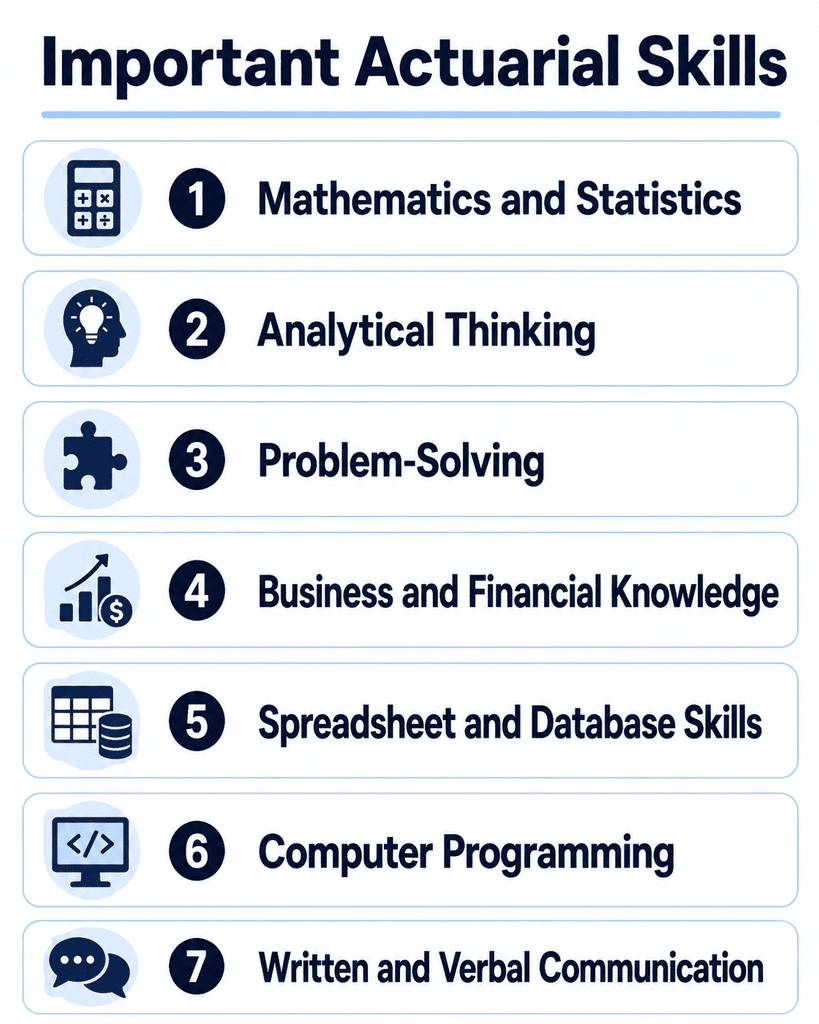
Important actuarial skills include:
And it’s surprisingly easy to overlook communication skills.
Actuaries don’t just calculate risk and hide behind spreadsheets, they often need to explain their findings to managers, clients, regulators, or others who don’t have the same math background.
The BLS specifically points to computer science, programming, spreadsheets, databases, and statistical analysis tools as useful skills to build.
How Hard Is It to Become an Actuary?
I’m going to be honest with you, because you deserve that: becoming a fully credentialed actuary is hard.
And yes, the biggest challenge is usually the exams. And prepping can be especially difficult, because you’ll often be studying for tough professional exams while working full time.
Plus, like anything worth doing, it’s not going to happen overnight. The Bureau of Labor Statistics says earning an associate-level credential can take up to seven years because of all the preparation. Fellowship can take even longer.
That said, you don’t have to ask yourself if you can spend the next decade taking exams.
A better question is:
Can I pass one or two exams and see how I feel?
That’s a much smaller commitment. If you like the material, do well on the exams, and enjoy the work, you can keep going.
Are the Actuary Requirements Worth It?
The answer depends on what you want from your career.
If you dislike math or the thought of studying after college sounds overwhelming, actuarial science may not be the best fit.
But the long qualification process also brings major career advantages.
The median annual wage for actuaries is $130,000, according to the Bureau of Labor Statistics. Employment is also projected to grow 9% from 2025 through 2035, compared with just 3% for all other occupations on average.
Employers may also support candidates during the exam process by paying for exams, study materials, or study time. Some provide raises or bonuses after employees pass exams.
That doesn’t make the exams easy, but it does mean you can earn a salary and move forward in your career while you complete them.
Bottom Line
Long story short: the requirements for becoming an actuary are demanding, but you don’t have to finish the whole credentialing process before you start your career.
You’ll usually need a bachelor’s degree, strong math skills, and to have passed some actuarial exams to be a strong entry-level candidate. After that, you can keep taking exams and meeting professional requirements while you work.
If you’re interested but feel overwhelmed by all the requirements, don’t judge the career by the finish line alone. Start by looking at the first actuarial exams and the kind of work actuaries do. If both seem appealing, the longer credentialing process could be worth it for a well-paid career with strong long-term demand.
If you want the hiring path around those requirements, how to become an actuary covers internships, first exams, and entry-level roles.
FAQs
How many exams do you need to become an actuary?
There isn’t one fixed number for every actuary. The total depends on whether you pursue the SOA or CAS path and how far you continue toward associate or fellowship credentials.
Do you need an actuarial science degree to become an actuary?
No. You can major in mathematics, statistics, finance, economics, or another related field as long as you build the skills needed for actuarial exams and work.
Can you become an actuary without passing any exams?
You can start preparing for the career without an exam, but passing at least one or two exams can make you a more competitive candidate for many entry-level roles.
How long does it take to become an actuary?
It often takes several years to earn an associate-level credential, especially because many candidates continue taking exams while working full time.
Is becoming an actuary worth it?
It can be if you enjoy math, problem-solving, and analytical work. The exam process is demanding, but actuarial careers can offer strong salaries and long-term advancement opportunities.

![ESG Institute Coupon [Verified Discounts]](https://www.miamiherald.com/careers-education/wp-content/uploads/sites/2/2026/09/esg-institute-discount-code-mh-1024x768.jpg)