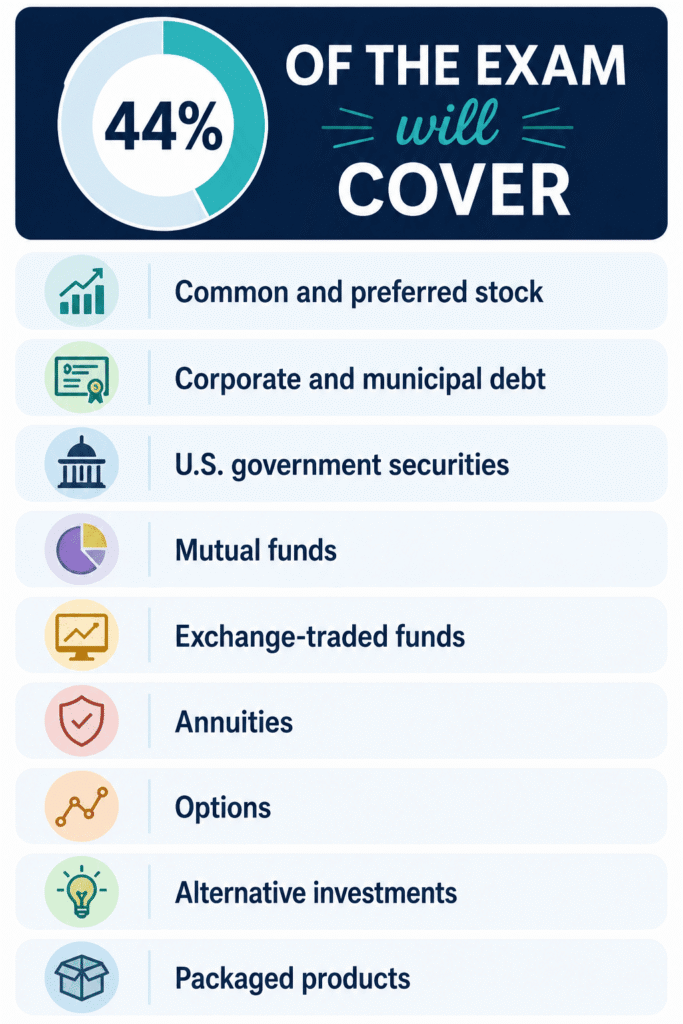
44% of the Securities Industry Essentials (SIE) exam focuses on understanding securities products and their risks. That can be a lot to take in when words like bonds, options, mutual funds, and derivatives are new to you.
A little context can make studying easier. Start with these five things.
Key takeaways
- The SIE Is the Starting Point: The SIE covers foundational securities concepts, including financial markets, investment products, trading, customer accounts, and regulations.
- Passing the SIE Isn’t the Same as Being Licensed: The SIE alone doesn’t authorize you to conduct securities business. You generally need an additional qualification exam based on your role.
- Your Career Determines What Comes Next: FINRA offers different qualification exams for different securities roles, and some registrations may also involve state-level requirements.
- You Don’t Need a Finance Degree: Anyone can take the SIE, but if financial terminology is new to you, you may need more time to build a solid foundation.
- How You Study Matters: Prep courses, practice questions, FINRA’s exam outline, and repeated exposure to financial concepts can make unfamiliar material easier to understand and remember.
What Is the Securities License Exam?
There isn’t one universal securities license exam for everyone entering the financial industry. Instead, FINRA administers different qualification exams based on the type of securities work you plan to do.
For many people, the Securities Industry Essentials (SIE) exam is the starting point. It covers foundational topics such as:
- Investment products and their risks
- Securities markets
- Regulatory agencies
- Prohibited practices
However, passing the SIE does not give you a securities license. Think of it as the foundation. Depending on your job, you may also need to pass a qualification exam before you can become registered.
For example:
- SIE + Series 7: A common path for someone pursuing registration as a General Securities Representative.
- SIE + Series 6: Covers products such as mutual funds, variable annuities, and variable life insurance.
The qualification exam you need ultimately depends on what you will be doing in your role.
That’s why searches for terms like “financial securities license” or “investment license exam” can get confusing. There isn’t one test that qualifies you for every securities job—the SIE may be your first step, but what comes next depends on your career path.
What Is the SIE Exam?
The SIE tests foundational knowledge of the securities industry. One reason it can appeal to people considering a career change is that you don’t need to work for a financial firm to take it.
You can register for the SIE on your own if you’re at least 18 years old. You don’t need to be associated with a FINRA member firm to sit for the exam.
The current SIE exam includes:
- 75 scored multiple-choice questions
- 10 unscored pretest questions
- 1 hour and 45 minutes of testing time
- 70 as the passing score
- $100 exam fee
The exam is divided into four major areas:
| SIE exam section | Percentage of Exam |
|---|---|
| Knowledge of Capital Markets | 16% |
| Understanding Products and Their Risks | 44% |
| Understanding Trading, Customer Accounts and Prohibited Activities | 31% |
| Overview of the Regulatory Framework | 9% |
That 44% is significant. The largest part of the exam requires you to understand securities products and the risks associated with them.
In other words, you’re not just memorizing a collection of financial vocabulary words.
You’re learning how different investments work, the purpose each one serves, and how to connect the dots.
What Does the SIE Cover?
The SIE provides a broad introduction to the securities industry. The four sections cover everything from financial markets to investment products and regulations.
Capital Markets
This section introduces the structure of the financial markets and the roles of different participants.
You’ll come across concepts involving economic factors, market structure, securities offerings, and the participants involved in bringing securities to market.
Securities Products and Risks
At 44%, this is the largest section of the SIE.
Topics include:
- Common and preferred stock
- Corporate and municipal debt
- U.S. government securities
- Mutual funds
- Exchange-traded funds
- Annuities
- Options
- Alternative investments
- Packaged products
You also need to understand the risks associated with different products.
That’s where just memorizing definitions becomes less useful. You need enough understanding to distinguish between products and why an investor might choose them.
Trading, Customer Accounts, and Prohibited Activities
This section covers concepts related to trading, customer accounts, and activities that securities professionals are prohibited from engaging in.
The material can start to feel more interconnected here because you’re applying information about financial products to customer and transaction situations.
Regulatory Framework
The final section covers the regulatory side of the securities industry, including regulatory agencies, registration requirements, and certain regulated and prohibited activities.
Understanding which organization regulates what can seem like pure memorization at first, but knowing the basic roles of the major regulatory bodies can make the information easier to organize.
What Are the Securities License Requirements?
Securities licensing requirements can vary depending on the registration you’re pursuing and whether your role also involves state-level requirements.
The SIE is available without firm sponsorship. However, qualification exams for specific registrations generally require you to be associated with a FINRA member firm.
These FINRA licensing exams are tied to specific roles within the securities industry, including:
- Series 6: Investment Company Representative
- Series 7: General Securities Representative
- Series 57: Securities Trader Representative
- Series 79: Investment Banking Representative
- Series 82: Private Securities Offerings Representative
- Series 99: Operations Professional
NASAA also develops state securities industry exams, including the Series 63, Series 65, and Series 66, which FINRA administers.
So before signing up for a securities exam, find out which registration your prospective position requires.
Otherwise, you could spend weeks studying for an exam that doesn’t apply to your career path.
Do You Need a Finance Degree to Take the SIE?
No.
FINRA doesn’t require a finance degree to take the SIE. The exam is available to people considering careers in the securities industry, including prospective candidates who aren’t associated with a financial firm.
But there’s a difference between not needing a finance degree and not needing to learn finance.
If you’re coming from outside the industry, you’ll still need to become familiar with financial products, markets, terminology, and regulations.
The time it takes will vary from person to person.
How Should You Study for the Securities License Exam?
No single study method works for everyone. The right approach can depend on how familiar you already are with financial terminology and concepts.
Give Yourself Time to Build Context
When I first started studying for the securities license exam, I underestimated the learning curve.
I had already studied for a life insurance exam without any prior experience in the insurance industry, so I had a good idea of what it felt like to learn the material for a financial licensing exam from scratch.
The SIE was different.
A page of course material could make sense on its own, but I didn’t always have enough context to see how one concept connected to the next. Eventually, I stopped trying to force my way through the material and spent some time immersed in a finance environment.
The more often I heard financial terminology used in context, the less foreign it became. If you find yourself struggling with the material, don’t assume you need to start over. In my case, spending more time around the industry gave me the context I was missing.
That’s my experience, though, and it won’t necessarily be yours. Someone with a finance or investing background may find the material much more intuitive from the start, while someone coming from another field may need more time to build that foundation.”
Start With the Language
If financial terminology is unfamiliar, start there.
Keep a running list of terms you don’t recognize and translate the definitions into language that makes sense to you. Then revisit them as you move through the course.
Eventually, you want to reach the point where seeing a term in a question doesn’t stop you in your tracks.
For me, repeated exposure made a noticeable difference. Seeing unfamiliar terms repeatedly made them easier to recognize and recall during quizzes.
Connect Products to Their Risks
Ask questions as you study:
- Why would an investor choose this product?
- What risks does it carry?
- How is it different from another product?
- Why does this regulation exist?
- What would happen if a particular condition changed?
You won’t necessarily need to explain every concept like a financial professional, but understanding the reasoning behind the material will make it easier to recall later.
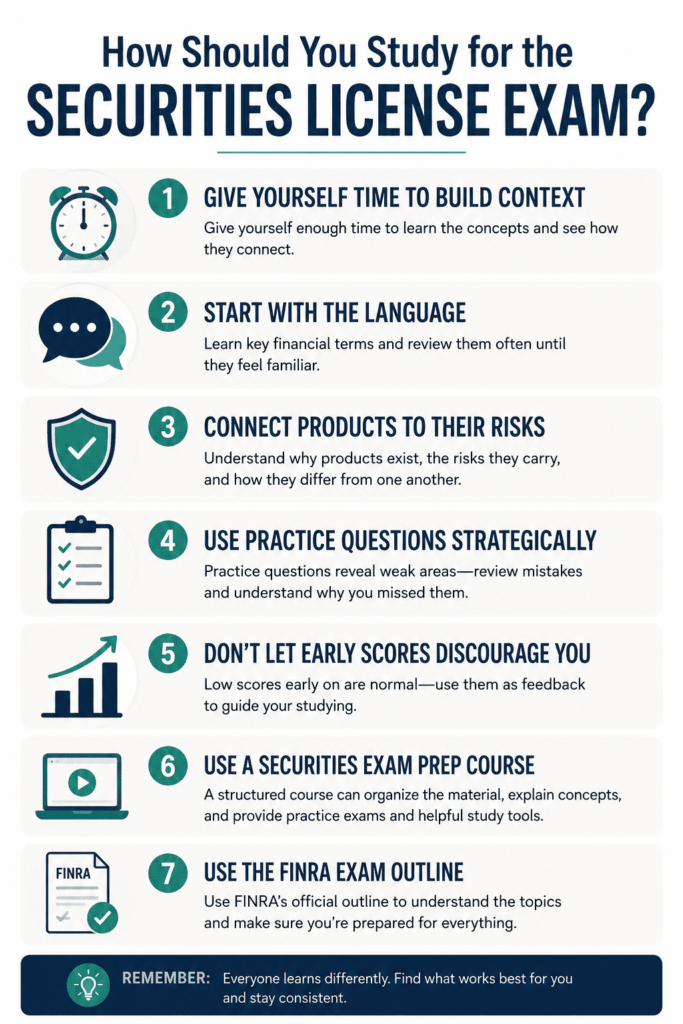
Use Practice Questions Strategically
Practice questions can show you where your knowledge is weakest.
When you get an answer wrong, don’t just memorize the correct answer. Figure out why you got it wrong.
Was the terminology unfamiliar? Did you misunderstand the question? Did you confuse two investment products? Or did you know the concept but forget an important rule?
Those are different problems, and they require different kinds of studying.
Don’t Let Early Scores Discourage You
Practice quiz scores are useful, but a low score early on isn’t necessarily a prediction of your final exam result.
In my case, becoming more familiar with the language and concepts was the difference between failing and passing quizzes. The important thing is to use those early quizzes as feedback.
If you’re consistently missing questions in one area, that’s a reason to spend more time there — not a reason to decide you’re bad at the subject.
Use a Securities Exam Prep Course
A structured securities exam prep course can be particularly useful if you’re learning the material from scratch.
A good prep program can organize the information, explain difficult concepts, provide practice questions, and help you track which topics need more attention.
Depending on the provider, courses may also include practice exams, video lessons, flashcards, or other study tools. Compare our best SIE exam prep courses to find a structured program that fits your study style.
Kaplan organizes the information well and in a way that isn’t overwhelming. It also provides videos that supplement the text if you’re more of a visual learner.
When comparing SIE exam prep courses, look for one based on the current FINRA exam content outline that includes explanations for practice questions.
Use the FINRA Exam Outline
FINRA provides an official SIE content outline that breaks down the topics covered on the exam. It also provides a practice test and other candidate resources.
Even if you’re using a commercial study program, the official outline can help you see what you’re expected to know and make sure you’re not overlooking an area.
What Happens After You Pass the SIE?
Passing the SIE is an important step, but it isn’t the end of the securities registration process.
To become registered to conduct securities business, you’ll usually have to pass the qualification exam associated with your role and become associated with a FINRA member firm.
For example, someone pursuing General Securities Representative registration needs to pass both the SIE and Series 7.
One advantage of taking the SIE before you have a job in the industry is that the passing result remains valid for four years. That gives prospective candidates some flexibility while they look for a position or determine which area of the industry interests them.
However, it’s important to note that there are firms that will sponsor your exam, resulting in a reduction of out-of-pocket expenses.
Your specific path after the SIE will depend on the position you’re pursuing.
Final Thoughts
The SIE is an entry point into the securities industry, but everyone’s path to preparing for it will look a little different. A finance background may give some candidates a head start, while others may need more time to become comfortable with the terminology and concepts.
If you’re struggling early on, don’t automatically assume you’re not capable of passing.
The key is finding a study approach that works for you, whether that’s a prep course, practice questions, the FINRA content outline, or some combination of the three.
FAQs
Is the Securities License Exam Hard?
The securities license exam can be hard, especially if you’re starting without a financial background. But it’s not the case for everyone.
Can You Take the SIE Without Working for a Financial Firm?
Yes, you can take the SIE exam without working for a financial firm. You must be at least 18, and you can register for the exam yourself. Passing the SIE alone, however, doesn’t qualify you to conduct securities business.
What Is the Difference Between the SIE and Series 7?
The SIE tests foundational knowledge of the securities industry. The Series 7 is a qualification exam for people seeking General Securities Representative registration. Candidates pursuing that registration need to pass both exams.
Do You Need a Finance Degree to Pass the SIE?
No, you do not need a finance degree to pass the SIE. However, people without a finance background may need additional time to become familiar with financial terminology, products, and concepts.
What Should You Do If You’re Struggling With the SIE Material?
If you’re struggling with the SIE material, start by identifying what’s actually causing the difficulty. If you’re unfamiliar with the terminology, work on the vocabulary. If you’re confused about investment products, focus on understanding their differences and risks. Practice questions can also help pinpoint specific weak areas.


![ESG Institute Coupon [Verified Discounts]](https://www.miamiherald.com/careers-education/wp-content/uploads/sites/2/2026/09/esg-institute-discount-code-mh-1024x768.jpg)