A Scrum Master is not a career you get by passing one exam and hoping a company takes a chance on you.
It shares a lot with project management, but the job is more focused on helping a team work well than on owning every deadline, budget, and project decision. Most people move into it after working with teams, projects, products, or operations.
You do not need a specific degree or a software development background. In this guide, I’ll cover what Scrum Master certification teaches, the different types you may see, and what else you need to move into your first role.
Key Takeaways
- Scrum Master certification teaches the basics of Agile and Scrum.
- You do not need coding experience or a certain degree to get certified.
- A Scrum Master helps the team work better. They are not the team’s boss.
- Beginner certification is usually enough when you are first starting out.
- Experience with people, projects, or processes is what helps you get hired.
What Is a Scrum Master Certification?
A Scrum Master certification is a professional credential you earn by learning Scrum and passing an exam.
Depending on the certification type, you may need to complete a course first. Other options let you study on your own, then take the exam when you are ready.
Most beginner certifications cover the same basic ideas:
- How Scrum teams work
- What a Scrum Master does
- How teams plan and track work
- How sprints, meetings, and backlogs work
- How Agile teams handle problems and changes
The Different Types of Scrum Master Certifications
Not every Scrum Master certification is meant for the same person.
Some are for people who are brand new to Agile. Others are for people who already have experience and want to work with bigger teams or more complicated projects.
| Certification Type | What It Usually Covers | Best For |
|---|---|---|
| Beginner Scrum certification | Core Scrum roles, terms, meetings, and team process | Career changers and new Agile learners |
| Advanced Scrum certification | Coaching, leadership, conflict, and harder team problems | People with Scrum or project experience |
| Scaled Agile certification | How several teams work together | People targeting larger companies |
| Broader Agile certification | Scrum plus other Agile methods | Project, product, or operations roles |
For most people, a beginner Scrum certification is the right first move.
You do not need the most advanced option before you have ever worked on a Scrum team.
That is kind of like buying the upgraded version of a game before you even know if you like playing it.
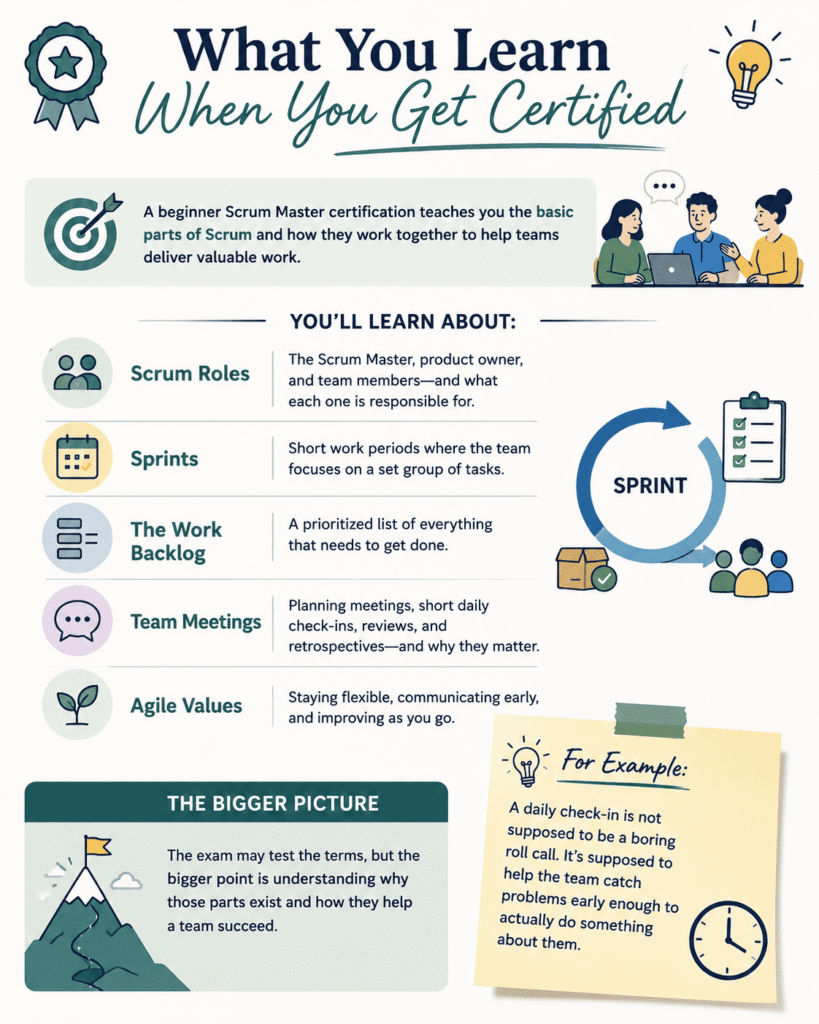
What You Learn When You Get Certified
A beginner Scrum Master certification teaches you the basic parts of Scrum.
You learn who does what, how the team plans work, what meetings are for, and how the team checks whether the process is actually helping.
That usually includes:
- Scrum roles: The Scrum Master, product owner, and team members.
- Sprints: Short work periods where the team focuses on a set group of tasks.
- The work backlog: A prioritized list of what needs to get done.
- Team meetings: Planning meetings, short daily check-ins, reviews, and retrospectives.
- Agile values: Staying flexible, communicating early, and improving as you go.
The exam may test the terms, but the bigger point is understanding why those parts exist.
For example, a daily check-in is not supposed to be a boring roll call. It is supposed to help the team catch problems early enough to actually do something about them.
Do You Have to Take a Course First?
It depends on the certification.
Some require a live class before you can take the exam. Others let you study on your own and take the test when you are ready.
A live course can be helpful if Scrum is completely new to you.
You can ask questions, hear examples, and get through the material without trying to figure out every term by yourself at midnight.
Self-study can be a better fit if you are good at teaching yourself and want a more flexible or lower-cost option.
The better question is not really “Which way is easier?”
It is “Which way will make me understand this well enough to actually use it?”
What Happens After You Get Certified?
Once you pass, you can add the certification to your resume and LinkedIn. It shows employers that you understand the Scrum framework, but it does not mean you are automatically an experienced Scrum Master or guaranteed a job.
The next step is building proof that you can use those ideas with real people and real problems. That can mean taking on team or project work where you already are, learning a task-management tool, or applying for coordinator and Agile support roles while you build toward a Scrum Master position.
My Final Thoughts
Scrum Master certification can be a smart first step if you like helping people, organizing moving parts, and figuring out why something keeps going wrong.
It is not a shortcut that replaces experience.
The stronger path is getting certified while you build real examples of working with teams, projects, workflows, or deadlines.
That way, you are not only saying, “I know Scrum.”
You can say, “Here is how I have already helped a team work better.”
Compare the best scrum master courses before you enroll in a certification program.
FAQs
Do I need a degree to become a Scrum Master?
No. Most Scrum Master roles do not require a specific degree, and many people move into the role from non-technical backgrounds.
Can I get Scrum Master certified with no experience?
Yes. Most beginner certifications do not require experience, but you will still need related team or project examples when applying for jobs.
Do Scrum Masters need to know how to code?
No. Scrum Masters do not need to code, although it can help to understand how a technical team works.
How long does Scrum Master certification take?
Some people finish a course in a few days, while self-study can take a few weeks depending on how much time you have.
Can I get a Scrum Master job right after certification?
You can apply, but many people first build experience in project support, coordination, operations, or another team-focused role.