A Scrum Master is not a career you get by passing one exam and hoping a company takes a chance on you.
It shares a lot with project management, but the job is more focused on helping a team work well rather than on owning every deadline, budget, and project decision.
Most people move into the role after working with teams, projects, products, or operations. You do not need a specific degree or a software development background.
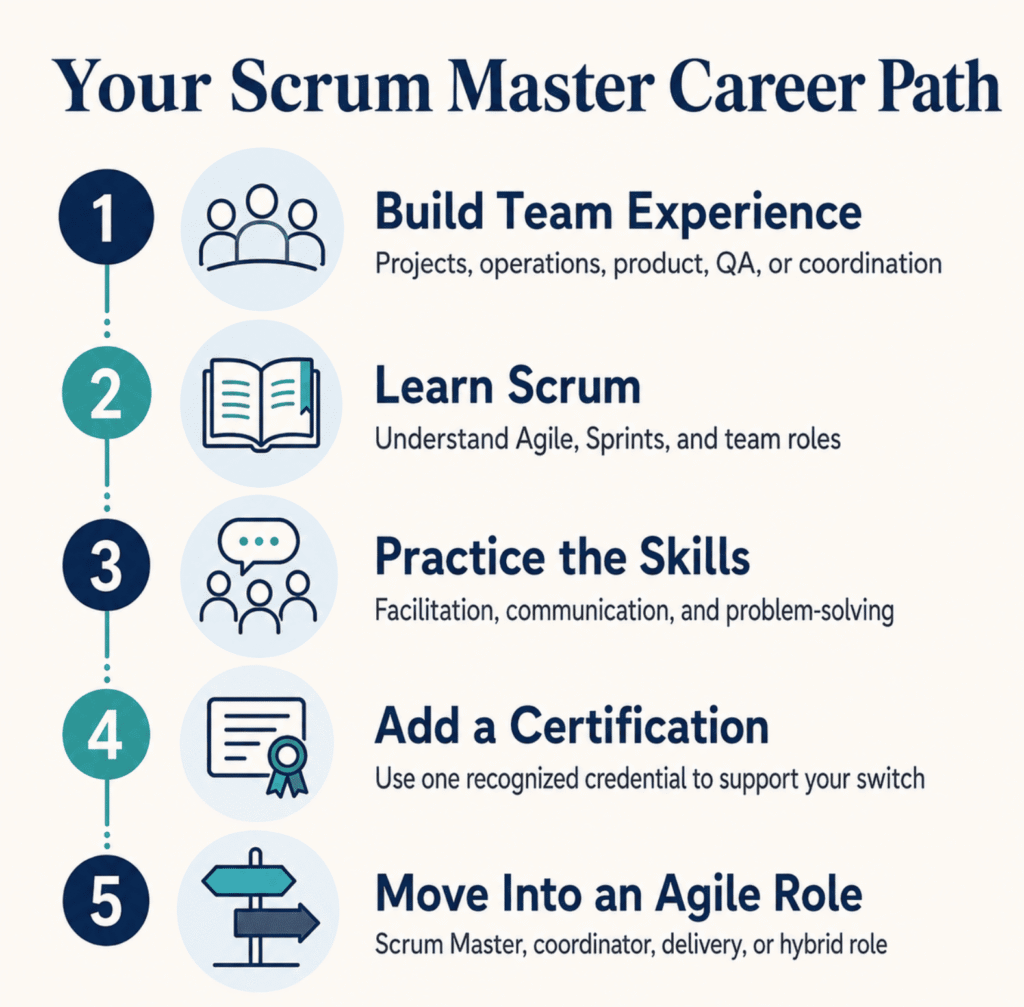
In this guide, I’ll walk through the actual path to becoming a Scrum Master, from building relevant experience to moving into your first role.
Key Takeaways
- There is no single required career path
- Team experience is the real foundation
- Scrum skills go beyond running meetings
- Certification supports the transition
- Related roles can lead to Scrum Master work
Start With a Team-Based Background
Most Scrum Masters do not begin their careers as Scrum Masters.
They often come from project coordination, business analysis, quality assurance, customer operations, product support, software development, or team leadership. These roles give them something important: experience working with people who have different priorities, deadlines, and problems.
You do not need to throw away your current background to make the switch. Instead, look at what already transfers.
| Current Background | Scrum Master Skills You May Already Have |
|---|---|
| Project coordinator | Planning, follow-up, scheduling, stakeholder updates |
| Business analyst | Gathering needs, clarifying work, finding gaps |
| QA or software | Working with product teams and handling changing work |
| Operations | Improving processes and fixing repeat problems |
| Customer success | Communication, conflict management, and problem-solving |
The goal is not to become an expert in every field. It is to build a history of helping teams get organized and work through issues.
Build the Skills Behind the Title
Scrum Masters need more than Agile vocabulary. The job depends heavily on how you work with people.
Start building these skills in your current role:
- Facilitation: Keep meetings useful without taking over
- Coaching: Help people think through a problem instead of answering everything for them
- Conflict management: Keep disagreement focused on the work, not the person
- Communication: Make priorities, blockers, and next steps clear
- Process improvement: Notice what keeps going wrong and help the team test a better way
For example, if your team keeps missing deadlines because work is unclear, help create a simpler way to track tasks and questions. If meetings turn into long status updates, try an agenda that gets people to decisions faster.
That is practical Scrum Master experience, even if the job title on your email signature says something else.
Learn Scrum Well Enough to Use It
Once you have the people side in mind, learn the Scrum framework itself.
You should understand:
- How a Sprint gives a team a short, focused work period
- How the Product Backlog helps organize upcoming work
- Why Sprint Planning, Daily Scrums, Reviews, and Retrospectives exist
- How the Product Owner, Developers, and Scrum Master work together
- How teams use feedback to adjust instead of following an outdated plan
Then watch how these ideas play out at work. Some teams say they use Scrum but only hold a daily meeting. Learning to spot the difference between real Scrum and random process habits will help you later.
Get Hands-On Agile Experience
The next step is using what you learn with an actual team.
Ask to help with a project that already has multiple people, moving parts, and regular deadlines. You might support a planning session, help organize a work board, take notes during a retrospective, or follow up on a blocker that affects several people.
Keep the work honest and small at first. You are not trying to force Scrum onto every group or pretend you are an Agile coach overnight.
Focus on outcomes you can explain later:
- Made work more visible: Set up a shared board so the team could see priorities and blockers.
- Improved a meeting: Added a clear goal and time limit so the group left with decisions.
- Helped solve a repeat issue: Brought the right people together to fix a handoff or communication problem.
- Tracked a process change: Checked whether the team’s new approach actually helped.
These examples are more useful than saying you “understand Agile.” They show that you can apply it.
Many candidates start with a prep course. Compare the best Scrum Master courses for live instruction, practice exams, and certification paths.
Use Certification as a Career Signal
Certification can support your experience, but it does not replace it.
A beginner Scrum certification can show employers that you understand the framework and have put time into learning it. Some options include live instruction, while others let you study independently before taking an assessment.
Choose one recognized certification that fits how you learn and the jobs you want to apply for. You do not need to collect several similar credentials. The bigger goal is being able to use Scrum well with a real team.
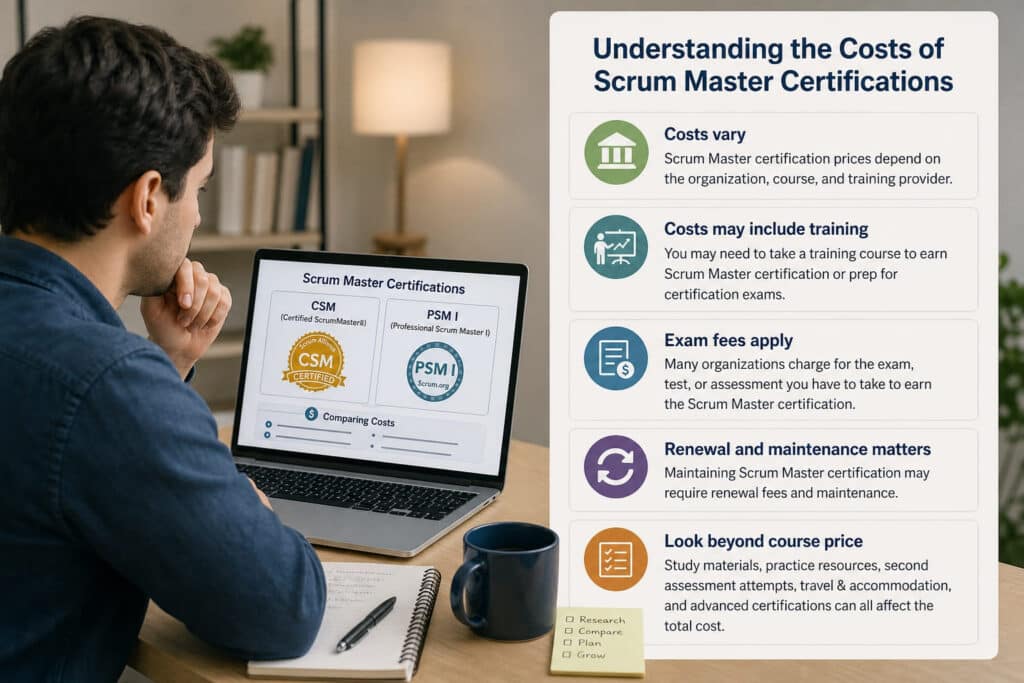
Budget matters here too, since Scrum Master certification costs range from a modest exam fee to a two-day live course plus renewals.
Turn Your Experience Into a Strong Application
When you start applying, make your resume about what changed because you were involved.
Generic lines like “excellent communicator” or “knowledge of Scrum” do not say much. Replace them with clear examples of teamwork and process improvement.
| Weak Resume Line | Better Resume Line |
|---|---|
| “Strong leadership skills” | “Facilitated weekly planning for a cross-functional project team” |
| “Experienced with Agile” | “Used a shared work board to track priorities, blockers, and next steps” |
| “Good problem-solver” | “Helped identify a recurring handoff issue and coordinate a new process” |
Do not make up numbers or claim a project used Scrum when it did not. A specific, truthful example is stronger than a pile of keywords.
Your first job search should include Scrum Master roles, but also Agile coordinator, delivery coordinator, iteration manager, project coordinator, and business analyst jobs. Many people move into Scrum Master work through one of those roles.
Moving Into Your First Scrum Master Role
Your first Scrum Master job may be a hybrid position, especially at a smaller company. You might handle team coordination, delivery updates, and Scrum support at the same time.
That is not a bad thing. It gives you the chance to practice facilitation, stakeholder communication, backlog discussions, and process improvement with a real team.
In interviews, expect questions about situations, not just definitions. Prepare a few short stories about times you helped a group solve a problem, handle conflict, adapt to a change, or improve a messy process.
A good answer shows that you can listen, make the issue clear, bring the right people into the conversation, and help the team decide what to do next.
My Final Thoughts
Becoming a Scrum Master is a career transition, not a one-day certification purchase.
Build on the team experience you already have. Learn Scrum, practice the skills in real situations, and use a certification to make your knowledge easier for employers to recognize. That is how you become someone who can actually do the job, not just someone who has heard the terms before.
FAQs
Do you need a degree to become a Scrum Master?
No specific degree is required. Employers often care more about team experience, Agile knowledge, communication skills, and problem-solving.
Can you become a Scrum Master without working in tech?
Yes. Scrum is common in software, but Scrum Masters also come from operations, project coordination, business analysis, quality assurance, and customer-facing roles.
Is a Scrum Master certification required?
Not always. Some employers ask for CSM, PSM I, or a similar credential, while others focus more on relevant experience.
How do I get Scrum experience if I have never had the title?
Look for ways to support planning, meeting facilitation, work tracking, process improvement, and team communication in your current role or a related project.
What is the best first job before becoming a Scrum Master?
Project coordinator, Agile coordinator, business analyst, QA, delivery coordinator, and product operations roles can all build relevant experience.