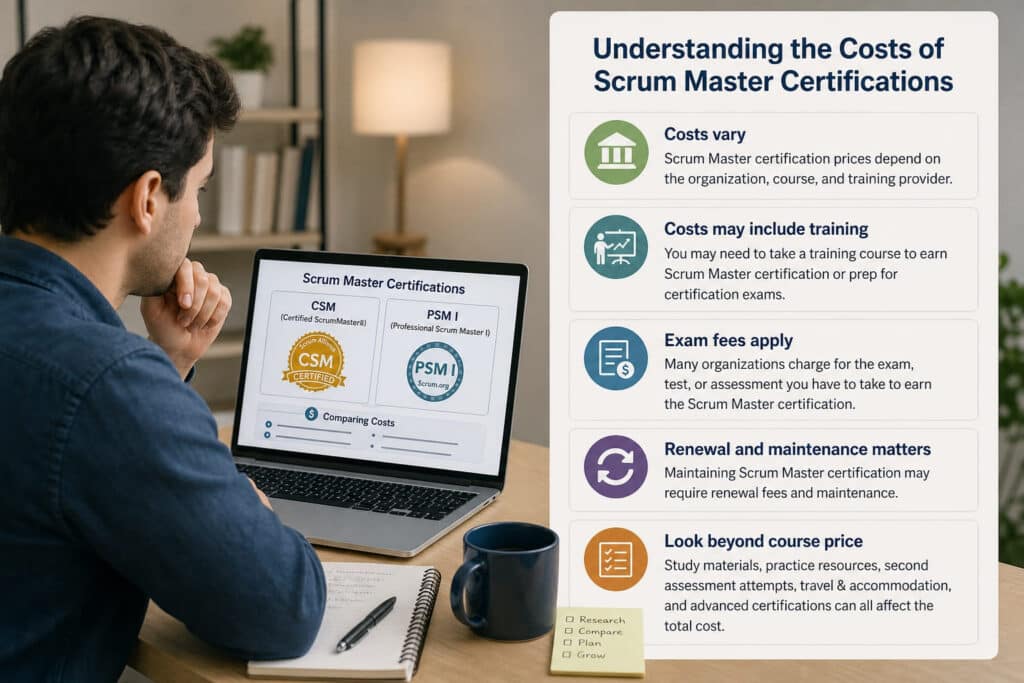
A 2023 report from the Business Agility Institute and Scrum Alliance found that 55% of organizations said they would pay higher salaries to people in agile roles who hold relevant certifications. So, many consider getting a product owner, Scrum, or Agile certification as an essential step on the path.
The path into product ownership isn’t exactly the same for everyone. You can build useful skills through your current job, learn Scrum, or gain hands-on experience.
Let’s look at what it takes.
Key Takeaways
- Learn Scrum: Start with the official Scrum Guide and understand the product owner’s accountability.
- Build People Skills: Communication, empathy, collaboration, and decision-making are all vital skills when it comes to product owner roles.
- Gain Practical Experience: Look for product-related tasks you can take on in your current role.
- Consider Certification: You can get certified to increase your chances of landing a product owner role.
- Keep Learning: Your product owner skills will grow through real product work, feedback, and continued study.
What Does a Product Owner Do?
In Scrum, the product owner is accountable for maximizing the value of the product created by the Scrum team. The role also includes managing the product backlog. Think of the product backlog as the team’s to-do list for the product. The product owner helps decide what belongs on that list and what should come first.
According to the Scrum Guide, product backlog management includes:
- Developing and communicating the product goal
- Creating and communicating product backlog items
- Ordering product backlog items
- Making sure the backlog is visible and understood
The product owner can delegate some of this work, but they remain accountable for it. They’re also one person, rather than a committee.
In simple terms, the product owner helps the team answer a key question: What should we work on next, and why?
Learn How Scrum Works
Your first step should be learning the basics of Scrum and Agile. You don’t need to memorize a giant textbook. Start with the official Scrum Guide and Agile Manifesto to learn how the framework works. They’re free to access and read online or print out to read.
The current official Scrum Guide is the November 2020 version. The current Agile Manifesto was created in February 2001.
Pay close attention to:
- Scrum/agile roles and accountabilities
- Sprints
- Product backlog management
- The Product Goal
- Sprint Reviews
- How the Scrum team works together
I recommend starting with the Scrum Guide before paying for a course. It gives you a solid foundation and helps you decide whether product ownership actually interests you.
Build Product Owner Skills
Learning Scrum and Agile is important, but knowing the framework doesn’t automatically make someone a good product owner. A big part of the job is working with people, making tough calls, and keeping everyone focused on what matters most.
Communication
You’ll spend a lot of time talking to different people who don’t always want the same thing. You might need to turn customer feedback into something developers can actually use, or explain to a manager why their requested feature isn’t the priority right now.
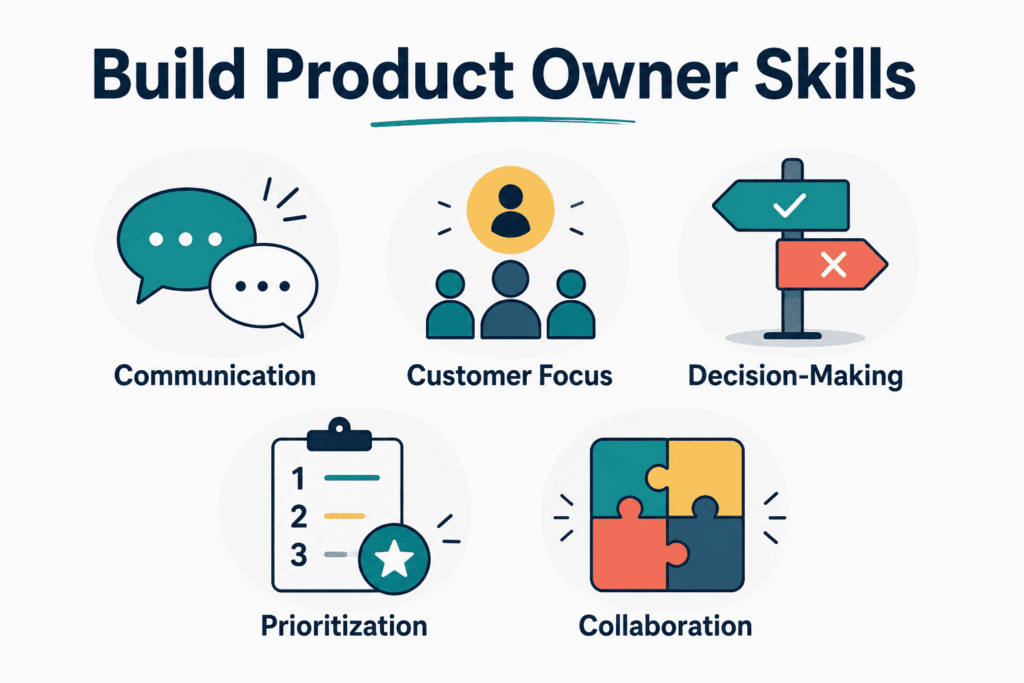
Customer Focus
It’s easy to get caught up in features and deadlines. A product owner has to keep bringing the conversation back to the customer: What problem are we actually trying to solve? Sometimes that means saying no to a good idea because it isn’t what customers need most.
Decision-Making
You probably won’t have enough time, money, or people to do everything everyone wants. Product owners have to make decisions anyway. You’ll weigh the options, consider the trade-offs, and choose a direction, even when there isn’t one obviously “right” answer.
Prioritization
Imagine having 30 things people want added to a product and enough time to work on five. That’s where prioritization comes in. You’ll help decide what needs attention now, what can wait, and what may not need to happen at all.
Collaboration
You’re not sitting somewhere making product decisions by yourself. You’ll work with developers, customers, managers, designers, and other stakeholders. Being able to listen, take feedback, explain your reasoning, and adjust when things change is just as important as understanding Scrum.
Gain Experience in Your Current Role
You don’t necessarily have to land a product owner job before you can start building relevant experience. Look at your current role and find opportunities to practice product owner skills.
For example, you might:
- Help gather customer feedback
- Work with a development or project team
- Help decide which tasks should come first
- Write clear requirements
- Join product planning meetings
- Talk with customers about their needs
- Help test or improve a product
Someone working in customer service, business analysis, project management, marketing, or another field may already have useful product management skills. You don’t need to throw away your current career and start from zero. In many cases, you can build on what you already know.
Consider a Product Owner Certification
A certification can give you structured training and a way to show that you understand product ownership. Our Product Owner certification guide compares CSPO, PSPO, and SAFe POPM.
Scrum Alliance Product Owner Path
One option is the Certified Scrum Product Owner (CSPO) certification track from Scrum Alliance. There are no prerequisites for joining the foundational CSPO course. Scrum Alliance also says prior Scrum, Agile, software development, or college experience isn’t required to attend its CSPO course.
You don’t need to take an assessment or test to earn certification. Instead, earning the CSPO requires completing a 16-hour training course taught by a Certified Scrum Trainer. However, for the CSPO, the lessons are taught live online or in person only. Upon completing the course, you earn a CSPO certification badge.
To maintain your CSPO badge, you need to renew your certification every two years, pay the fee, and submit 20 Scrum Education Units (SEUs). You can also study further with the Advanced Certified Scrum Product Owner (A-CSPO®) and Certified Scrum Professional® Product Owner (CSP-PO) certifications. They are also test-free training courses that require maintenance to renew, but are available in a self-paced format, not just live online/in-person.
Choosing A Product Owner Certification Course
When choosing a course or certification, don’t look only at the certificate. Check what you’ll actually learn and how the training or preparation fits your learning style and role.
Live and in-person training offers the benefits of instructor support and hands-on experience. However, fitting scheduled lessons into a busy schedule may be difficult. In contrast, self-paced training may offer more flexibility. But it might not include as much guidance.
The way you qualify also affects your costs and certification path. A test may be daunting, while only training without an assessment may not push you to learn and memorize all concepts. Fees are another consideration, with full training courses and exam fees adding up to a few hundred or even thousands of dollars. Never mind renewal fees.
Look for Entry-Level Opportunities
Once you’ve built your knowledge and got a certification and/or some practical experience, start looking for roles where you can use those skills.
Product owner job titles vary between companies. You might see positions such as:
- Associate Product Owner
- Junior Product Owner
- Product Owner
- Business Analyst
- Product Manager
These roles aren’t all the same. A product manager and product owner, for example, can have different responsibilities depending on the company.
Read job descriptions carefully. Look for positions that let you work with customers, stakeholders, product teams, or backlogs.
You can also talk to people already working in product roles. Ask how they got started and what they wish they’d known earlier. Sometimes one useful conversation can save you hours of wandering around the internet.
Keep Developing Your Skills
Getting your first product owner role isn’t the finish line. It’s the beginning.
As you gain experience as a product owner, you’ll learn how to handle competing requests, unclear customer needs, changing priorities, and difficult trade-offs. Those lessons are hard to learn from a course alone.
You can also keep developing through:
- Product, Agile, and Scrum training
- Reading product management resources
- Working with experienced product owners
- Asking for feedback
- Studying customer behavior
- Practicing prioritization and product decisions
Final Thoughts
Becoming a product owner doesn’t require one specific degree or career path. You can come from a technical, business, customer-facing, or other professional background.
If you’re serious about the role, start by learning Scrum and understanding the product owner’s responsibilities. Then build practical skills, look for ways to gain experience, and consider certification if structured training would help you.
Most importantly, don’t wait until you feel like you know everything. Product ownership involves learning, listening, making decisions, and adapting as you go. That’s part of the job.
If you want adjacent Scrum training next, compare our best Scrum Master courses.
FAQs
Do I need a degree to become a product owner?
No. Scrum Alliance says a college or university degree isn’t required for its foundational CSPO course. However, the majority of product owners did have at least a bachelor’s or associate degree, usually in business or computer science. Bachelor’s degree holders also earned more.
Do I need to be a developer to become a product owner?
No. Product ownership involves product value, customer needs, prioritization, communication, and backlog management. A technical background can be useful, but it isn’t necessarily a requirement for the product owner role.
Do I need Scrum experience before becoming a product owner?
Not necessarily. Scrum Alliance says its foundational CSPO course doesn’t require prior Scrum, Agile, or software development experience. Instead, it acts as your introduction to product ownership, Scrum, and agile methodologies.
Is a product owner certification required?
No certification is required by the Scrum Guide to be a product owner. However, training or certification can help you learn the role and demonstrate your knowledge. It can also help you land your dream product ownership role and get paid more for it.
How long does it take to become a product owner?
There’s no single timeline. Your product ownership path depends on your current skills, experience, training, and opportunities to work with products or Scrum teams. However, getting certified can take a week, while changing to a product ownership role can take a matter of months.