At first glance, a Certified Scrum Developer might seem like someone who spends all day coding, right?
Not exactly.
In Scrum, Developers help turn planned work into a usable product during each Sprint. One may code, while another tests, designs, manages data, or builds hardware.
The Certified Scrum Developer credential shows that you completed formal training in Scrum and agile product development.
Key Takeaways
- The Role Goes Beyond Coding: CSDs may code, test, design, or work with data and hardware.
- CSD Is a Professional Certification: It is not a required job license.
- It Connects Scrum and Technical Work: Training applies Scrum to real product development.
- There Are No Formal Prerequisites: No degree, experience, or prior certification is required.
- It Fits Scrum-Based Careers: CSD is most useful for people working on Scrum or agile teams.
What Is a Certified Scrum Developer?
A Certified Scrum Developer (CSD) has earned Scrum Alliance’s foundational developer certification. The training covers Scrum teamwork and development practices such as design, refactoring, test-driven development, and delivering products in smaller stages.
Basically, the certification shows that someone understands how their work fits into a Scrum team and helps move a product forward during each Sprint.
What Does a Certified Scrum Developer Do?
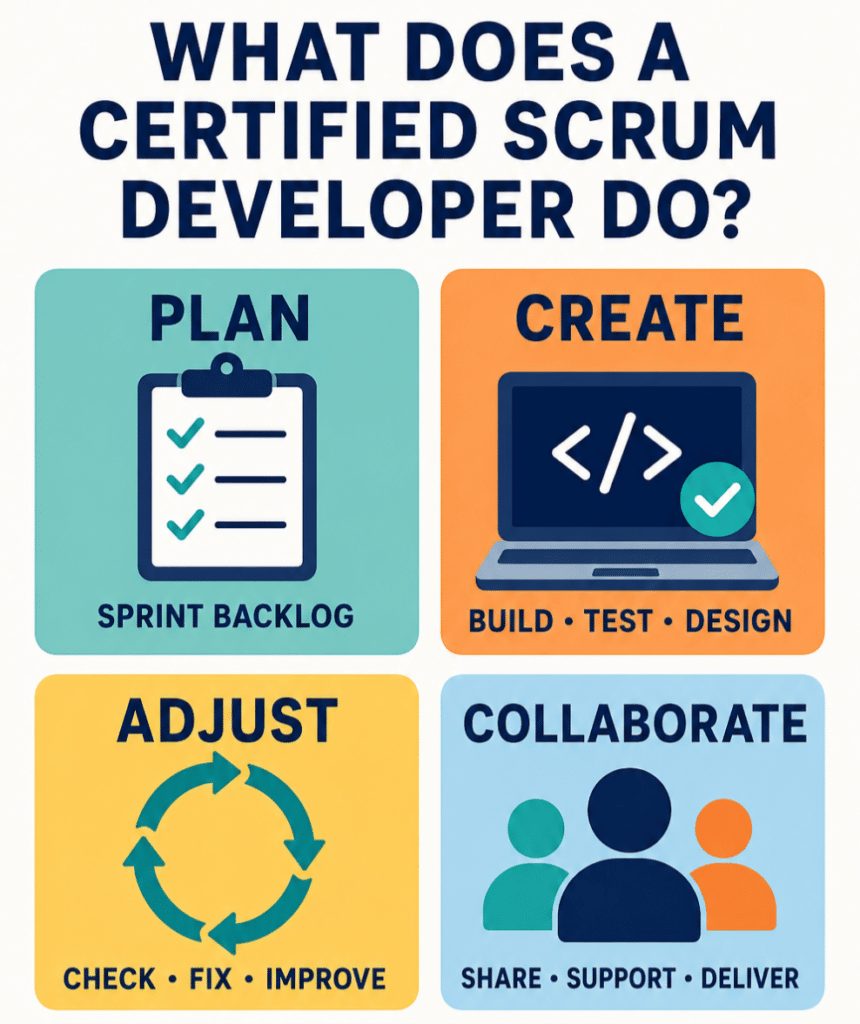
The day-to-day work depends on the person’s specialty. However, all Scrum Developers share the same main responsibilities:
Plan the Sprint:
Create the Sprint Backlog and decide how the work will get done.
Create Quality Work:
Build, test, design, research, or improve the product while following the Definition of Done.
Adjust the Plan:
Check progress each day and make changes when problems come up.
Work as a Team:
Communicate with teammates and hold one another accountable.
For example, a restaurant app team may spend a Sprint adding online ordering. A Scrum Developer could build and test the checkout page, then fix any errors the team finds. When the Sprint ends, customers can use the app to place their orders.
Scrum Developer Specialties and Job Options
Scrum does not officially divide Developers into separate job types. In the workplace, though, a CSD may have one of several specialties:
| Common Job | What They Do |
|---|---|
| Front-End Developer | Builds the things on a website or app that users can see |
| Back-End or Full-Stack Developer | Builds features, databases, and behind-the-scenes systems |
| Mobile App Developer | Creates and improves apps for phones and tablets |
| QA or Test Automation Engineer | Finds problems and creates tests that protect quality |
| DevOps or Platform Engineer | Manages builds, releases, cloud systems, and automated delivery |
| UX or Product Designer | Researches user needs and designs clear experiences |
| Data Specialist | Builds data pipelines, reports, models, or data-based features |
| Hardware or Embedded Developer | Creates physical products, firmware, or connected devices |
The exact mix depends on what the team is building. A medical device team and a shopping app team will need different skills, even if both use Scrum.
How to Become a Certified Scrum Developer
Good news: the CSD path is not very long. The one catch is that you must complete approved training.
Follow These Steps
- Build Your Main Skill: Learn programming, testing, DevOps, design, hardware, or another product specialty.
- Review Scrum Basics: Learn its accountabilities, events, artifacts, and commitments.
- Choose Approved Training: Find a live online or in-person class led by an approved CSD Trainer.
- Complete the Course and Assessment: Your trainer may use an exam, classroom activity, or both.
- Accept the CSD License: Finish the steps in your Scrum Alliance account.
For a closer look at the process, read my complete guide on how to become a Scrum Master.
Scrum Developer Certification Levels
| Certification | Level and Main Requirements |
|---|---|
| CSD | Foundational; approved course and assessment, with no formal prerequisite |
| A-CSD | Advanced; CSD or an accepted PSM I/II alternative, plus at least 12 months of relevant experience within the past five years |
| CSP-D | Professional; A-CSD plus at least 24 months of relevant experience within the past five years |
Pros and Cons of CSD Certification
Like most certifications, CSD has real benefits, but it also has limits.
Pros
- Provides hands-on Scrum training
- Teaches a shared language for agile teams
- Connects Scrum to product development
- Can strengthen a résumé for Scrum-based workplaces
- Starts the path toward A-CSD and CSP-D
Cons
- Course prices vary and can be expensive
- The credential must be renewed every two years
- Does not use a universal assessment
If your employer will pay for the course, the choice becomes much easier. If you are paying yourself, compare the training with what employers in your field actually request.
Is Certified Scrum Developer Worth It?
The short answer? It depends on where you are in your career.
In general, I think CSD may be worth it if you:
- Already have a technical or product skill
- Work on a Scrum team or plan to join one
- See Scrum or agile in the jobs you want
- Want to continue to A-CSD or CSP-D
- Can use employer reimbursement
I would wait if you still need the basic skills for your target job. A future software developer usually gets more value from learning to code and building projects first. It makes the most sense when it builds on skills you already have.
Related Guide
CSD sits on the same Scrum framework as the Scrum Master path, so the best Scrum Master courses comparison shows which training styles, hours, and prices actually prepare you to work on a Scrum team.
Final Thoughts
Certified Scrum Developers can have very different jobs, but they all help move a product from an idea to something the team can actually use or release. Some write code, while others test, design, work with data, or handle hardware.
A Certified Scrum Developer understands how Sprints work, how the team plans and adjusts its work, and how each person helps complete the final product.
FAQs
Is a Scrum Developer the Same as a Software Developer?
Not always. A software developer can serve as a Scrum Developer, but Scrum also uses the term for other people who help create the product Increment.
Is a Certified Scrum Developer the Same as a Scrum Master?
No. Developers create the product Increment, while the Scrum Master helps the team understand Scrum and improve its effectiveness.
Do I Need Coding Experience for CSD?
Scrum Alliance lists no formal prerequisites. However, many CSD courses are made for product or software developers and may expect basic technical knowledge.
Does CSD Have an Exam?
It has a trainer-led assessment, but there is no single universal exam. Your trainer may use a test, practical activity, classwork, or a combination.
How Long Does CSD Training Take?
The current Scrum Alliance CSD page requires at least 14 hours of approved training. Some of its other pages and individual course listings show 16 hours or more, so check the exact class before registering.
Does CSD Certification Expire?
Yes. CSD follows a two-year renewal cycle and currently requires 20 SEUs plus the foundational renewal fee.
Can CSD Certification Get Me a Job?
It can make your Scrum knowledge easier to show, but it cannot qualify you by itself. Employers still care most about the technical skills, experience, and work samples needed for the job.