Product owners can earn strong salaries, but figuring out what the role actually pays is not always simple.
Product owners who advance from junior to lead-level roles can increase their base salary by more than 80%, showing just how much experience and responsibility can affect earning potential. Product ownership can also be a satisfying career, with product owners reporting an average job satisfaction rating of 3.61 out of 5.
That is a wide range for one job title. Here is a breakdown of the typical Product Owner Salary by experience, location, responsibilities, and employment type, along with what can help you move into a higher salary range.
Key Takeaways
- The Typical Salary Is Around $115,000: Most U.S. product owner offers fall between $95,000 and $155,000.
- Experience Makes a Major Difference: Junior product owners may start around $80,000, while lead-level professionals can earn as much as $195,000 in base pay.
- Responsibilities Matter More Than Titles: Product owners who control strategy and outcomes generally earn more than those who mainly manage a backlog.
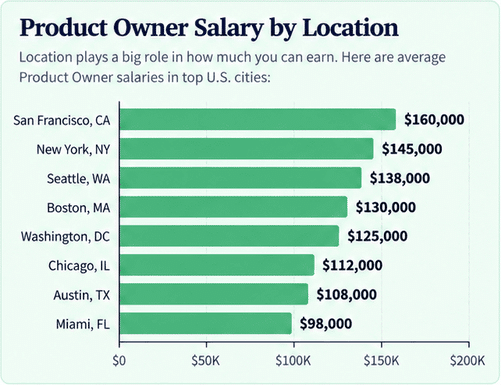
- Location Still Affects Pay: San Francisco, New York City, and Seattle offer some of the highest average salaries.
- Specialized Skills Can Increase Earnings: Technical, compliance, data, machine-learning, and scaled-agile experience may lead to higher-paying roles.
What Does a Product Owner Actually Do?
A product owner helps an agile team decide what to build and in what order. They represent customer and business needs while keeping the development team focused on the most valuable work.
Common responsibilities include managing the backlog, refining user stories, setting acceptance criteria, communicating with stakeholders, reviewing completed work, and helping shape the roadmap.
Some product owners turn a product manager’s roadmap into work for one development team. Others create the roadmap, coordinate teams, defend decisions to executives, and own business results. That difference is one reason salary estimates vary so much.
Average Product Owner Salary
Salary surveys put a national base near $115,000, with most real offers ranging from $95,000 to $155,000. The BLS project management outlook is a useful check on related pay bands.
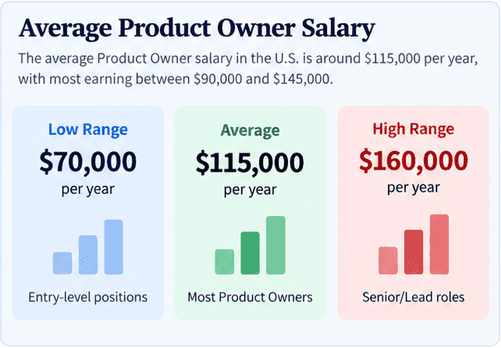
Built In also reports average additional cash compensation of $12,699, bringing average total compensation to approximately $121,100.
Treat these figures as reference points instead of one guaranteed salary. Each source collects information from a different group, and a junior employee who maintains a backlog may appear in the same category as a lead who controls product decisions.
Product Owner Salary by Experience Level
Experience is a clear predictor of pay, but employers also look at what you have owned, shipped, and decided independently.
Associate or Junior Product Owner
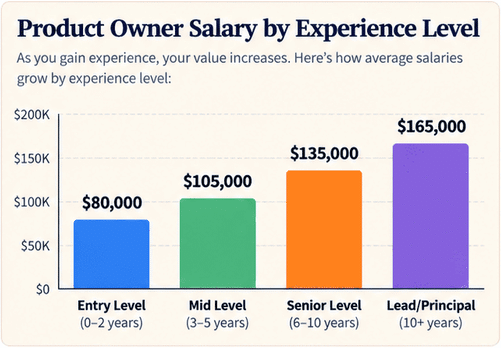
Product owners with zero to two years of experience typically earn between $80,000 and $105,000.
At this level, you may refine stories, help run backlog grooming sessions, update project boards, and learn to prioritize requests under a more senior professional. Related experience as a business analyst, quality assurance professional, or project coordinator may help you reach the higher end of the junior range.
Mid-Level Product Owner
With three to five years of experience, the typical salary range rises to $105,000 to $130,000.
Mid-level product owners usually manage one team’s backlog from beginning to end. Employers want evidence that you can keep a team moving, handle competing requests, and make practical prioritization decisions.
Senior Product Owner
Senior product owners with roughly five to eight years of experience can earn between $125,000 and $160,000.
Senior professionals are paid for judgment. They may own an entire product area, influence the roadmap, mentor team members, and negotiate trade-offs with executives. Employers want someone who can question whether the team is solving the right problem, not just organize assigned work.
Lead or Principal Product Owner
At eight or more years of experience, base salaries may range from $150,000 to $195,000.
Lead product owners may coordinate several teams, support scaled-agile programs, manage portfolio decisions, or overlap with product management. Total compensation can exceed $200,000 when bonuses or equity are included.
How Location Affects Product Owner Pay
Remote work has made product owner jobs less dependent on location, but geography still affects salary.
Remote product owners can still earn competitive pay. The provided Built In figure places the average remote Product Owner Salary near $127,600, higher than several on-site metro estimates. However, some employers adjust salaries to an employee’s location, while others use a national range.
What Factors Increase a Product Owner Salary?
Years of experience help, but the highest-paying jobs usually require a combination of scope, specialized knowledge, and proven results.
Greater Decision-Making Authority
A product owner who receives priorities from a manager generally earns less than someone who decides what the roadmap should include. Owning outcomes and making decisions that affect revenue or customer retention can move a role into a higher band.
Technical or Industry Expertise
Specialized product owners can command a premium because fewer candidates have the right background. Valuable areas include platforms, APIs, data, machine learning, fintech, healthcare technology, HIPAA, SOC 2, and other regulated products. Employers still want proof that you can understand technical trade-offs or guide work in that domain.
Managing Multiple Teams
Product owners who coordinate several teams or work within SAFe or LeSS environments often earn near the top of the senior or lead range because they must synchronize backlogs and translate portfolio strategy into coordinated work.
Bonuses and Equity
Base pay makes up most compensation for junior and mid-level product owners. Senior packages may include equity and target bonuses of 8% to 15%, sometimes more when the role directly affects revenue.
Do Product Owner Certifications Increase Salary?
Credentials such as CSPO, PSPO, or SAFe Product Owner/Product Manager can strengthen a resume and help with initial screening. However, certification usually creates only a modest increase by itself. Employers care more about products you have shipped, priorities you have defended, and results your decisions produced.
Full-Time vs. Contract Product Owner Pay
Independent product owners generally charge between $65 and $130 per hour, depending on experience and specialization. The provided ZipRecruiter contract figure centers around $54 per hour when junior workers are included.
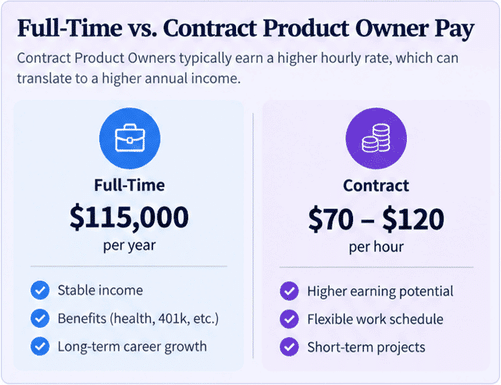
Billing $85 per hour for 45 working weeks produces approximately $153,000 in gross income. However, after self-employment taxes, health insurance, unpaid leave, retirement contributions, and gaps between assignments, it may feel closer to a $105,000 to $115,000 salaried position with benefits.
Contract work can be valuable for specialists charging $120 or more per hour. Full-time employment provides more predictable income, benefits, and long-term ownership.
How To Earn More as a Product Owner
If you want to move into a higher salary range, focus on expanding what you can confidently own.
Track improvements in revenue, adoption, retention, delivery time, product usage, or team efficiency. Build useful expertise in areas such as compliance, fintech, healthcare, data, or machine learning. You should also strengthen your ability to explain trade-offs and align stakeholders. Higher salaries usually go to people who connect backlog decisions to customer problems and business goals.
Related Guide
If you are using a credential to push pay, the product owner certification guide shows which designations hiring managers screen for and which ones rarely move the offer.
Final Verdict
A product owner can build a well-paying career, with typical U.S. base pay around $115,000 and a range from approximately $80,000 for junior roles to $195,000 for lead positions. The title does not determine the paycheck by itself.
Your Product Owner Salary will depend on your experience, location, industry knowledge, technical ability, decision-making authority, and the number of teams or outcomes you manage.
Showing that your decisions create measurable value gives you a stronger case for reaching senior or lead salary ranges.
FAQs
What is the average Product Owner Salary in 2026?
The provided data places the national base near $115,000, with most offers between $95,000 and $155,000. Individual salary sources report averages ranging from about $102,494 to $141,889.
How much does an entry-level product owner make?
Associate and junior product owners with zero to two years of experience generally earn between $80,000 and $105,000.
Can a product owner make more than $150,000?
Yes. Senior product owners may earn as much as $160,000, while lead or principal product owners can earn between $150,000 and $195,000 in base pay. Total compensation may exceed $200,000 in some organizations.
Do product owner certifications lead to higher pay?
Certifications such as CSPO, PSPO, and SAFe POPM can help with resume screening and may support a modest increase. However, practical experience, product results, and decision-making ability usually have a greater effect on salary.
Are remote product owner jobs paid less?
Not necessarily. The provided data places average remote product owner pay near $127,600, although individual employers may adjust salaries based on an employee’s location.