You search “Product Owner certification” expecting one clear answer.
Then Google hands you a bunch of random letters like CSPO, PSPO, and SAFe POPM, with absolutely no explanation of what they mean and which one you actually need.
A Product Owner certification teaches you how teams decide what gets built and what can wait. It can also help you break into product work.
But no, you do not automatically need one, and picking the wrong credential will not help much.
In this guide, I’ll explain what Product Owner certification actually proves, who it helps, and how to choose the right credential for your career. Let’s clear this up.
Key Takeaways
- Not a Must But a Benefit: Product Owner certification is optional for most jobs.
- Things Vary: Different credentials follow different training and testing formats.
- Career Changers Have Weight: Career changers may benefit more than experienced Product Owners.
- Resume Booster: Certification supports your résumé but cannot replace real experience.
- Job Options Matter: Your target employers should influence which credential you choose.
Understanding the Basics of a Product Owner Certification
A Product Owner certification shows that you understand how products are managed within Scrum or another Agile framework.
The role centers on helping the product deliver the best possible results for customers and the business. Under the official Scrum Guide, this also includes setting the Product Goal and managing the Product Backlog effectively.
In normal workplace terms, that can mean:
- Deciding which features should come first
- Turning customer needs into clear work for developers
- Explaining why one request matters more than another
- Adjusting priorities when feedback or business goals change
- Keeping stakeholders focused on the same product direction
- Saying no to ideas that do not support the goal
A certification teaches the framework behind those decisions. It may cover Scrum principles, product vision, backlog management, stakeholder communication, customer value, and prioritization. It does not give you ownership of an actual product. That part comes from the job.
Who Is Product Owner Certification For?
Product Owner certification makes the most sense when you are:
- Trying to break into product
- Applying for junior Product Owner roles
- Moving from business analysis or project management
- Joining a team that uses Scrum or SAFe
- Seeing the same credential across job listings
It can turn experience with customers, developers, requirements, and project priorities into product skills employers recognize.
The certification is helpful, but it cannot carry your entire application. You still need examples showing that you can handle competing requests, understand what customers need, and decide what should get built first.
Which Product Owner Certification Should You Choose?
Three organizations offer some of the most widely recognized Product Owner credentials. Compare the learning format, exam, cost, and workplace framework before deciding.
| Certification | Training/Exam | Cost/Renewal | Best Fit |
|---|---|---|---|
| CSPO | Required 16-hour live course; no exam | Price varies; $100 and 20 SEUs every two years | Beginners wanting an instructor and guided activities |
| PSPO I | Optional training; 80 questions; 60 minutes; 85% passing score | $200 per attempt; no renewal | Independent learners wanting an exam-based credential |
| SAFe POPM | Required course; 45 questions; 90 minutes; 82% passing score | Course price varies; annual renewal | Employees at larger organizations using SAFe |
How Do You Get Product Owner Certified?
Do not pick whichever acronym looks best beside your name. Start with the jobs you actually want.
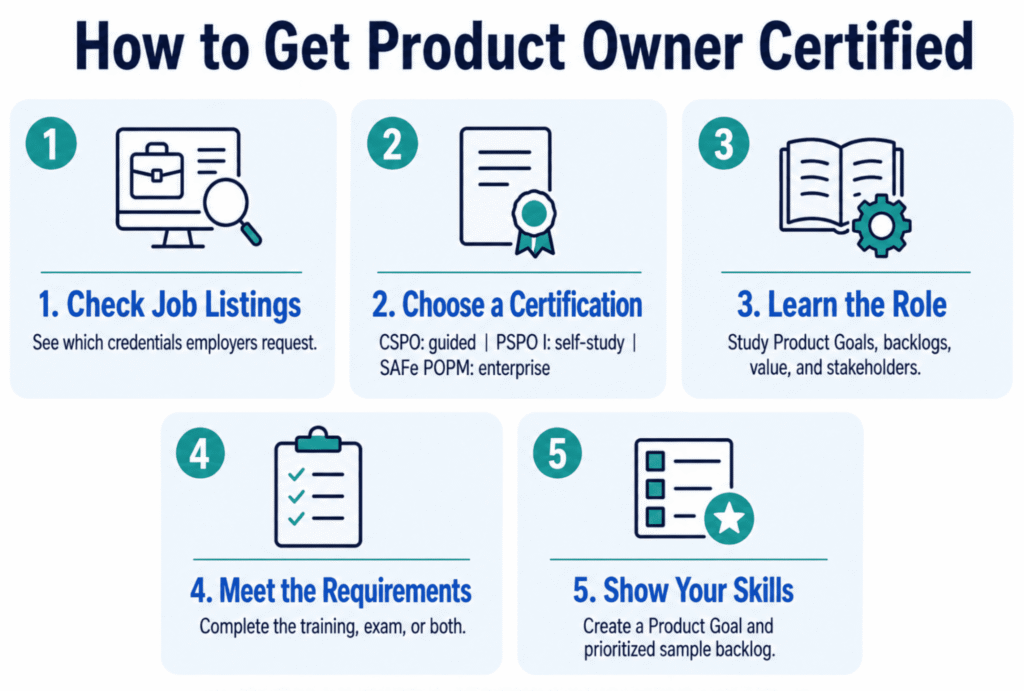
- Search relevant openings. Note whether employers mention CSPO, PSPO, SAFe, or only general Scrum experience.
- Choose your learning format. CSPO provides guided instruction. PSPO I allows independent study. SAFe POPM connects directly to enterprise SAFe training.
- Learn the role, not just the vocabulary. Study Product Goals, backlog ordering, customer value, stakeholder decisions, and how Scrum accountabilities work together.
- Complete the requirement. Attend the approved training, pass the exam, or complete both, depending on the credential.
- Create evidence of your skills. Build a sample backlog, write a Product Goal, prioritize competing features, or analyze how you would improve an existing product.
That final step matters during interviews. A badge shows that you studied the framework. A solid example shows that you can think like a Product Owner.
Is Product Owner Certification Worth It?
Product Owner certification is usually worth it when you are changing careers, lack formal product experience, or regularly see a specific credential in job listings. It gives you a structured way to learn the role and something recognizable to add to your résumé.
It may not be worth the cost if you already have strong Product Owner experience or your target employers do not care about certification. Check actual job listings before paying. The credential should support your next move, not become an expensive badge with no clear purpose.
What Can Product Owner Certification Do for Your Career?
A certification can give your career a real push, but it is not going to magically turn one course into years of product experience. For the full role path, see how to become a product owner.
| What It Can Do | What It Cannot Do |
|---|---|
| Help you pass résumé filters | Guarantee you a Product Owner job |
| Support a move into product work | Replace hands-on product experience |
| Strengthen your case for higher-paying roles | Guarantee a specific salary or immediate raise |
| Help with an internal promotion | Prove you can make difficult product decisions |
| Give you useful Scrum vocabulary | Teach every tool used by every company |
| Build confidence before interviews | Automatically qualify you for senior roles |
Use the credential to get your foot in the door. Once you are there, employers will care more about how you handle customers, priorities, feedback, and competing requests.
Final Thoughts
Product ownership is basically making the call when five people want five different things. A certification will not magically give you perfect judgment, but it can show you how teams make those decisions without everything becoming a mess.
Pick the credential that fits where you want to work, then actually use it. Build a sample backlog, rethink an app you use, or solve a customer problem. That effort is what makes the badge feel valuable instead of random.
If your team runs Scrum, our how-to guide to becoming a Scrum Master maps the parallel path.
FAQs
Is Product Owner certification required?
No. Companies can hire Product Owners without certification. However, some employers prefer or request CSPO, PSPO, or SAFe credentials.
Which Product Owner certification is best for beginners?
CSPO works well if you want instructor-led training. PSPO I may be better if you prefer self-study and feel comfortable preparing for a difficult exam.
Can you become a Product Owner without experience?
Yes, especially when you have related experience in business analysis, project management, software development, marketing, customer research, or operations. You still need to show how those skills transfer to product decisions.
How long does Product Owner certification take?
CSPO requires a 16-hour course. PSPO I has no required training period, so preparation could take several days or weeks. SAFe POPM requires instructor-led training, with the exact schedule depending on the provider.
Does Product Owner certification expire?
PSPO I does not expire. CSPO requires renewal every two years, while SAFe certifications follow an annual renewal cycle.