The SIE exam covers a little bit of everything.
You have investment products, market rules, customer accounts, prohibited activities, and enough industry terms to make your notes look like another language. It can feel heavy at first, especially if finance is completely new to you.
Still, you do not need to memorize an entire textbook or study every free hour you have. You need the right resources, a plan you can follow, and enough practice to catch weak areas early.
Today, I’ll walk you through how to prepare, what deserves the most attention, and how to know when you are actually ready.
Key Takeaways
- Start With the Outline: Know exactly what you will be tested on.
- Choose Complete Prep: Your course should teach, test, and track your progress.
- Study by Exam Weight: Bigger sections deserve more of your time.
- Review Every Mistake: Wrong answers show what still needs work.
- Practice the Real Format: Take a full timed exam before test day.
Understand What You Need to Pass
The SIE has 85 multiple-choice questions, but only 75 count toward your score. The other 10 are unscored pretest questions mixed throughout the exam.
You need a score of 70 to pass, with 1 hour and 45 minutes to complete it.
Here is how the scored questions are divided:
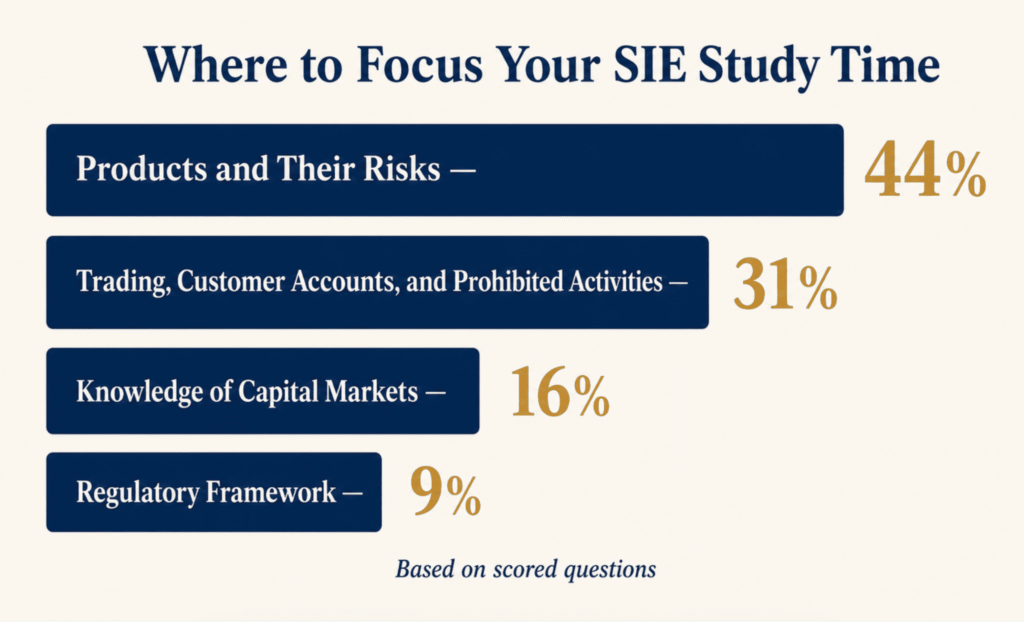
- Products and Their Risks: 33 questions
- Trading, Customer Accounts, and Prohibited Activities: 23 questions
- Knowledge of Capital Markets: 12 questions
- Regulatory Framework: 7 questions
💡 Pro Tip: Take a short diagnostic test before studying. A bad first score is fine. You only need it to show what you already know and where you are starting from scratch.
Choose an SIE Prep Course That Covers Everything
Not everyone chooses to use extra study resources, but they can really make or break your SIE prep. A full SIE prep course gives you the lessons, schedule, and question bank needed to work through everything in order. Compare our best SIE exam prep courses if you want a structured starting point.
Look for these tools:
- Complete lessons for all four sections
- Explanations for right and wrong answers
- Topic quizzes and mixed practice sets
- Full-length simulated exams
- Flashcards or quick review tools
- Progress reports that highlight weak areas
The format matters, too. A textbook-heavy course may work if you learn by reading. On-demand videos can make unfamiliar products easier to understand, while live classes give you more structure and access to an instructor.
You do not need every tool available. Choose a course you will actually open and use consistently. Once you have one, pick an exam date and work backward. Divide the course into weekly goals, then leave the final week open for practice exams and review.
Give the Biggest Sections More Attention
All four sections count, but they do not deserve equal study time.
Products and Their Risks make up 44% of the scored exam. Spend extra time comparing stocks, bonds, funds, options, annuities, and other investments.
For each product, ask:
- How can an investor make money?
- What risks come with it?
- Does it pay interest or dividends?
- How easily can it be sold?
- Who issues it?
- What type of investor may use it?
Trading and customer accounts also deserve plenty of attention. Make sure you understand account types, order instructions, settlement, prohibited practices, and the responsibilities of securities professionals.
You should still review capital markets and regulations. They have fewer questions, but those points can help when you are close to passing.
If you are not sure the SIE is even the right first test, the securities license exam overview explains how it fits with the Series exams your employer may require.
Pro Tip: Explain difficult topics out loud without looking at your notes. If you cannot explain a bond’s price and yield relationship simply, you probably need another review.
Use Practice Questions the Right Way
Do not wait until you finish the entire course to begin answering questions.
Start with a small quiz after each lesson. Once you understand the individual topics, move into mixed sets that force you to switch between products, rules, and customer situations.
When you miss a question, write down why:
- You did not know the rule.
- You confused two products.
- You missed a word such as except or least.
- You changed a correct answer.
- You rushed through the scenario.
- You could not remember a calculation.
This helps you fix the real problem. Reading the explanation and immediately moving on can make the answer look obvious without making it easier to remember later.
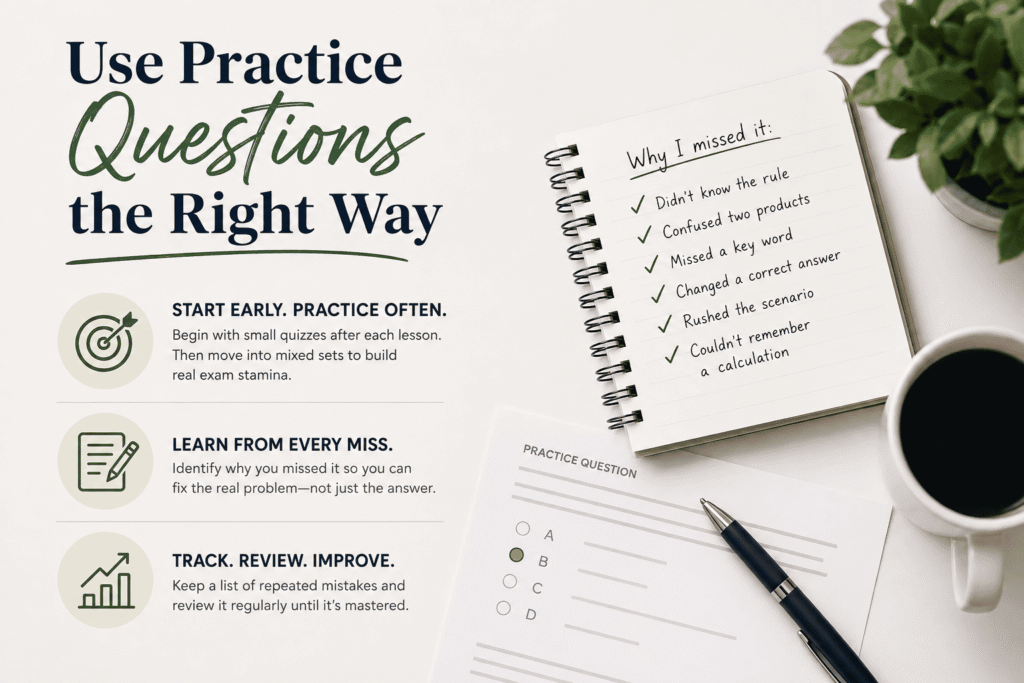
Keep a small list of repeated mistakes. Review it every few days and remove topics once you can answer them without help.
Know When You Are Ready to Take the SIE
One good practice score does not automatically mean you are ready. Look for consistent results across several quizzes and simulated exams.
Before test day, you should be able to:
- Finish 85 questions within 105 minutes
- Score above your course’s recommended benchmark consistently
- Explain why an answer is correct
- Handle mixed questions without relying on notes
- Finish without guessing through the final section
- Identify and improve your weakest topics
Take at least one full simulated exam under realistic conditions. Put away your phone and notes, use the real time limit, and avoid pausing whenever you get distracted.
Review every answer afterward, including the ones you got right. A lucky guess can hide a topic you still do not understand.
If one section keeps dragging down your score, return to its lessons before taking another full exam. Repeating simulations without fixing anything will not move you forward much.
Prepare for the Final Week and Exam Day
The final week should be about tightening up what you already learned.
Review your weak-topic list, complete mixed practice sets, and revisit important rules or formulas. Flashcards can help with definitions, but do not let them replace full questions with realistic scenarios.
The night before, keep it light. Confirm your appointment, prepare your identification, and stop studying early enough to sleep.
On exam day:
- Arrive early enough to complete check-in.
- Read every question carefully.
- Flag anything taking too long.
- Use easier questions to build time.
- Answer everything before submitting.
- Review flagged questions if time remains.
There is no penalty for guessing, so never leave an answer blank. One difficult question also does not mean the entire exam is going badly. Choose your best answer, flag it, and keep moving.
Final Thoughts on Passing the SIE Exam
You do not need to walk into the SIE knowing every tiny detail perfectly. You need a solid understanding of the main concepts and enough practice to use them when the wording changes.
Let your prep course guide the order, but do not follow it blindly. Slow down when a topic is not clicking, spend more time on the larger sections, and keep track of why you miss questions.
The goal is not to finish the material as quickly as possible. It is to reach the point where your scores stay steady, you can explain your answers, and one unfamiliar question does not throw off your entire pace.
Before exam day, also read how long the SIE exam takes so you can practice pacing under the real 105-minute limit.
FAQs
What score do you need to pass the SIE exam?
You need a score of 70. The exam includes 75 scored questions and 10 unscored pretest questions that are mixed together.
Do you need an SIE prep course to pass?
A prep course is not required, but it can make studying much easier. It organizes the topics, provides practice questions, and shows which sections still need work.
How long should you study for the SIE exam?
It depends on your finance background and weekly schedule. Give yourself enough time to complete the material, review weak areas, and take several practice exams without cramming. When planning your calendar, also consider how long the SIE exam takes.
Can you pass the SIE without finance experience?
Yes. The SIE is an introductory exam, and you do not need a finance job or employer sponsorship to take it. Beginners may need more time with products and industry terminology.
How many practice exams should you take?
There is no required number. Take enough to see consistent scores and complete at least one full simulation under the real 105-minute limit.
What should you do if you get stuck during the exam?
Choose your best answer, flag the question, and move on. Return to it after answering the easier questions. Since there is no guessing penalty, never leave it blank.


![ESG Institute Coupon [Verified Discounts]](https://www.miamiherald.com/careers-education/wp-content/uploads/sites/2/2026/09/esg-institute-discount-code-mh-1024x768.jpg)