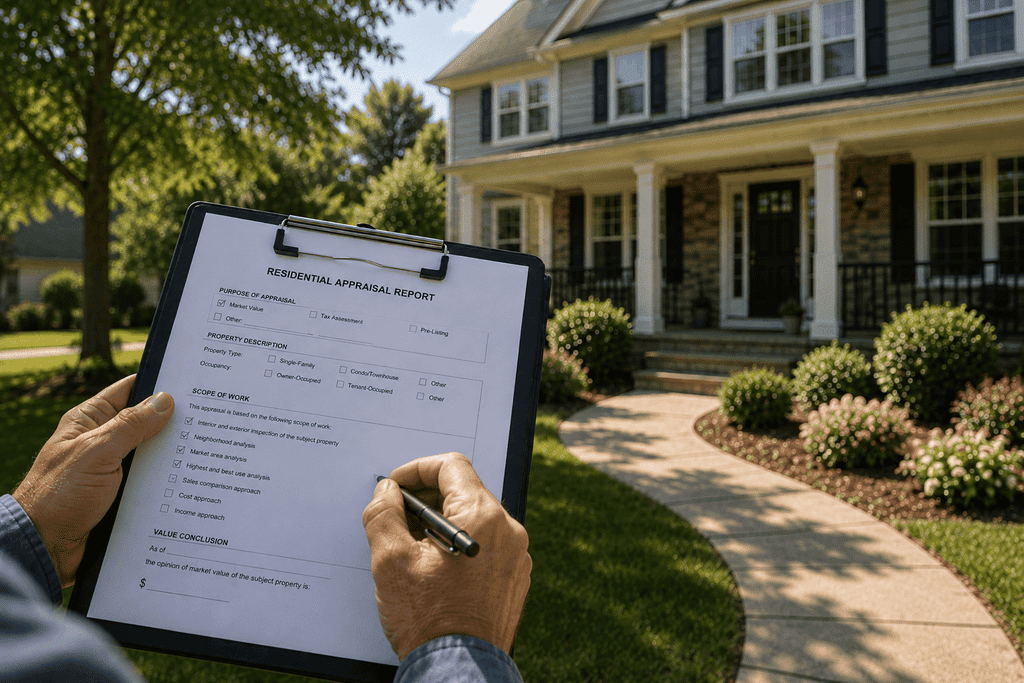
You don’t have to sell homes to build a career in real estate. Appraisal work puts the focus on researching properties, analyzing market data, and determining value. Florida property appraisers and assessors earned a median annual wage of $65,620 in 2025, with the highest-paid 10% earning at least $108,240, according to O*NET’s Bureau of Labor Statistics data.
If that mix of property research and analytical work appeals to you, this guide explains how to become an appraiser in Florida, from trainee registration and education to supervised experience and choosing your certification path.
Key Takeaways
- Begin as a trainee: Most people who enter the field start as registered trainee appraisers and work under the supervision of a certified appraiser.
- Complete the education: Florida requires 100 hours of approved education for trainee registration, with additional education required for certified residential and certified general appraisers.
- Build experience: Certified residential appraisers need 1,500 hours of qualifying experience, while certified general appraisers need 3,000 hours, including 1,500 hours of nonresidential experience.
- Choose your credential: Certified residential appraisers focus on qualifying residential properties, while certified general appraisers can appraise any real property.
- You have to pass the exams: Those applying for certification must pass both the relevant national exam and the Florida Supplemental exam.
Become an Appraiser in Florida
If you’re wondering how to get an appraiser license in Florida, think of the process less like getting one license and more like moving through a career ladder.
As someone who’s gone through Florida’s real estate licensing process, I initially thought becoming an appraiser would follow a similar playbook: take the required education, pass an exam, and get to work. It doesn’t. The supervised experience requirement changes the equation.
Florida has three main appraiser classifications:
- Registered Trainee
- Certified Residential
- Certified General
The registered trainee level is the entry point, while the two certified classifications allow for broader independent appraisal work.
The basic progression is:
- Complete the required education.
- Register as a trainee appraiser.
- Get a qualified supervisory appraiser.
- Get the required appraisal experience.
- Complete the education requirements for certification.
- Pass the required exams.
- Apply for certification through the Florida Department of Business and Professional Regulation (DBPR).
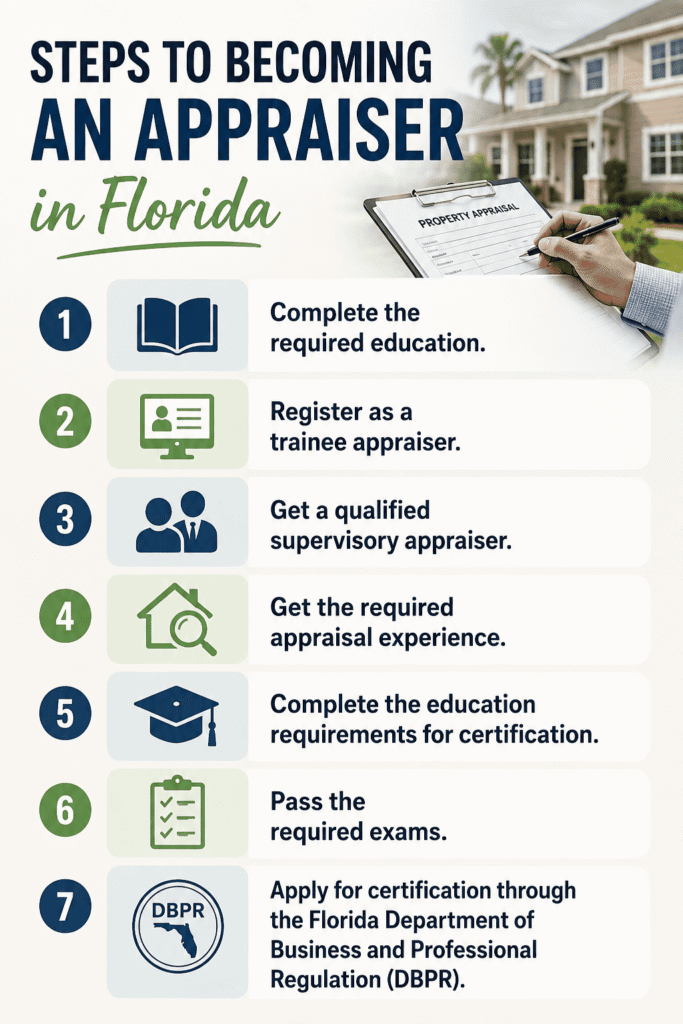
The important part is choosing your end goal early because the requirements aren’t the same for every credential.
Registered Trainee Appraiser
Becoming a registered trainee appraiser is the first stage for those who are new to the profession, and a trainee is allowed to carry out appraisal services only when working directly under the supervision of a certified appraiser.
Florida requires trainee applicants to be at least 18, have a high school diploma or equivalent, and complete 100 hours of approved prelicensing education.
Those 100 hours include:
- A 15-hour National USPAP course
- 30 hours of basic appraisal principles
- 30 hours of basic appraisal procedures
- 25 hours of appraisal subject-matter electives
The electives include Florida laws and rules and a supervisor-trainee course.
Certified Residential Appraiser
A certified residential appraiser can appraise residential real property consisting of one to four units, regardless of transaction value or complexity, within the scope permitted by the credential.
Florida requires:
- 200 hours of approved prelicensing education
- Satisfy the applicable college-level education requirement
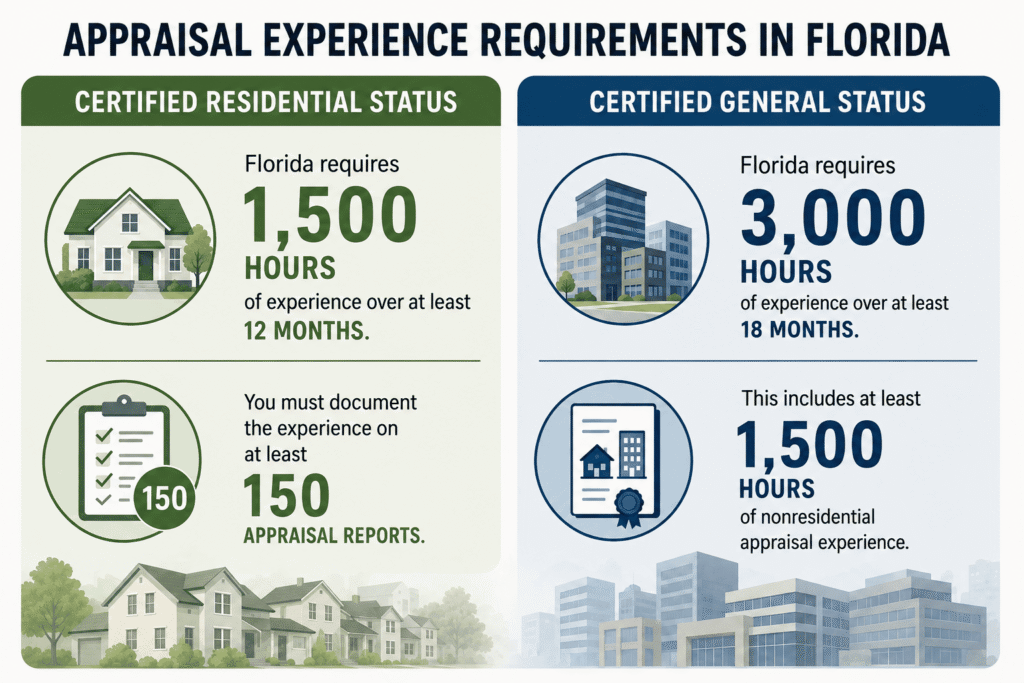
- At least 1,500 hours of qualifying appraisal experience over a minimum of 12 months
- Applicants must document the experience on at least 150 appraisal reports
Certified General Appraiser
The certified general classification has the broadest scope. A certified general appraiser is qualified to issue appraisal reports for any real property.
Florida requires:
- 300 hours of approved prelicensing education
- A bachelor’s degree or higher
- At least 3,000 hours of qualifying appraisal experience over a minimum of 18 months
- At least 1,500 of those hours must involve nonresidential appraisal work
Florida Appraiser License Requirements
The Florida appraiser license requirements depend on the credential you’re pursuing, but the trainee requirements are relatively straightforward.
To become a registered trainee appraiser, you must:
- Be at least 18 years old
- Have a high school diploma or equivalent
- Have a valid Social Security number
- Complete 100 hours of approved education
- Submit the required application and fee
- Complete the required fingerprinting and background check
- Register your supervisory appraiser with the state
Florida allows you to complete the required trainee education through approved distance or classroom instruction.
One detail worth paying attention to: Your qualifying education generally must have been completed within five years of applying. The state also has specific rules concerning how recently an applicant must have completed the USPAP course.
Find a Supervisory Appraiser
This is one step you don’t want to leave until the last minute.
A registered trainee needs a certified residential or certified general appraiser to supervise the work that counts toward certification.
The supervisory appraiser must have held the certification for at least three years and be in good standing. A supervisor can oversee no more than three trainees at a time.
The trainee, primary supervisor, and any secondary supervisor must also be affiliated with the same firm or business.
In practical terms, you can complete your coursework independently, but you need a plan for where you’ll get your hands-on experience.
Complete Your Appraisal Education
Education is a big part of earning a Florida real estate appraiser license, and the number of hours increases as you move up the ladder.
| Credential | Required Education |
|---|---|
| Registered trainee appraiser | 100 hours |
| Certified residential appraiser | 200 hours |
| Certified general appraiser | 300 hours |
The coursework covers the principles, procedures, and professional standards used in real estate appraisal. Your education must also come from a provider and course that meet Florida’s approval requirements.
If you’re searching for real estate appraisal certification programs in Florida, don’t just choose a course because it says it’s for aspiring appraisers. Make sure it meets the Florida education requirement for the credential you want.
Gain Appraisal Experience
Once you’re registered as a trainee, you can begin gaining the supervised appraisal experience required for certification.
The type of work you complete during this stage matters. Your experience must meet Florida’s requirements for the credential you’re pursuing, and you’ll need to document that experience when you apply for certification.
Keep an accurate work log as you complete assignments. Florida requires appraisal experience logs as part of the certification process.
Study for and Pass the Appraiser Exams
Completing the required coursework doesn’t necessarily mean you’re ready to take the exam. Set aside time to review what you’ve learned and work through practice questions before test day. Appraiser exam prep courses and study materials can help you review appraisal principles, terminology, calculations, and exam-style questions.
A prep course can be especially useful if you completed your qualifying education months ago and need to refresh the material before testing. Practice questions can also help you get comfortable applying appraisal concepts.
Florida certification applicants must pass two exams:
- The appropriate national appraisal exam
- The Florida Supplemental Examination
The national exam depends on the certification you’re pursuing. Certified residential applicants take the Residential National Exam, while certified general applicants take the General National Exam. Both must also pass the Florida Supplemental Examination with a score of at least 75%.
Apply for Your Florida Real Estate Appraisal License
Once you’ve completed the required education and experience and passed the exams, you’re ready to apply for certification through DBPR.
You’ll need to submit the appropriate application and supporting documents. Florida also requires fingerprinting as part of the licensing process.
For certified applicants, the state reviews the experience claimed on the application, so make sure that your appraisal experience log and supporting records are complete before submitting everything.
Florida Real Estate Appraiser License vs. Certification
If you’ve been searching for a Florida real estate appraiser license, you may have noticed that “license” and “certification” aren’t always used consistently online.
Florida’s official classifications help clarify things.
- A registered trainee appraiser works under supervision
- A certified residential appraiser can independently appraise qualifying residential properties
- A certified general appraiser has the broadest scope and can appraise any type of real property
So when you’re researching a real estate appraiser license in Florida or a Florida real estate appraisal license, pay attention to the specific credential rather than assuming every program or article is referring to the same thing.
How Long Does It Take to Become an Appraiser in Florida?
There’s no single timeline for everyone who wants to become an appraiser in Florida.
You can complete the education before you begin gaining experience, but certification requires a minimum amount of supervised appraisal experience. Certified residential applicants need at least 1,500 hours over 12 months, while certified general applicants need 3,000 hours over at least 18 months.
It doesn’t mean that all you have to do to become a certified appraiser is attend a single class and pass one exam; experience is a major component of the process.
Final Thoughts
As someone familiar with Florida’s real estate licensing process, the biggest thing to understand about becoming an appraiser is that passing the exam is only one piece of it. The education gets you started, but the supervised experience is what takes you from someone learning appraisal theory to someone qualified to do the work independently. Our national guide to how to become an appraiser covers the same path outside Florida.
Knowing this helps you decide between the residential and general paths before you sign up for a course. If you want to work mostly with homes, certified residential is a good choice. If you’re interested in commercial or other types of real property, certification generally requires more education and experience but offers a wider range of work.
Either way, knowing the destination before you start logging those hours can save you from working toward a credential that doesn’t fit what you’re looking for.
When you are ready to pick a school, compare our best online real estate appraisal courses.
FAQs
How do I get an appraiser license in Florida?
To get an appraiser license in Florida, start by completing 100 hours of approved education and applying to become a registered trainee appraiser. You’ll then work under a qualified supervisory appraiser and accumulate the experience required for certification.
What are the Florida appraiser license requirements?
The Florida appraiser license requirements include education, supervised experience, and exams, depending on the credential.
Do you need a degree to become an appraiser in Florida?
You do not need a bachelor’s degree to become a registered trainee appraiser in Florida. Trainees must have a high school diploma or equivalent.
Can you become an appraiser in Florida without experience?
Yes, you can become a registered trainee appraiser in Florida without previous appraisal experience. The trainee credential allows you to enter the profession and gain qualifying experience under the supervision of a certified appraiser.
What does a real estate appraiser do in Florida?
In Florida, a real estate appraiser develops an opinion of a property’s value by analyzing the property and relevant market information. The work can involve researching comparable properties, analyzing market conditions, and preparing appraisal reports.