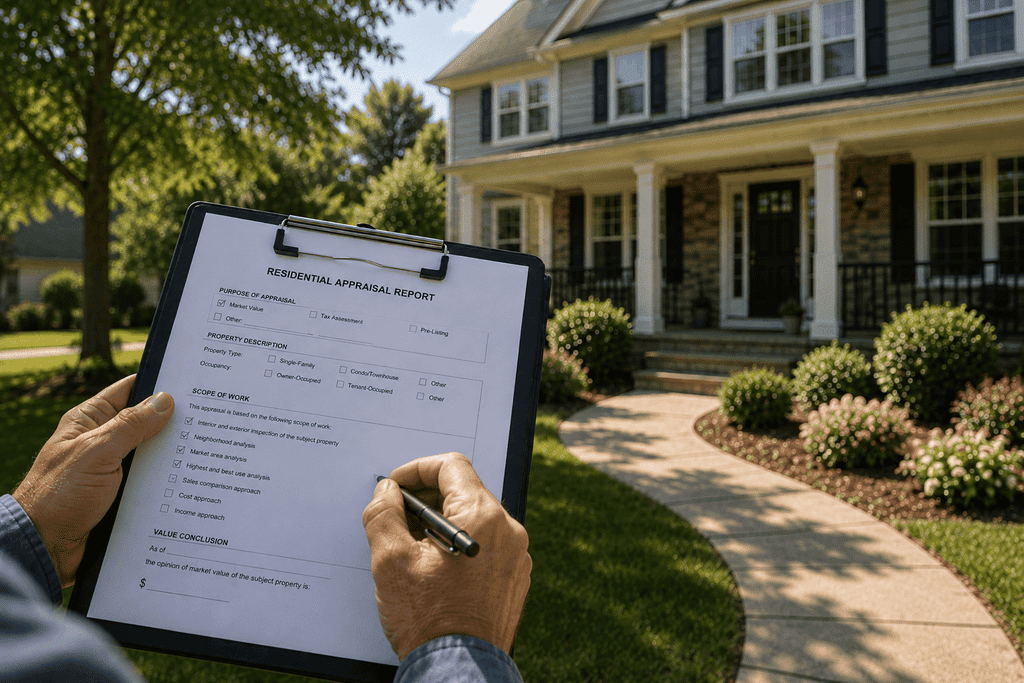
Real estate appraisers estimate what a property is worth by inspecting it, researching recent sales, and comparing it with similar properties. The work combines time in the field with research and report writing. Property appraisers and assessors earned a median annual wage of $67,960 in May 2025.
You may be able to get started without a four-year degree, depending on your state and the credential you pursue. But you’ll still need to meet education, experience, and licensing requirements before working independently.
This guide explains how to become a real estate appraiser, what the different credentials allow you to do, and which requirements to check before paying for classes.
Key Takeaways
- Start With Your State: Appraiser requirements vary depending on where you plan to work.
- College Isn’t Always the First Step: Some credentials let you enter the field without a degree.
- Experience Has More Than One Route: Different pathways can help you meet the experience requirement.
- Your Credential Sets Your Scope: The credential you hold determines which properties you can appraise.
- There’s Room to Move Up: You can pursue a higher credential as you meet additional requirements.
Step 1: Choose the Type of Appraisal Work You Want
This guide focuses on real estate appraisers, or professionals who estimate the value of homes, land, and commercial buildings.
That is different from appraising jewelry, artwork, antiques, cars, or businesses. Those specialties follow their own training and credentialing systems.
Residential Appraisal
Residential appraisers work with homes and properties containing one to four housing units.
This is usually the most straightforward place to begin because the education and experience requirements are lower.
Commercial Appraisal
Commercial appraisers may value offices, stores, hotels, farmland, industrial properties, and large apartment complexes.
These assignments are more complex. If you eventually want to appraise commercial real estate, you will need the Certified General credential.
Step 2: Pick the Right Appraiser Credential
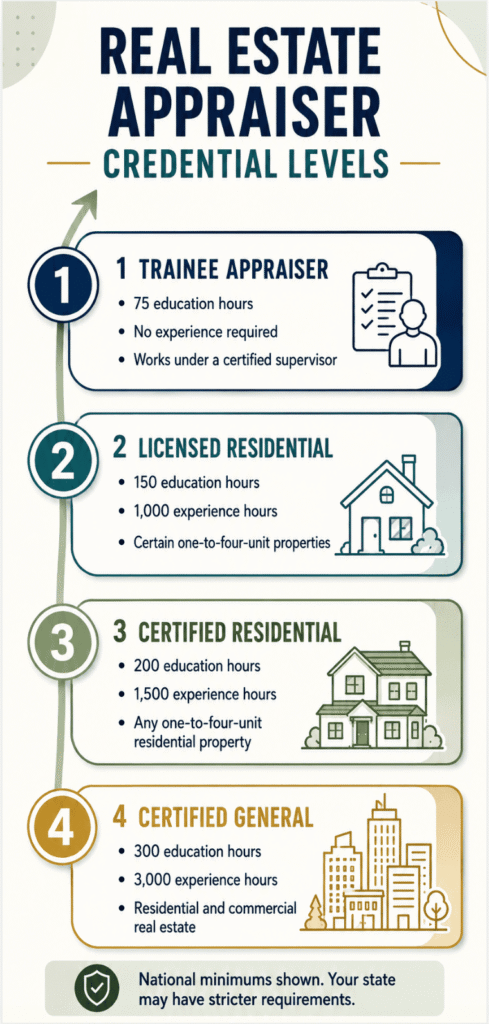
There is no single universal appraiser license. Each credential level determines which properties you are allowed to appraise.
The Appraisal Qualifications Board sets the national minimum requirements. However, states can make their rules stricter.
This chart makes the options easier to compare:
| Credential | What You Can Appraise | Education | Experience |
|---|---|---|---|
| Trainee Appraiser | Properties allowed by your supervisor’s credential | 75 hours plus the supervisor-trainee course | None |
| Licensed Residential | Certain one-to-four-unit residential properties | 150 hours | 1,000 hours in at least 6 months |
| Certified Residential | One-to-four-unit residential properties of any value or complexity | 200 hours | 1,500 hours in at least 12 months |
| Certified General | All real estate, including commercial properties | 300 hours | 3,000 hours in at least 18 months |
Certified General applicants must have a bachelor’s degree. At least 1,500 of their experience hours must involve nonresidential appraisal work.
Not every state offers every classification. Some states have stopped offering the Licensed Residential credential, while others handle trainees differently.
Step 3: Check Your State’s Rules
Please do this before buying an expensive course package.
Florida has its own path to becoming an appraiser in Florida.
Your state regulatory agency decides which courses count, when you must register, and how to document your experience. Starting with the wrong course or working before registering could delay your progress.
Use The Appraisal Foundation’s state regulatory agency directory to find the correct board.
Questions to Ask Your State
- Which credential can I apply for first?
- Do I need to register as a trainee?
- Which courses and education providers are approved?
- Does the state accept PAREA or practicum experience?
- Do I need a background check or fingerprints?
Course companies may explain the national minimums without clearly showing your state’s additional rules. Your state board has the final answer.
Step 4: Complete Your Appraisal Courses
Next, complete the state-approved qualifying education required for your chosen credential.
The courses cover property inspections, comparable sales, market research, appraisal math, valuation methods, professional standards, and report writing.
Starting With the Trainee Courses
Most beginners start with 75 hours of qualifying education:
- 30 hours of Basic Appraisal Principles
- 30 hours of Basic Appraisal Procedures
- 15 hours of National USPAP
USPAP covers the ethical and professional rules appraisers must follow. You will also need a Supervisory Appraiser/Trainee Appraiser Course if you plan to work under a supervisor.
Step 5: Gain the Required Appraisal Experience
Your experience must follow state rules and be documented in an official log. You generally have three ways to earn it:
- Supervisory appraiser: Work with a certified appraiser while learning inspections, comparable sales, market analysis, calculations, and report writing. Contact local appraisal firms, independent appraisers, and professional groups to find openings.
- PAREA: Complete simulated assignments with mentorship through the Practical Applications of Real Estate Appraisal program. It may replace up to 100% of the experience required for Licensed Residential or Certified Residential, but your state must accept it.
- Approved practicum: Complete a structured course using real or realistic appraisal assignments. A practicum may replace some or all of your required experience, depending on the program and your state.
PAREA cannot provide the nonresidential hours required for Certified General certification. Whichever path you take, update your experience log as you work. Rebuilding hundreds of assignment details later would be a nightmare.
Step 6: Pass the Exam and Get Licensed
Once you finish your classes and experience hours, you can take the appraiser exam for your chosen license.
Each exam has 125 questions, but only 110 count toward your score. The other 15 are test questions that may be used on future exams.
- Licensed Residential: Four hours
- Certified Residential: Four hours
- Certified General: Six hours
Questions cover appraisal math, property values, appraisal reports, and USPAP rules. You will also need to use what you learned to solve real appraisal situations.
Your state will tell you how to schedule the exam. After you pass, send in your final application and wait for the state to approve your license.
How to Study for the Exam
Spend extra time on the topics you keep missing. Knowing why an answer was wrong will help more than memorizing the correct letter.
- Use the exam outline to see which topics will be tested.
- Practice appraisal math without looking at your notes.
- Learn when to use each approach to value.
- Review USPAP rules, ethics, and report requirements.
- Take timed practice tests and review every wrong answer.
- Practice with the same calculator you will use on exam day.
A USPAP prep course can help you focus on the right topics and get comfortable with the types of questions you will see. Start with our USPAP certification guide if you need the standard itself.
Final Thoughts
Becoming an appraiser takes time, but the steps are pretty clear once you know which credential you want.
Check your state’s rules first, then complete your classes and choose how you will earn your experience hours. Try to plan that part early since finding a supervisor can take time.
You do not need your entire career figured out right now. Start with the credential that fits your goals, get some experience, and move up later if you want to appraise more types of property.
When you are ready to pick a school, compare our best online real estate appraisal schools.
FAQs
How long does it take to become a real estate appraiser?
The shortest national experience period is six months for Licensed Residential. Your complete timeline may be longer because you also need education, an exam, and state approval.
Do you need a college degree to become an appraiser?
Not for every credential. Certified General requires a bachelor’s degree, while Certified Residential applicants have several possible college education pathways.
Can you become an appraiser without a supervisor?
Possibly. PAREA or an approved practicum may replace traditional supervised experience, but your state must accept the program.
Is becoming a real estate appraiser hard?
The education is manageable, but finding an approved experience opportunity can be difficult. The work also requires research, math, writing, and close attention to detail.
How much do real estate appraisers make?
The median annual wage for property appraisers and assessors was $65,420 in May 2024, according to the U.S. Bureau of Labor Statistics. Earnings vary by location, credential, specialty, and workload.
Can you complete appraiser training online?
Many qualifying education courses are available online. Confirm that your state accepts the provider, courses, and delivery format before enrolling.
What is the difference between an appraiser and a home inspector?
An appraiser estimates a property’s value. A home inspector examines its physical condition and identifies possible problems.