One exam. Then another. Then several more.
That is the part people leave out when they say actuaries “take an exam.”
The process can sound confusing when every test has a different name, subject, and place in the pathway. It gets much easier once you see how everything connects.
In this guide, I’ll break down what actuarial exams are, who takes them, and what the full process actually looks like.
Key Takeaways
- Expect a Multi-Year Process: Actuarial candidates complete several exams over the course of their training.
- Progress Into Specialized Topics: Exam subjects become more focused as you move through the credentialing process.
- Know What Varies: Exam formats, fees, and pass rates differ depending on the exam.
- Understand the SOA and CAS Paths: Each organization leads toward different actuarial career specialties.
- Look Beyond the Exams: Earning actuarial credentials also requires additional education and professional requirements.
So, What Is an Actuarial Exam?
How does an insurance company decide what to charge you—or whether it has enough money to cover claims 30 years from now?
Actuaries use math and data to answer those questions. Actuarial exams prove they can actually do it.
The exams cover things like:
- Predicting insurance claims
- Pricing policies
- Calculating retirement payments
- Measuring investment risk
- Building models from financial data
This is not one licensing exam taken after college. It is a series completed over several years. Passing one or two can help you compete for internships and entry-level actuarial jobs, then you keep earning credits while working toward your full credential.
How those exams fit alongside a degree, internships and the other credential requirements is covered in the actuary career path guide.
What Are the Different Types of Actuarial Exams?
The exam process moves from general math into more advanced career specialties.
| Exam Stage | What It Covers | Examples |
|---|---|---|
| Foundational exams | Probability, financial mathematics, and statistics | P, FM, SRM |
| Associate-level exams | Insurance mathematics, modeling, pricing, reserves, and analytics | FAM, PA, MAS-I, MAS-II |
| Advanced associate exams | More specialized insurance and risk problems | ALTAM, ASTAM, CAS Exams 5 and 6 |
| Fellowship exams | Advanced topics based on a chosen career specialty | FSA specialty exams or CAS Exams 7, 8, and 9 |
The exams are not the only requirements. Depending on the pathway, candidates may also complete online modules, educational credits, projects, and professionalism courses.
You will not take every exam in the table. Your chosen credential determines which ones belong in your path.
Actuarial Exam Format and Requirements
There is no universal actuarial exam format or price.
Some exams are multiple-choice. Others require written explanations, data analysis, spreadsheets, projects, or longer constructed responses.
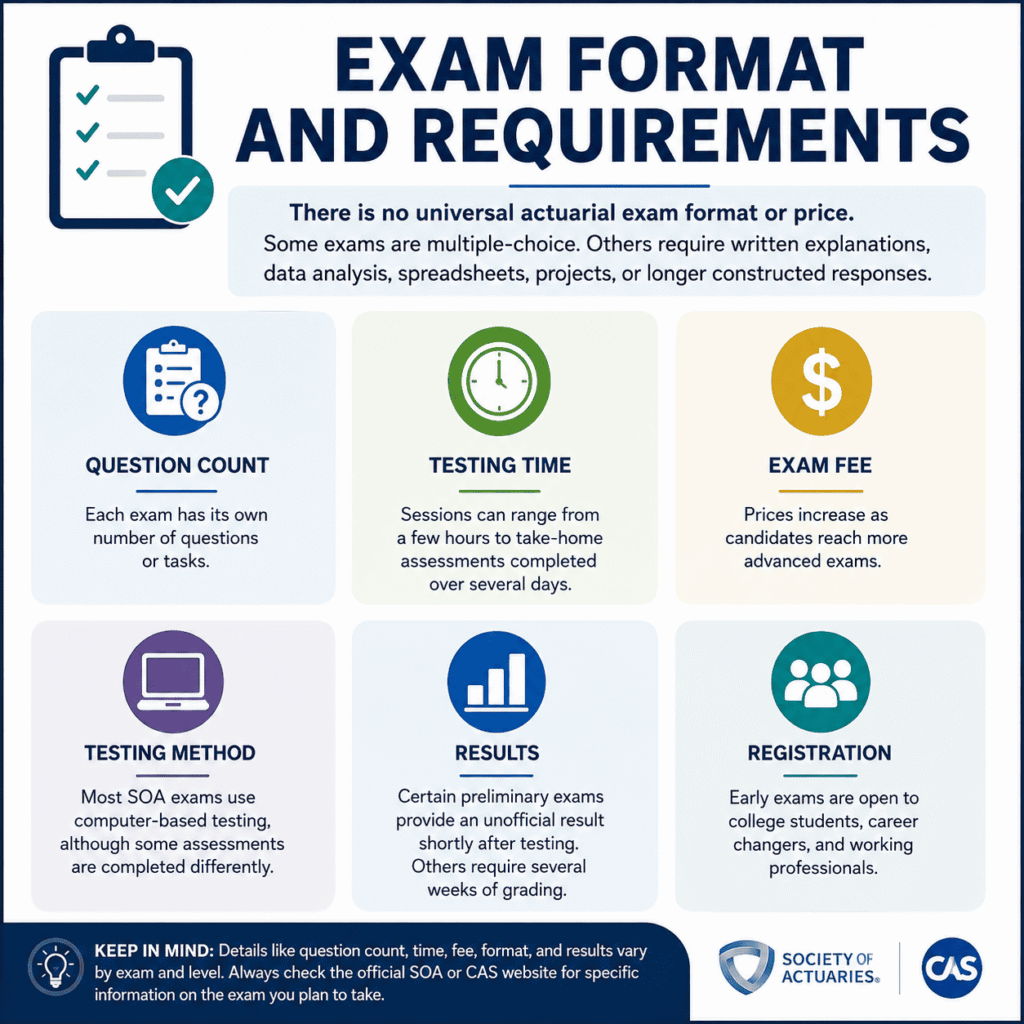
Here is what generally changes:
- Question Count: Each exam has its own number of questions or tasks.
- Testing Time: Sessions can range from a few hours to take-home assessments completed over several days.
- Exam Fee: Prices increase as candidates reach more advanced exams.
- Testing Method: Most SOA exams use computer-based testing, although some assessments are completed differently.
- Results: Certain preliminary exams provide an unofficial result shortly after testing. Others require several weeks of grading.
- Registration: Early exams are open to college students, career changers, and working professionals.
What Is Covered on Actuarial Exams?
The subjects change as you move through the process.
Math and Statistics
The early material creates the foundation for everything that follows.
You may study:
- Probability
- Financial mathematics
- Interest rates and cash flows
- Statistical models
- Random variables and distributions
- Regression and time-series analysis
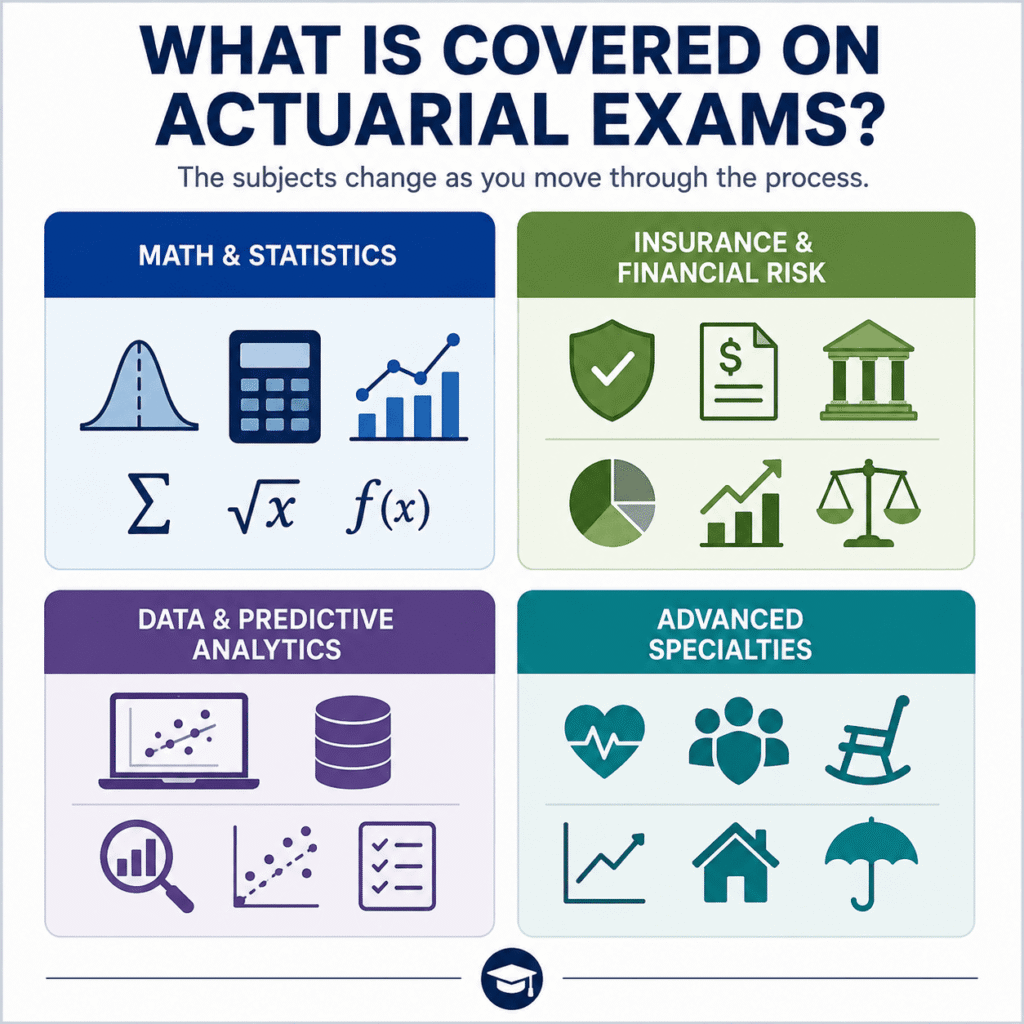
Insurance and Financial Risk
Later exams apply that math to the decisions insurance companies and financial institutions make.
Topics may include:
- Insurance benefits and premiums
- Ratemaking
- Claim liabilities and reserves
- Asset and liability management
- Investment risk
- Financial reporting
- Insurance regulation
Data and Predictive Analytics
Some exams test whether you can work with data instead of only solving a calculation.
That can include:
- Choosing a statistical model
- Analyzing a data set
- Testing whether a model works
- Explaining results clearly
- Using predictions to solve a business problem
Advanced Specialties
Fellowship exams focus on a specific area of actuarial work. Options may include life insurance, health benefits, retirement, investments, enterprise risk, property insurance, casualty insurance, or reinsurance.
Why Are There Different Actuarial Exam Paths?
The two main U.S. actuarial organizations prepare candidates for different careers.
- ➡️ SOA: Life insurance, health insurance, retirement, investments, finance, and enterprise risk
- ➡️ CAS: Auto, home, business, liability, and other property and casualty insurance
SOA candidates work toward the ASA credential and may later continue toward the FSA. CAS candidates work toward ACAS and then FCAS.
Actuarial Exam Scoring, Pass Rates, and Difficulty
There is no universal passing percentage. The SOA and CAS set pass marks for individual exams and report each sitting separately.
The SOA grades many exams from 0 to 10, with 6 as the lowest passing grade. That does not mean 60% correct.
Recent pass rates show how much difficulty can vary:
- SOA Exam PA: 65.0%
- CAS MAS-I: 43.4%
- CAS Exam 5: 38.3%
- CAS Exam 7: 23.7%
Some exams passed nearly two-thirds of candidates, while others passed fewer than one in four. The challenge may involve multi-step math, choosing the correct method, analyzing data, or explaining an answer clearly.
How to Prepare for an Actuarial Exam
You cannot really cram your way through these exams.
A solid study routine looks like:
- Follow the syllabus for your exact exam
- Learn one topic at a time
- Complete practice problems immediately afterward
- Keep a list of mistakes by topic
- Redo missed questions without viewing the solution
- Practice with unfamiliar questions
- Take timed exams before test day
Do not count a question as mastered because you recognize the answer. You should be able to solve it again when the numbers, wording, or situation changes.
A prep course can help organize the lessons, formulas, question bank, and practice exams when building everything yourself feels like another job.
My Final Thoughts on Actuarial Exams
An actuarial exam is difficult by design, but it’s also a manageable career milestone, not a mysterious test of genius.
Choose the pathway that matches the actuarial work you want, confirm its current requirements, and focus on one exam at a time. One pass will not finish the journey, but it can help you compete for internships, entry-level roles, and employer support.
FAQs
Are actuarial exams harder than college exams?
Often, yes. They cover more material than a typical college test and require you to solve unfamiliar problems accurately within a strict time limit.
Do you need a degree to take an actuarial exam?
No. Anyone can register for an early actuarial exam. However, employers typically expect candidates to have a bachelor’s degree and strong math skills.
Can you take actuarial exams while in college?
Yes. Passing one or two exams before graduation can strengthen your applications for actuarial internships and entry-level jobs.
Do actuarial exam credits expire?
Passed exams generally do not expire. When requirements change, the SOA and CAS publish transition rules explaining how previously earned credits apply.
What score do you need to pass an actuarial exam?
It depends on the exam. The SOA uses a 0–10 scale for many exams, with 6 passing, but that does not mean 60% correct.
Can you become an actuary after passing one exam?
You can qualify for some entry-level actuarial jobs, but you are not fully credentialed. Earning an ASA, FSA, ACAS, or FCAS requires additional exams and requirements.

![ESG Institute Coupon [Verified Discounts]](https://www.miamiherald.com/careers-education/wp-content/uploads/sites/2/2026/09/esg-institute-discount-code-mh-1024x768.jpg)