
Flores: Attempts to tank ‘attack the integrity of the game.’ How, exactly, is it done?
READ MORE
At the center of the Flores lawsuit
Brian Flores’ bombshell lawsuit against the Dolphins and the NFL puts Miami and team owner Stephen Ross at the center of the league’s latest racial reckoning.
Expand All
Does the NFL discriminate against Black coaches? What a Miami Herald analysis found
Flores: Attempts to tank ‘attack the integrity of the game.’ How, exactly, is it done?

Brian Flores, ‘a man of principle,’ is an unlikely face for NFL’s latest racial reckoning

How Dolphins owner Stephen Ross went from average Miami Beach High student to $8.3 billion
Miami Dolphins’ 10 biggest scandals, and where Brian Flores/Stephen Ross bombshell ranks | Opinion
To tank or not to tank?
That was a question former Dolphins coach Brian Flores said he had to answer during his first season in Miami — and his decision, he said, cost him his job.
Flores contended in a 58-page lawsuit filed earlier this week against the Dolphins and the NFL that alleged racial discrimination that Dolphins owner Stephen Ross “told Mr. Flores that he would pay him $100,000 for every loss.” The lawsuit continued to say that Dolphins general manager Chris Grier told Flores “that ‘Steve’ was ‘mad’ that Mr. Flores’ success in winning games that year was ‘compromising [the team’s] draft position.’ ”
Flores was fired in January after going 24-25 in three seasons with the Dolphins and alleged in his lawsuit that “the writing had been on the wall since Mr. Flores’ first season as Head Coach of the Dolphins, when he refused his owner’s directive to ‘tank’ for the first pick in the draft.”
Flores said he did not accept the money and did not tank because he felt doing so would “attack the integrity of the game.”
“That’s what I felt was happening in that instance,” Flores said Wednesday on “CBS Mornings” during his round of TV interviews in his first public comments regarding the lawsuit. “I wouldn’t stand for it.”
Ross said in a statement that Flores’ claims are “false, malicious and defamatory” and the Dolphins in a separate statement said they “vehemently deny any allegations of racial discrimination” and that the implication that we acted in a manner inconsistent with the integrity of the game is incorrect.”
With that, a note: Players and coaches generally aren’t the ones tanking. Even if a roster isn’t up to the competition of its counterparts, those who directly impact the play on the field still have to play at a high level in order to keep their careers and future prospects intact.
That was evident with the way the Dolphins closed the 2019 season, finishing 5-11 after an 0-7 start.
Miami’s Week 16 win against the Cincinnati Bengals that year — a 38-35 overtime victory — ensured the Bengals (not the Dolphins) would get the No. 1 overall pick in the 2020 NFL Draft. The Dolphins closed the season with a 27-24 win over the New England Patriots.
Should a team want to tank, the onus, then, falls on the owner and the front offense to craft the roster in such a way that it is all but impossible for the team to win.
Are there rules in place to make teams avoid tanking?
Not really, at least in the NFL.
The NBA and NHL have lottery systems in place that make it so that there’s not a guarantee the team with the worst record gets the No. 1 overall pick.
MLB and the NFL, by contrast, set their draft order by reverse order of record for teams that don’t make the playoffs. In other words, the team with the worst record gets the No. 1 overall pick, the team with the second-worst record gets the No. 2 overall pick and so on and so forth.
This, in some ways, can provide incentive for teams that don’t make the playoffs to try to play for a worse record — tank, if you will — because it gives them a better chance of getting a higher draft pick.
Some front offices take advantage of that by putting together subpar rosters that make it tougher for their team to win games in the short term with the hope of getting better picks to jump-start a rebuild that will benefit them long term.
It’s also not a new phenomenon.
Look back to 2011, when Dolphins fans were clamoring at the start of the season for Miami to play for the No. 1 pick for the chance to draft quarterback Andrew Luck — “Suck for Luck” was the mantra then, as “Tank for Tua” was the mantra in 2019. Miami started that season 0-7 before finishing the year with a 6-10 record, eerily similar to the 2019 season that started 0-7 and ended 5-11.
How the Dolphins’ 2019 roster was constructed
The Dolphins’ roster from the end of the 2018 to the start of 2019 experienced massive turnover.
Only 23 of the 66 players on the Dolphins’ roster or injured reserve at the end of the 2018 season — 34.8 percent — were with the team for Week 1 of the 2019 season. Thirteen players no longer on the roster had started at least 10 games for the Dolphins in 2018.
This includes an exodus of several of their top players.
Starting quarterback Ryan Tannehill? Traded along with a 2019 sixth-round pick to the Tennessee Titans for a 2019 seventh-round pick and 2020 fourth-round pick. Miami went with a duo of Ryan Fitzpatrick and Josh Rosen for the season.
Their starting offensive tackles, Laremy Tunsil and Ja’Wuan James? Both gone. Tunsil was traded along with receiver Kenny Stills, a 2020 fourth-round pick and a 2021 sixth-round pick to the Houston Texans for a 2020 first-round pick, 2021 first-round pick, 2021 second-round pick, cornerback Johnson Bademosi and tackle Julien Davenport. James went to free agency and signed a four-year, $51 million deal with the Denver Broncos.
Davenport, when healthy, was Miami’s primary left tackle in 2019. Jesse Davis was the primary right tackle.
Two of their top three tacklers, linebacker Kiko Alonso (team-high 125) and safety T.J. McDonald (third, 86)? Gone before the season. The Dolphins traded Alonso to the Saints on Sept. 1 for Vince Biegel. McDonald was released.
Safety Minkah Fitzpatrick, Miami’s first-round pick in 2018 who was fourth on the team with 80 tackles and had two interceptions in his rookie season, was traded to the Pittsburgh Steelers two weeks into the season.
The Dolphins went youth heavy with their front seven, with none of their primary defensive linemen or linebackers having more than two years of NFL experience heading into the season.
Flores’ decision to stick with Fitzpatrick
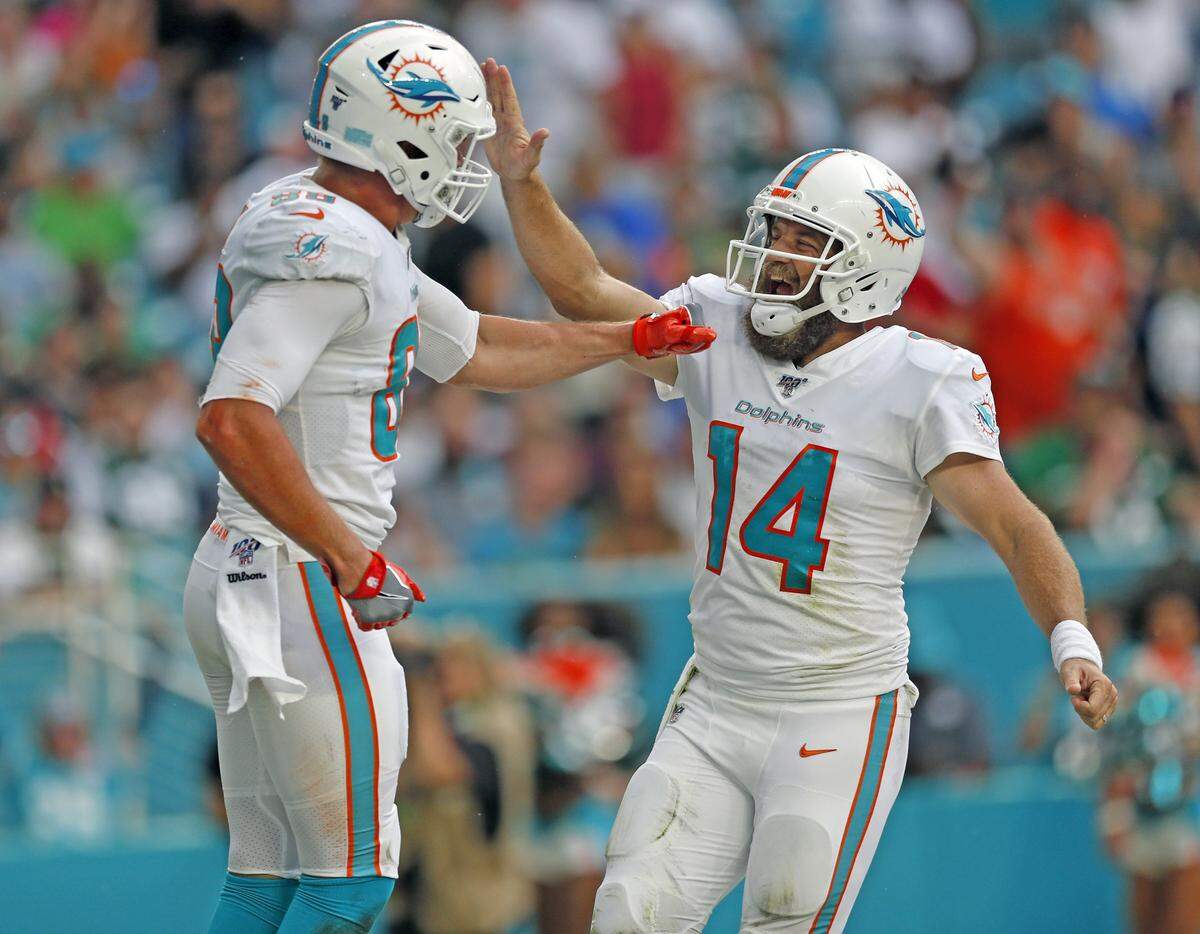
One of the primary decisions Flores made that went against an attempt at tanking in 2019 was deciding after Week 7 to stick with Fitzpatrick as his quarterback over Rosen.
The team had yet to win a game at that point, with Flores going back and forth between Fitzpatrick and Rosen in the early going of the season.
“I think he gives us the best chance to win,” Flores said at the time.
That ultimately turned out to be the case.
The Dolphins won their first game of the season two weeks later in a 26-18 victory over the New York Jets and went 5-4 overall in their final nine games, including that win against the Bengals in Week 16 that ensured Cincinnati would get the top pick in the draft and the upset win over the Patriots in Week 17 to close the season.
This story was originally published February 4, 2022 at 8:43 PM.
.JPG)