
Lessons from Florida: Thought Trump’s Big Lie was a problem? DeSantis’ is even scarier | Opinion
READ MORE
Lessons from Florida
In its series “Lessons from Florida,” the Editorial Board evaluates Ron DeSantis’ role as governor as he takes the “Florida Blueprint” nationwide in his presidential campaign. We know what it’s like to live under his influence. Given his vow to “make America Florida,” it’s important that people beyond the state’s border know, too.
Expand All
Lessons from Florida: ‘Blueprint’ DeSantis touts is missing one thing: a reality check | Opinion
Lessons from Florida: DeSantis vilifies minorities. Imagine what he’d do as president | Opinion
Lessons from Florida: Thought Trump’s Big Lie was a problem? DeSantis’ is even scarier | Opinion

Lessons from Florida: DeSantis will decry classroom ‘indoctrination’ — unless it’s his own | Opinion
Lessons from Florida: DeSantis willfully exploits racial fears. Reject his dangerous vision | Opinion
When Gov. Ron DeSantis signed a controversial elections law in 2021, he blocked all media from covering a signing ceremony, except Fox News, which exalted him during the live segment.
DeSantis’ move was emblematic of how Florida’s governor has treated voting access. His approach is one-sided, meant to appease the conservative voters he’s courting in the 2024 presidential primary — too many who still believe the 2020 election was stolen from former President Donald Trump.
His approach isn’t to make it easier for voters to cast ballots, especially if they are voters of color, poor and elderly. Much to the contrary.
If Trump created the “Big Lie,” DeSantis’ actions have advanced it. He’s not necessarily an election denier, and he finally said last month that Trump lost in 2020. But voters should look at what he’s done in Florida to understand how a potential DeSantis presidency could approach voter access.
DeSantis might not be in the White House — or ever get there, based on polling — but a case his administration is arguing in court could have implications for the 1965 Voting Rights Act, a hallmark of the Civil Rights movement that banned discriminatory voting practices.
A President DeSantis would appoint judges and, potentially, Supreme Court justices, allowing him to cement his vision even further through the judicial system. Beyond what a president can do via official actions, his leadership and words also matter. A president who speaks about voting-rights protections as if they were “woke” special privileges for minorities can push his party to pass restrictive state voting laws, as Trump did after 2020.
Diluting Black power
Lawyers defending Florida against a lawsuit recently admitted in court that the congressional map DeSantis forced lawmakers to pass violated state safeguards against diminishing Black voting power. The map did away with a majority-Black district in North Florida. The state argues that such protections violate the U.S. Constitution. If that argument is successful, the case could be used to overturn voting protections at a national level, the Herald reported.
A federal judge on Saturday rebuffed the governor’s legal argument and struck down that North Florida district.
The Florida Supreme Court, where DeSantis appointees hold a majority, is expected to decide the case by the end of the year.
Using the courts has been a common strategy by conservatives to reverse hard-fought rights. DeSantis has also used another tool: the immense power states have over elections.
Just hours after Trump won Florida in 2020, DeSantis praised how smoothly the state ran the elections:
“People are actually looking at Florida and asking the question, ‘Why can’t these states be more like Florida?’” he said at a news conference in Tallahassee.
Only months after that statement, the Republican-led Legislature, under the guise of securing elections, restricted Florida’s mail-voting system, which has been a model for the country.
Senate Bill 90 — the law DeSantis signed in front of Fox News cameras — forced voters to renew their vote-by-mail applications every election cycle, or two years. Previously, those applications were good for four years. In Miami-Dade County, 438,000 requests expired after the 2022 elections. So far, only 160,000 have been renewed ahead of this and next year’s elections, according to the county Supervisor of Elections Office. This unnecessary change will catch many voters by surprise when they find out it’s too late to vote by mail. The law also restricted mail-ballot drop boxes, among other measures.
Targeting nonprofits
DeSantis signed another law this year increasing fines for third-party voter registration groups that don’t turn in voter forms in time while also giving them less time to do so. He banned non-citizens — even people in the country legally, such as green-card holders — from registering people to vote. Ironically, immigrants with green cards are allowed under federal law to donate money to political campaigns.
SB 7050 looks like a laser-focused attempt to undermine nonprofit organizations, such as the League of Women Voters or the NAACP, that often register voters in poor and immigrant communities. The law also prohibited those groups from keeping any voter information, a provision U.S. District Judge Mark Walker said was overly vague when he temporarily blocked portions of the law in July.
“It’s like target practice,” League of Women Voters of Florida co-President Cecile Scoon told the Herald Editorial Board.
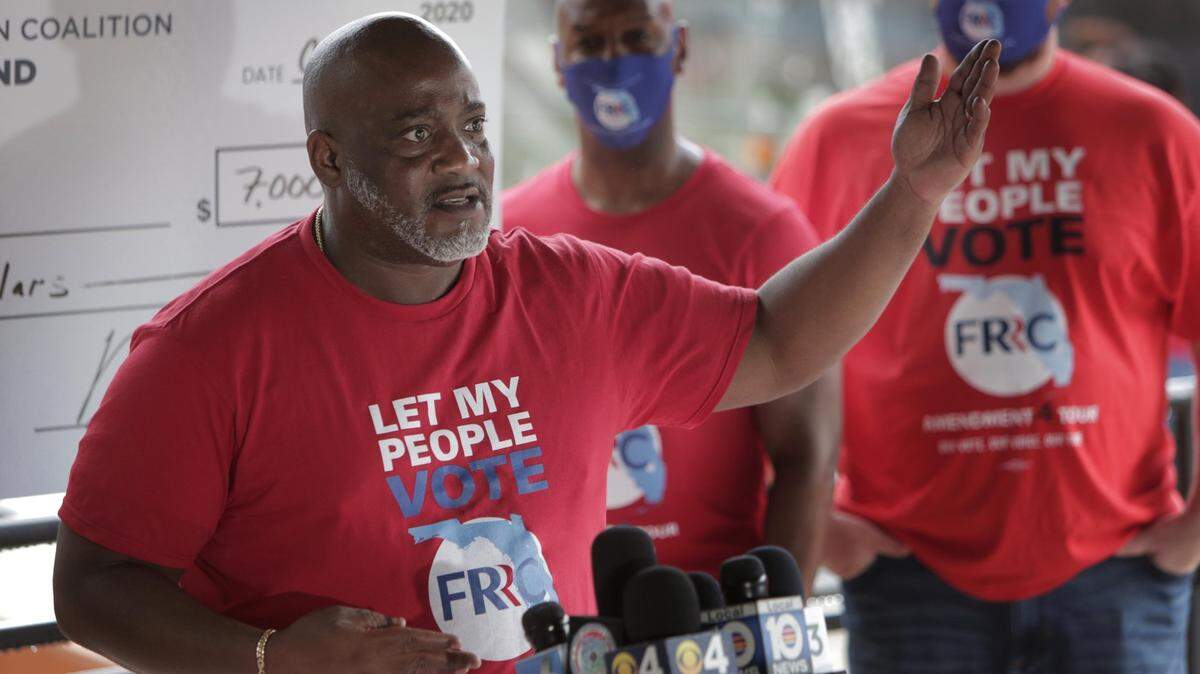
With DeSantis’ approval, lawmakers also tried to thwart the will of the voters who approved Amendment 4 to restore voting rights for some felons. The Legislature also gave him an elections crime police, which he then used to arrest felons whom his own administration didn’t flag as ineligible to cast ballots.
Voting restrictions haven’t been unique to Florida since 2020, but DeSantis’ campaign touts our state as a model for the rest of the nation.
What would that look like?
When it comes to encouraging citizens to participate in our democracy, DeSantis’ “Florida Blueprint” would make it harder, not easier.
Click here to send the letter.
BEHIND THE STORY
MOREWhat's an editorial?
Editorials are opinion pieces that reflect the views of the Miami Herald Editorial Board, a group of opinion journalists that operates separately from the Miami Herald newsroom. Miami Herald Editorial Board members are: opinion editor Amy Driscoll and editorial writers Isadora Rangel and Mary Anna Mancuso. Read more by clicking the arrow in the upper right.
What's the difference between an op-ed and a column?
How does the Miami Herald Editorial Board decide what to write about?
The Editorial Board, made up of experienced opinion journalists, primarily addresses local and state issues that affect South Florida residents. Each board member has an area of focus, such as education, COVID or local government policy. Board members meet daily and bring up an array of topics for discussion. Once a topic is fully discussed, board members will further report the issue, interviewing stakeholders and others involved and affected, so that the board can present the most informed opinion possible. We strive to provide our community with thought leadership that advocates for policies and priorities that strengthen our communities. Our editorials promote social justice, fairness in economic, educational and social opportunities and an end to systemic racism and inequality. The Editorial Board is separate from the reporters and editors of the Miami Herald newsroom.
How can I contribute to the Miami Herald Opinion section?
The Editorial Board accepts op-ed submissions of 650-700 words from community members who want to argue a specific viewpoint or idea that is relevant to our area. You can email an op-ed submission to oped@miamiherald.com. We also accept 150-word letters to the editor from readers who want to offer their points of view on current issues. For more information on how to submit a letter, go here.
This story was originally published September 6, 2023 at 8:47 AM.