Miami was a cartoon town in the 1930s and ‘40s. Get the backstory
READ MORE
Get the backstory
If you ever wondered about a landmark or how a place came to be, it likely has some history in South Florida. Check out this series to get the answers.
Expand All
Miami was a toon town?
It’s not the way most people would describe a city known mostly for its climate, beaches and nightlife. But for a while, in the early 1940s, such cartoon luminaries as Popeye, Olive Oyl, Ko-Ko the Clown and Betty Boop did reside in Miami, in a giant animation studio in Northwest Miami-Dade.
The studio at 1701 NW 30th Ave. eventually became a youth center and a police substation.
Max Fleischer was born in Vienna, Austria, in 1883 and moved to New York with his parents at the age of 4. He became the art editor of Popular Science Monthly in 1914, where he wrote and illustrated articles on inventions.
Along with his younger brother Dave, who worked as a film cutter for Pathe Films, they developed the rotoscope, a device that traced live-action footage into animation. It helped speed up the process of drawing each individual frame.
Using the rotoscope, the brothers made their first short cartoon, “Out of the Inkwell,” which featured Ko-Ko the Clown emerging from a bottle of ink on Max’s desk. It was a success and enabled them to found their own company, Out of the Inkwell Inc., in 1919. They produced cartoons for Paramount Pictures in New York.
When sound was added to cartoons, the Fleischers introduced Betty Boop, who soon became one of their biggest stars. In 1933, Popeye the Sailor Man joined the Fleischers’ roster.
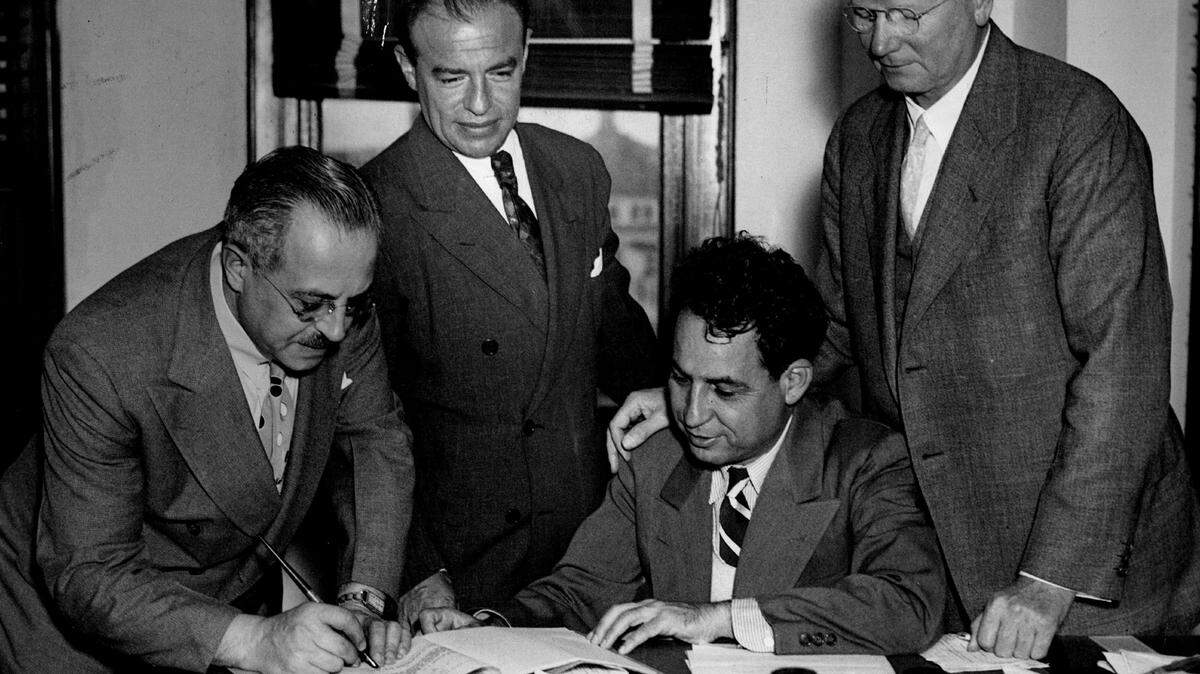
When a strike by Paramount’s commercial artists and designers’ union threatened to affect the Fleischers in 1937, Max looked for a new location to move his studios. He settled on Miami and moved to the city in 1938, along with Dave, who received the director’s credit on Fleischer films, and brothers Lou, Charlie and Joe.
In September, the new Fleischer Studios opened at a 32,000-square-foot facility at Northwest 17th Street and what was then 29th Avenue. More than 500 animators, writers, sound men and assistants worked at the facility. Ads in local newspapers welcomed the animators, who competed with Walt Disney Studios.
In addition to their regular cartoon shorts, the studio’s first Miami production was the December 1939 release of “Gulliver’s Travels,” an ambitious full-length adaptation of the book. “Snow White and the Seven Dwarfs” had been a great success for Disney the year before, and the Fleischer film tried to capitalize, with plenty of Disneyesque cartoon animals cavorting around a rotoscoped Gulliver.
The film was a moderate success, but the studio’s follow-up feature, “Mr. Bug Goes To Town,” released in 1941, was an expensive flop. Bug’s failure resulted in the dismissal of the Fleischers by Paramount. Paramount also closed the Miami studio and moved it back to New York, renaming it Famous Studios.
Creative differences between the Fleischers resulted in their splitting up, although both Max and Dave remained active in animation.
The building that housed the studio was later used, among other things, to train Pan Am airline pilots. In 1967, it was purchased by Miami-Dade County and turned into the Youth and Family Development Center to offer counseling and treatment.
.JPG)