
A Miami luxury hotel got hit by a bank failure and then a fire
The Royal Palm Hotel was one of early Miami’s most luxurious and famous winter resorts. Its main competition, the Halcyon Hotel, sat on Flagler Street and Northeast Second Avenue — and for a while was just as well-known as its bigger rival.
Salem and Emily Graham, a Canadian couple who managed winter hotels in Florida and summer hotels up North, became managers of the three-story Biscayne Hotel in downtown Miami in 1899. The enthusiasm and optimism felt by many Miamians at the turn of the century proved contagious to the Grahams, and they soon began to dream of owning and operating a hotel that could compete with the elegant Royal Palm.
After drafting detailed plans, the Grahams got a loan from the Fort Dallas Bank.
Construction on the hotel began in 1904. Graham’s amateur plans were turned into drafts by Walter F. Crofts, a local carpenter. But without a real architect, costly delays plagued construction. When the workers were ready to install the lavatories, they discovered no plumbing had been provided.
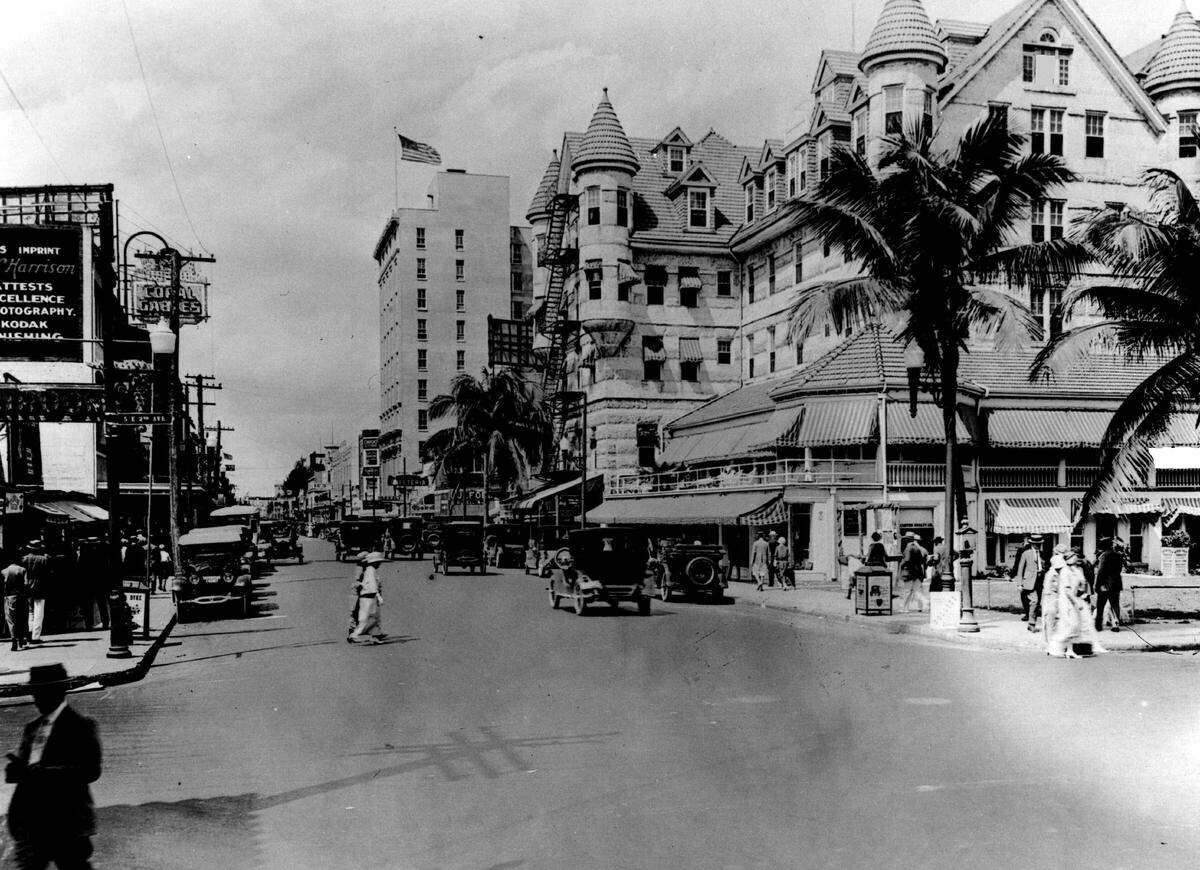
Halcyon Hall, as the Grahams named the resort, opened Dec. 15, 1906. Offices and stores filled the ground floor. The first five floors were labeled S-A-L-E-M, and because the Grahams disliked alcohol, the hotel had no bar.
At first, the hotel was a big success. A special song, “The Halcyon Hall March,” was written for the 1907 New Year’s Ball. When the hotel closed for the season at the end of March, the Grahams left for Michigan to manage a summer hotel.
Then disaster struck.
On July 5, 1907, the Fort Dallas Bank failed. Bank president W.M. Brown told the press that the whole crash was “primarily due to one unfortunate, large investment, the Halcyon Hall Hotel.”
The Grahams watched their dream slip away.
The hotel was placed in receivership and leased to A.L. Kline. It reopened Jan. 1, 1909, with high expectations. But business fell short and Kline closed a week early and in debt.
At 3:30 a.m. March 23, a fire swept through the hotel, causing $10,000 damage. The cause of the fire was never determined. Kline was lambasted by the local press and left town, never to return.
In December 1910, the hotel reopened as the White Palace, under the management of Minnie Hill March, the widow of one of Miami-Dade County’s early citrus fruit growers. The next year she bought the hotel for a bargain $91,200, and renamed it the Halcyon Hotel.
For the next 11 years, the hotel enjoyed modest success and attracted many of Miami’s most famous personalities.
March sold her interests in the hotel to T.J. Peters, known as the county’s “tomato king,” and quit the hotel business in 1921. The property was forced into liquidation in 1932 and purchased by the duPont family from Jacksonville for $336,000. The Alfred I. duPont Building at 169 E. Flagler St. was built on the site in 1939.
When the hotel was torn down in 1937, many of the blocks used to build it were sold off intact. Some of those stones became part of the seawall at Morningside Park in Northeast Miami-Dade.
This story was originally published May 14, 2026 at 2:05 PM.