New redevelopment wave to revive Flagler Street in downtown Miami? Here are highlights
READ MORE
Miami Property King
Billionaire Moishe Mana has spent eight years amassing buildings. Is it self-indulgence or the start of a downtown revival?
Expand All

Long promised and long deferred, the full resuscitation of downtown Miami’s bedraggled Flagler Street — the city’s original main street — may have to wait on the unpredictable designs of quirky entrepreneur Moishe Mana, who controls much of the corridor’s real estate but has yet to realize his grandiose plans for it.
But Mana is not the only game in town.
Even as Mana’s approximately 70 properties on or abutting the famed street sit largely grimy and vacant, carving a lifeless hole in the core of Miami’s central business district, other property owners, entrepreneurs and investors are moving ahead with projects large and small. Like tugboats guiding a massive freighter, they could help set a new course for the long-listing Flagler corridor.
They include a microbrewery in one of downtown’s oldest and most architecturally distinctive buildings, a 1912 courthouse and post office. A new multi-story jewelry center in a once-derelict high-rise, renovated to a gleaming polish. New offices in a revamped 1926 skyscraper that’s downtown’s most ornate boom-era building. A handful of hip new bars and nightspots, bringing a smattering of life after dark to downtown’s bleak streets. And an Al Capone-themed speakeasy and food hall in the soaring atrium of the historic 1936 Streamline Moderne building that once housed the nation’s largest Walgreens store.
“Downtown is going to be something else,” said Devlin Marinoff, co-founder and managing partner at the brokerage firm Dwntwn Realty Advisors. “It doesn’t matter what Mana is going to do or not do.”
Those commercial efforts are bolstered by some significant new residential building in the downtown core. Prolific apartment developer The Melo Group’s first central business district project, a 57-story tower with 560 units, is now under construction on Southwest First Street, joining the nearby Centro condominium tower, which opened in 2016.
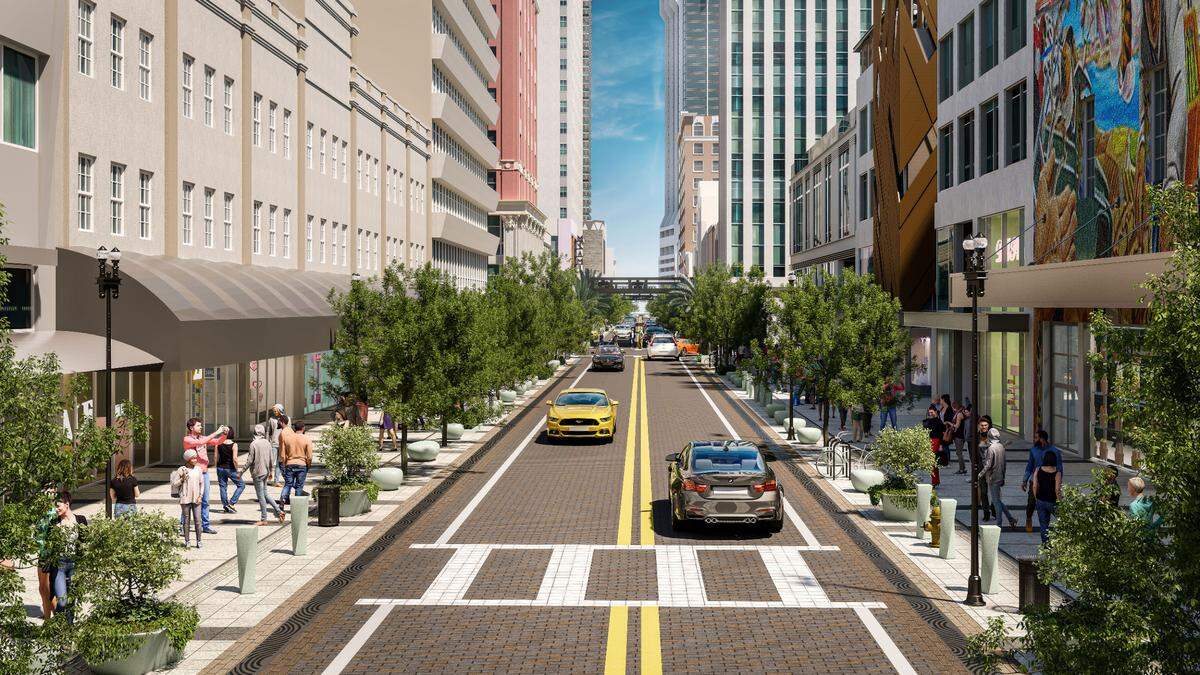
Setting the stage: a costly and ambitious city plan to completely rebuild Flagler Street itself that finally appears to be on track after years of false starts, delays and foul-ups. The $32 million scheme — championed by Mana after a previous makeover was stalled for a nearly a decade by the city’s managerial and contracting woes — will transform the half-mile-long stretch of Flagler from Biscayne Boulevard to the Miami-Dade County Courthouse into a stately, cobblestoned boulevard worthy of the street’s name and historical import.
Just as significantly, the street reconstruction, now underway and scheduled for a late 2023 completion, is bringing modern infrastructure — think new underground electrical vaults, fiber-optic communication lines and water and sewer mains — to a street where some buried pipes date back 100 years.
That doesn’t mean it’s smooth sailing yet for Flagler’s hoped-for turnaround.
The street rebuild, proceeding one block at a time, could still discourage the kind of foot traffic the new businesses will need to thrive. The coronavirus pandemic, meanwhile, helped kill some clubs and restaurants, ones fledgling and others long-established, including a Starbucks. Office and courthouse workers, meanwhile, have yet to return in force. A hard-core contingent of homeless people who decline help from Miami-Dade’s well-funded system of assistance continue to occupy sidewalks and the entryways of shuttered storefronts.
And the completion of certain new projects, from simply designed bars to complex top-to-bottom renovations, has been slowed considerably by permitting delays that business owners along Flagler — including Mana — blame on what they say is a lumbering and onerous city bureaucracy.
Flagler’s revival has been prematurely declared as fact more than once, only to fade away. This time, though, the experience, patience and financial resources of a new wave of entrepreneurs seem likely to bring a good half-dozen significant efforts to fruition, joining a handful of endeavors already making their mark on the corridor.
Those include:
▪ A full revamp of the historic Security Building, once home to a failed residential loft project and more recently home to downtown’s WeWork, which leased the 17-story building from 2017 until it ran into financial turmoil in 2021. A $10 million renovation by new owners has swapped out WeWork’s open floor plans and communal tables with private offices and cubicles, a coffee bar and bar in the lobby.
The elegant 1926 building, a rare example in Miami of French Second Empire architecture with a sloping copper mansard roof topped by a cupola and granite and terra-cotta facades, reopens this month as an office building with space for between four and 15 companies. The prior owner, Security Building AR Owner LLC, sold the tower to Security Building Miami LLC for $12 million in 2021 after facing a $46 million foreclosure lawsuit.
Security Building leasing agents say its modernization and revival presages a new day for the downtown core that hinges on Miami’s new appeal for firms focusing on technology and financial services, a fast-growing sector.
“A hundred years ago, we had a boom in downtown Miami. Instead of gas lamps, today we have LED lights. A hundred years later, we have another boom,” said Tony Arellano, one of the leasing agents for the building along with Marinoff.
The brokers expect to start signing leases this month. Based on interest from prospective tenants, the brokers see interest from fintech firms from across the country, Canada and Europe.
▪ Julia & Henry’s Eatery and Drinks will pack a food hall, speakeasy and office space into the Art Deco former Walgreens building, more recently home to the La Epoca department store, which closed in 2016. The food hall is named after Julia Tuttle and Henry Flagler, known as the mother and father of Miami, respectively.
Developer and owner Stambul, which acquired the Walgreens building in 2018 for $19.75 million, declined to provide an update on the project. When it was announced, Stambul said Julia & Henry’s would open its doors this spring. A look inside the front door suggests that won’t happen. Substantial construction work on the gutted building has begun, but appears to have a long way to go.
Stambul officers have said the idea for the speakeasy was inspired by the building’s Depression-era past. During Prohibition, Miami resident Al Capone supposedly used underground tunnels in downtown Miami to move booze. The five-story building opened in 1936, three years after Prohibition ended, as the country’s largest Walgreens store, featuring an 88-foot-long soda fountain counter inside a three-story atrium. Miami declared the building a historic and architectural landmark in 1988.
▪ One of the Flagler corridor’s few thriving and longstanding enterprises, a compact jewelry district centered around the famed Seybold Building, will expand substantially when the new Time Century Jewelry Center debuts in August.
Time Century Holdings President Yair Levy is spending $30 million to convert the eight-story former Metro Mall, for years a shuttered and rundown eyesore, into a one-stop magnet providing retail and wholesale merchandise and services for jewelry aficionados, including finished jewelry, precious stones and cleaning and repair.
“Downtown Miami is the existing jewelry center, but it needs something new,” said Levy, who enlisted his daughter, Time Century vice president Rafaela Levy-Obadiah and Time Century’s vice president, and son-in-law, Time Century managing director Ronald Obadiah, to help oversee construction and operations.
The building can accommodate 100 tenants, including retail and wholesale. Isis Pellegrino, who is handling leasing and formerly worked at competitor Seybold, has signed about 50 tenants so far. They’re coming from the Seybold across the street, from across the country — from Georgia, Michigan and New Jersey, among others — and from around the globe, including Turkey, Israel, Argentina, Brazil, Italy, Canada and Mexico.
Response has been so encouraging, Levy said, that he’s already envisioning new projects for himself and his family in downtown Miami. He wants to start working on a new hotel and condo as soon as next year to tap into downtown’s potential. He’s bullish on a promising future because of downtown’s close proximity to the Brightline rail line’s MiamiCentral station, the Brickell neighborhood and Interstate 95, a connection to many other parts of the city. He also sees the big investments others are pouring into downtown.
▪ Margot, a “natural” wine bar run by the group behind Miami Beach’s well known Broken Shaker lounge, opened last year to strong reviews and word-of-mouth in the historic Ingraham Building. Designed by Schultze and Weaver, the partnership behind the Freedom Tower and hotels like Coral Gables’ Biltmore, Palm Beach’s The Breakers and New York’s Waldorf-Astoria, the tower is another opulent standing vestige of the Roaring ‘20s in downtown Miami.
The bar, which snagged Miami New Times’ Best Wine Bar award in 2021, serves 80 natural vintages, low-alcohol cocktails and small dishes by Chef Jimmy Lebron, of 27 Restaurant & Bar, his eatery in the Broken Shaker’s Mid-Miami Beach location. A vintage ‘70s Marantz audio system cranks out background tunes.
▪ Lost Boy, a homey, unpretentious neighborhood bar that opens onto Flagler Street, has been packing them into its ground-floor space in the 1936 Alfred I. DuPont Building, Miami’s grandest post-Depression office tower, since opening in 2018. The bar was at first a clothing shop started by the Alonso family, owners of the La Epoca store, after they closed and sold the old Walgreens building, which stands catty-corner to the DuPont.
But family member Randy Alonso turned it into a watering hole after concluding that entertainment, not the retail that long characterized Flagler, is the street’s future. “We love the history, grit, and color of downtown, and are proud to serve the neighborhood,” Lost Boy’s website says.
Alonso and landlord Gary Ressler say they worry about the effect of the street reconstruction project, which moves to their block next, but hope the bar’s loyal clientele, which helped it weather the pandemic, will keep coming.
After COVID-19 restrictions were lifted, Alonso said, “we’re having the best six months we’ve ever had.”
Other entertainment entrepreneurs have placed their bets on the corridor along with Alonso.
▪ Next door to Lost Boy, Broken Shaker veterans opened Over Under, a bar serving some unusual bites, like crunchy gator bits, jackfruit nachos and wild boar empanadas. Eater named it one of the country’s best 11 new restaurants last year. Though it’s closed temporarily because of issues over its liquor license, landlord Gary Ressler said it will reopen by the end of April.
▪ Mama Tried, a funky late-night cocktail bar, sits around the corner. Another historic office tower, the 1925 Huntington Building, on Southeast First, houses upscale sports bar Black Market Miami.
▪ After years of construction work, Biscayne Bay Brewery says on its website that it’s “close to opening” a taproom in the historic, classically inspired Old U.S. Courthouse and Post Office, Miami’s first significant federal building, which dates to 1912. Gleaming copper tanks can be seen through the glass doors that flank the building’s grand front stairway, and banners advertising the brewery’s craft beers have been recently hung on its facade.
But brewery President Jose Mallea did not return messages from the Miami Herald asking for an update on the project. And his landlord, building owner Stambul, the developer behind the old Walgreens building revamp, declined to speak for this story.