If you’re preparing for the CPA exam and wondering which of the CPA exam sections you should take first, I have the answer for you.
Spoiler alert: It’s the FAR section.
Now, hold up a minute. I know what you’re thinking. “Is FAR really the best place to start for everyone?” Well, the short answer is that it depends. But for many of you, getting ready to dive into the CPA exam and kicking things off with Financial Accounting and Reporting (FAR) is a smart move.
Why, you ask?

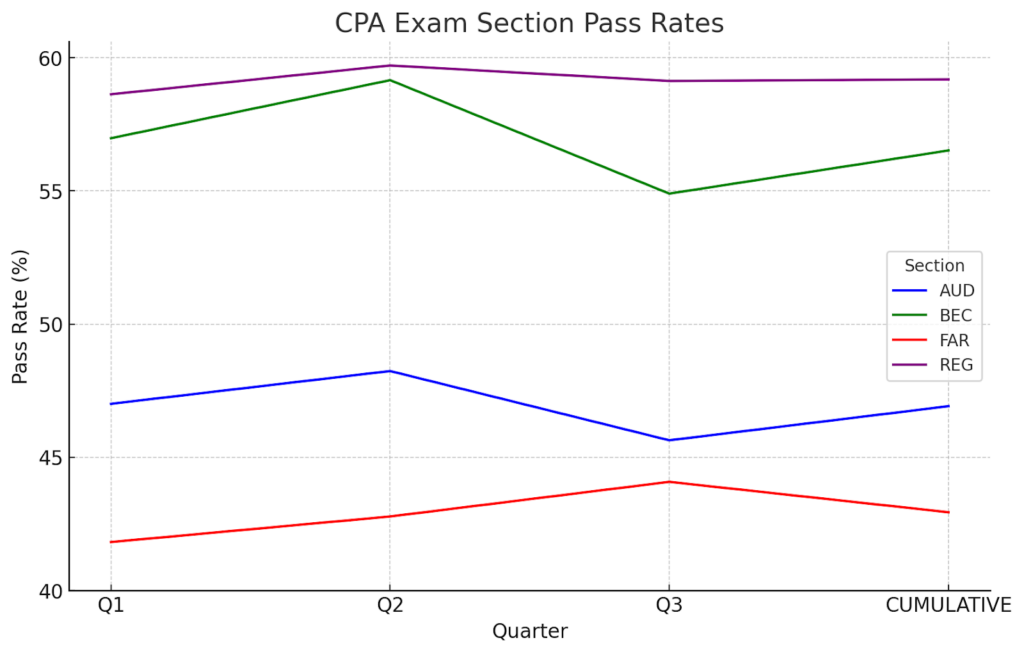
Well, for starters, it’s got a bit of a reputation as the toughest section, with stats that show less than 43% of folks passing it.
That might sound a bit intimidating, but hear me out. FAR covers a ton of ground on financial accounting and reporting rules, and getting through it first can give you a serious confidence boost. Plus, it lays down a solid foundation of knowledge that will come in handy for the other sections. ‘
So, let’s get into why tackling FAR first might just be the best play you make.
Key Takeaways
- Tackling FAR first lays a solid foundation for other CPA exam sections due to its comprehensive scope.
- Passing the challenging FAR section first can significantly boost a candidate’s confidence.
- Knowledge from FAR is crucial for understanding concepts in other exam sections, making subsequent studies more manageable.
- Starting with FAR helps develop disciplined study habits that are beneficial throughout the CPA exam process.
The Beast of the CPA Exam: Which to Take First?
Starting with FAR sets a solid foundation for the rest of your CPA journey. It’s like learning to swim in the deep end; once you’ve got that down, everything else seems a bit easier. The knowledge you gain from FAR is not just foundational; it’s critical for understanding the other sections, especially AUD (Auditing and Attestation) and REG (Regulation), which include elements of financial reporting and federal taxation.
FAR is often seen as the beast of the CPA exam. It’s not just about the volume of material—it’s the depth. From the conceptual framework to the nitty-gritty of financial statement accounts, FAR spans a broad spectrum of financial accounting and reporting. This includes everything from the basics of accounting principles to more complex areas like federal taxation and financial management.







Big Test, Big Changes
Also, many CPA candidates don’t feel that the CPA exam blueprints for FAR accurately represent the way this Uniform CPA exam section is structured. As cavalierzebra7 from Reddit put it, “They might as well just rename the test to government and nonprofit reporting…FAR says gov is only 5–15%; definitely felt like way more than that…”
Others on the thread agreed, with one stating, “There’s a reason why they put NFP and Gov at the end of Becker. They want it fresh in your mind on test day. If you get the basics of NFP and Gov it makes passing easier because so many MCQ are related to it.”
Although the 2024 blueprints claim that this will change, with much of it shifting to the corresponding CPA exam discipline, how much remains to be seen? Only the top online CPA prep courses stay up to date when it comes to creating study plans for core exams like FAR.
The Psychological Edge of Taking FAR First
There’s also a psychological advantage to taking on the hardest section first. Passing FAR can give you a significant confidence boost. It’s like climbing the highest mountain first; after that, the others don’t seem so daunting. Plus, knowing you’ve conquered the section with the lowest pass rate can keep you motivated through the rest of your CPA exam journey.
As you can see here, FAR had the lowest pass rates of all CPA exam sections every quarter in 2023, finishing with a 43% pass rate over the year.
Here are some Reddit comments from those who passed the FAR section of the CPA exam:
“I checked my portal and had a PASSED, Credit in my exam section history!!! This is my first CPA exam. It took me like 4 months to study because I didn’t know how to approach it at first (that learning curve is real).” – melocoton22
“This was my first time taking any part of the CPA exam and man it was grueling. I put it probably 200+ hours of studying and sacrificed some of my summer, but I managed to get an 81. After finishing the exam, I wasn’t confident that I passed and was definitely leaning more towards fail…If I can pass, I guarantee you all can, too. I’m just relieved to be done with FAR. On to audit!” – IslandMidnight
“This was my first attempt and passed FAR with 76!! I thought I’d fail because I guessed most of the Sims questions in Testlet 3. And I was so nervous when taking the exam because English is not my first language and other people except me left the test room way earlier than me, so I was alone when I submitted the exam. Now it’s time to move on to AUD.” – Quiet_Afternoon196
The Ripple Effect After Passing the FAR Exam
The knowledge you gain from studying for FAR has a ripple effect on the other sections. Understanding financial statements, for example, is crucial not just for FAR but also for AUD and REG. Similarly, while more directly tested in REG, a grasp of business law and federal tax procedures is also beneficial for FAR. This interconnectedness means that starting with FAR can make studying for the other sections more efficient.
Here’s how FAR prepares you for each discipline:
- Business Analysis & Reporting (BAR): FAR’s focus on financial reporting and accounting principles directly supports the BAR discipline, enhancing your understanding of business analysis, data management, and the preparation and analysis of financial statements.
- Tax Compliance & Planning (TCP): The foundational knowledge from FAR about financial statements and transactions provides a base for understanding tax compliance and planning strategies, helping you navigate the complexities of tax laws and regulations.
- Information Systems & Controls (ISC): While ISC focuses on technology and controls, the financial reporting knowledge from FAR is essential for understanding how financial data is managed, protected, and audited within information systems.
A Few Reasons to Consider Other Sections
Of course, there are a few reasons you might choose a different section to start with. If you’ve recently taken an audit class or if you’re working in a role that gives you a lot of exposure to another discipline, it might make sense to capitalize on that fresh knowledge or experience. However, for most candidates, FAR remains the best bet for setting the tone for your CPA exam success.
Final Thoughts
In the grand scheme of your CPA journey, selecting FAR as your first exam section could be your best strategy. It’s not just about getting the hardest section out of the way; it’s about building a strong foundation, developing effective study habits, and gaining confidence. With FAR under your belt, the rest of your CPA exam feels like smooth sailing. So, buckle up, dive into those financial reporting standards, and let FAR be the first step toward your CPA success story.
FAQ
Choosing the right order can influence your study effectiveness and motivation, potentially easing the path to passing all sections.
While there’s no one-size-fits-all approach, starting with FAR is often advised due to its broad content that lays a foundational understanding beneficial for other sections.
FAR is chosen first by many for its extensive coverage of accounting principles, making subsequent sections seem less daunting by comparison.
Yes, candidates are free to take the CPA exam sections in any order they prefer, allowing them to tailor their exam strategy to their strengths and schedule.
Consider starting with the section you’re most familiar with or the one you find most challenging. Assessing your own comfort level and strategic goals can guide this decision effectively.

![McKissock Promo Codes for Real Estate [Verified Discounts]](https://www.miamiherald.com/careers-education/wp-content/uploads/sites/2/2026/07/McKissock-Coupons-feature-img-1024x605.png)

![Hogan School of Real Estate Promo Code [Verified Discount]](https://www.miamiherald.com/careers-education/wp-content/uploads/sites/2/2026/07/Hogan-Promo-Code-feature-img-1024x717.png)