Most people have taken at least one language class in school. But let’s be real, a few quizzes and vocab sheets usually aren’t nearly enough to become fluent.
There are so many reasons to learn a foreign language, from easier travel to better career options.
The best part?
You don’t have to start with the hardest one. Some languages simply give English speakers a head start; why not make the most of it?
So today, I’m breaking down the top 5 easiest languages for English speakers—and why they click faster. Let’s dive in.
Key Takeaways
- Easy Still Takes Work: These languages are simpler, not effortless.
- Your Goal Matters: Travel, work, or speaking can change the best pick.
- Quick Wins Help: Early progress makes it easier to keep going.
- Every Language Has a Catch: Some are easy to read but harder to speak.
- Location Helps: Hearing it around you makes practice easier.
Why Some Languages Are Easier for English Speakers to Learn
A language feels easier when it gives you shortcuts. Familiar words, clear sounds, and normal sentence order make it easier to pick up faster.
A few things make the biggest difference:
- Shared Words: Similar words help you guess meanings faster
- Clear Sounds: Words are easier when they sound how they look
- Sentence Order: Phrases feel easier when they’re built like English
- Same Letters: You can start reading without learning a new alphabet
- Real-Life Use: Hearing or using the language helps it stick
“Harder” languages usually add more at once: new letters, new sounds, different rules, and words that look nothing like English. That doesn’t make them impossible, just slower to pick up.
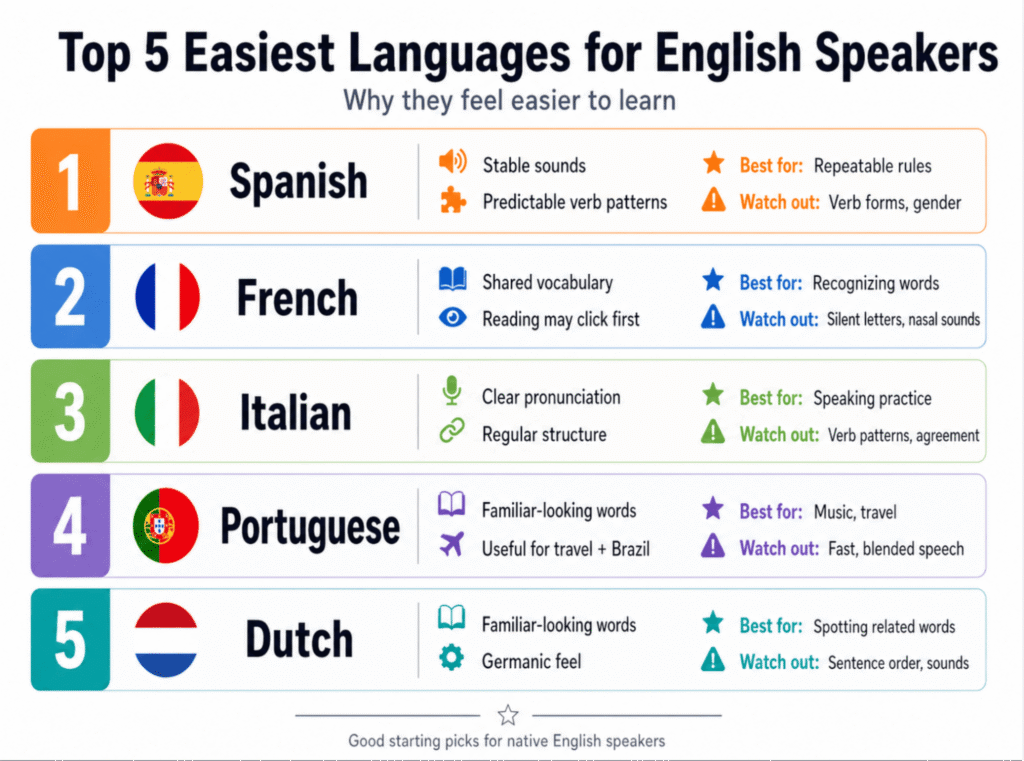
1. Spanish → Consistent Sound System & Predictable Verb Patterns
Spanish has a stable sound system. Each vowel has one sound, and most letters don’t change depending on the word. That means once you learn the basics, you can read new words out loud without guessing.
Spanish also uses verb conjugations, but they follow patterns. Once you learn how verbs change, you reuse that system over and over. It’s not random, just repetitive. The sentence order is similar to English, so building basic phrases feels more natural than in languages where verbs move around.
Best For: Learning a repeatable system
Watch Out For: Verb forms and gender agreement
French is not easy in every way, but the vocabulary does give English speakers a small head start. You’ve probably seen French words without thinking about it, like café, menu, déjà vu, ballet, chef, and Mardi Gras. That doesn’t mean French sounds like English, because it really doesn’t. It just means reading can feel less foreign than speaking at first.
The difficulty shows up in pronunciation. French uses silent letters, connected speech, and nasal sounds that don’t exist in English. Because of that, it’s common to understand written French before feeling confident speaking it.
Best For: Reading and recognizing words
Watch Out For: Sound and spelling not matching
3. Italian → Clear Pronunciation With Regular Structure
In the Italian language, spelling matches the sound closely. Most words are pronounced the way they’re written, which removes a lot of early confusion. For example, amico is pronounced “ah-mee-koh,” and each vowel is actually said. You’re not dealing with a bunch of silent letters.
The grammar still includes verb changes and gender, but the patterns stay consistent. That makes it easier to learn over time because the rules feel more repeatable.
Italian is especially beginner-friendly for speaking because the pronunciation is clear, smooth, and easier to follow out loud.
Best For: Clear speaking and steady progress
Watch Out For: Verb patterns and agreement
4. Portuguese → Familiar Words With Smooth, Blended Speech
Portuguese is not always the first language people think of, but it has way more reach than people realize. It’s spoken in Brazil, Portugal, Angola, Mozambique, and a few other places, so it opens up a lot more than just one country.
Some words are also easy to remember because they look familiar. Casa means house, música means music, and família means family. So you’re not starting from zero every time.
The catch is how it sounds. Spoken Portuguese can be soft, fast, and blended, so reading may click before listening does. Phrases like tudo bem? Phrases like “all good?” or “how are you?” are useful early on, but real conversations still take practice.
Best For: Familiar words, music, travel, and Brazil-focused learning
Watch Out For: Fast speech, blended sounds
5. Dutch → Familiar Words With Weird Sentence Flow
Dutch has words that look like strange cousins of English words. Water means water, “appel” means apple, and “kat” means cat, so parts of it can feel easy to spot early.
The tricky part is sentence flow. Dutch can move the action word to places that feel unnatural, especially in longer sentences.
In English: “Today I go to school.” In Dutch: “Vandaag ga ik naar school.” Direct translation: “Today go I to school.”
That little switch is what makes Dutch interesting. It’s not that the words are impossible. It’s that the sentence rhythm works differently, so your brain has to get used to hearing the action earlier or later than expected.
Best For: Familiar words and a Germanic feel
Watch Out For: Sounds and sentence order
Which Language Should You Really Learn?
The easiest language is not always the best one for you. Pick the one you will actually use, enjoy, and feel excited to keep learning.
- Want something you’ll actually use day-to-day? → Spanish
- Want words that already feel familiar? → French
- Want to sound good when speaking early? → Italian
- Want a smooth, global language with a cool vibe? → Portuguese
- Want something a little different but still recognizable? → Dutch
Pro Tips For Learning Any Language
My biggest advice is to keep it fun and simple because a few small habits can make learning feel way more natural.
- Listen To Music: Play songs in the language, which helps recognize words.
- Try A Fun Quiz: Use a quick game or quiz to learn words without feeling bored.
- Join A Course: A course or study app can give you easy steps to follow.
- Grab A Buddy: Learn with a friend so it feels less awkward.
- Start Small: Start with smaller words you’ll actually say, like food, places, and greetings.
Final Verdict
The easiest languages for English speakers are not magic shortcuts. They just give you a smoother place to start.
That is what makes languages like Spanish, French, Italian, Portuguese, and Dutch such good starting points. They still take practice, but they give you enough early wins to feel like you are actually learning.
So, the real goal isn’t to find a “perfect” language; it’s to start with one that feels doable, useful, and exciting enough to keep coming back to.
FAQs
The Foreign Service Institute rankings indicate that Spanish, French, Italian, Portuguese, and Dutch are among the easiest languages. They usually take less time because they share familiar words, use the same alphabet, or have patterns that are easier to pick up.
Spanish is highly phonetic with consistent pronunciation rules, making it easier to read and speak. It also offers abundant learning resources and practical advantages in the U.S., helping learners achieve conversational ability quickly.
French shares many cognates with English, giving learners a head start in vocabulary. While pronunciation can be challenging, French is especially useful for academic reading and professional contexts due to familiar words and global relevance.
Languages are easier when they have shared vocabulary with English, predictable pronunciation, familiar grammar, abundant learning resources, and when learners have motivation and exposure to the language in real contexts.
Spanish is often the best choice for quick conversational skills because of its phonetic spelling, consistent sound rules, and wide availability of learning materials, making real-world communication more accessible early on.

![Learn Laugh Speak Promo Code [Verified Coupons]](https://www.miamiherald.com/careers-education/wp-content/uploads/sites/2/2026/10/learn-laugh-speak-promo-code-mh-1024x768.jpg)

![Rocket Languages Promo Code [Verified 2026 Discounts]](https://www.miamiherald.com/careers-education/wp-content/uploads/sites/2/2026/07/rocket-languages-coupon-1-1024x768.jpg)
![Rosetta Stone Discount Promo Code [Verified Coupons]](https://www.miamiherald.com/careers-education/wp-content/uploads/sites/2/2026/07/rosetta-stone-discount-1024x768.jpg)