75 questions. 1 hour and 45 minutes. A lot of securities information packed into one exam.
The SIE is considered an entry-level exam, but that does not mean you can skim a few definitions and pass. Products, risks, trading rules, customer accounts, and regulations can start blending together quickly.
As a test prep reviewer, I know studying gets easier once you stop treating every topic like it deserves equal attention.
In this guide, I’ll show you what to study, where most of the questions come from, and how to prepare without wasting time on material you already understand.
Here is what you need to know:
Key Takeaways
- Start With a Diagnostic: Identify your strengths and weak spots before you begin studying.
- Prioritize High-Weight Topics: Spend more study time on the sections that make up the largest portion of the exam.
- Understand the “Why”: Focus on how products and risks connect instead of relying only on memorization.
- Learn From Mistakes: Review missed questions to understand what went wrong and strengthen weak areas.
- Use the Final Week Wisely: Focus on practice questions and review rather than trying to cram new material.
Know Where the Points Come From for the SIE Exam
The SIE includes 75 scored questions and 10 unidentified pretest questions. You have 1 hour and 45 minutes and need a passing score of 70.
Here is how the scored questions are divided:
- Products and their risks: 33 questions
- Trading, accounts, and prohibited activities: 23 questions
- Capital markets: 12 questions
- Regulatory framework: 7 questions
Products and trading account for 56 of the 75 scored questions. That should shape your study time. Spend the most time understanding investments, risks, orders, accounts, and prohibited conduct.
Still cover the smaller sections. You just do not need to give seven regulatory questions the same number of study hours as 33 product questions.
Choose One Study Setup and Make a Schedule
Start by choosing one main resource instead of collecting five books, three apps, and a pile of random videos.
Your setup could be:
- A self-paced SIE course with lessons and a question bank
- A textbook paired with online practice questions
- Live classes if you need deadlines and instructor help
This comparison of the best SIE prep courses can help you choose based on price, support, and learning format.
Once you have your materials, take the included diagnostic without notes. A low starting score is normal. What matters is whether the results show which topics gave you trouble.
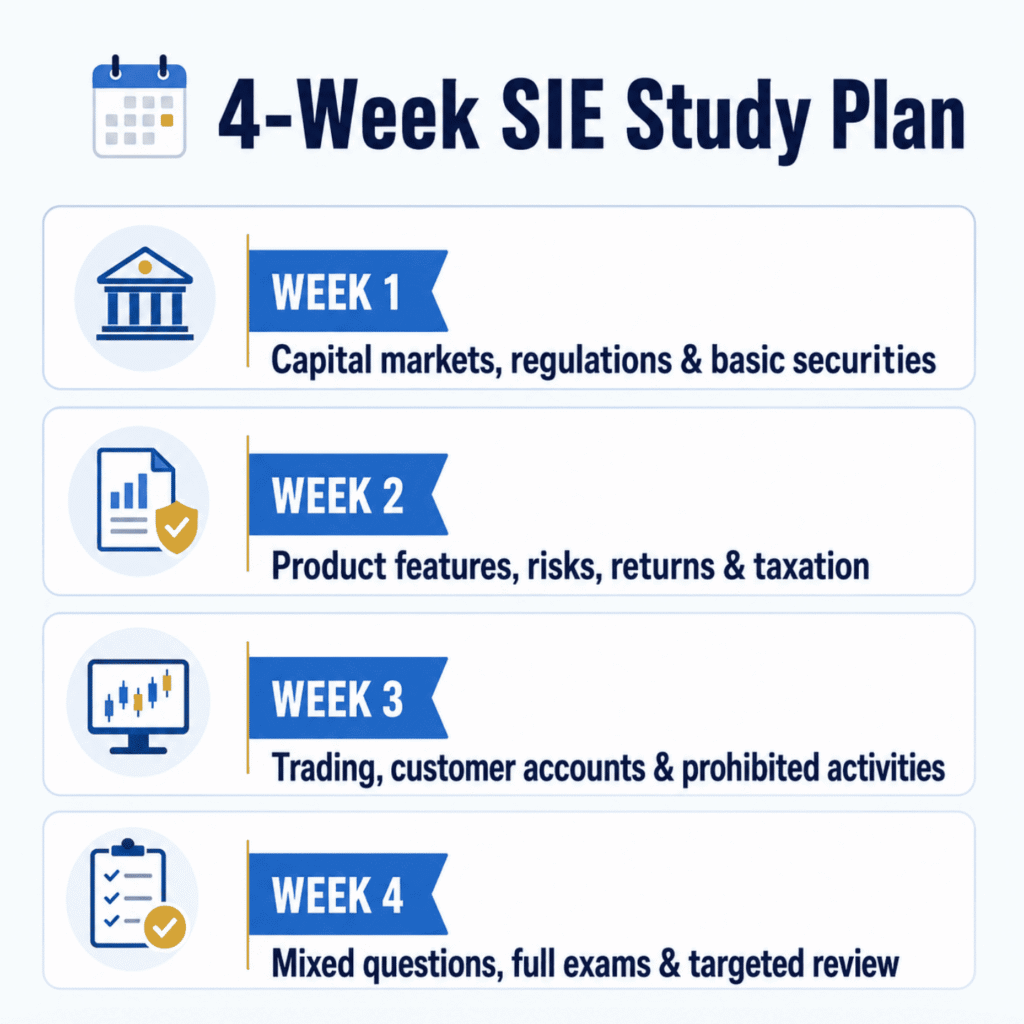
Use that breakdown to adjust a simple four-week schedule:
- Week 1: Capital markets, regulations, and basic securities
- Week 2: Product features, risks, returns, and taxation
- Week 3: Trading, customer accounts, and prohibited activities
- Week 4: Mixed questions, full exams, and targeted review
Add more time if several topics are completely unfamiliar. Your schedule should match your starting point, not someone else’s countdown online.
Study Connections, Not Isolated Definitions
The SIE does test terminology, but memorizing a definition will not always help when two answers sound correct.
After studying a product, make sure you can answer four questions:
- How can it make money?
- What can make it lose value?
- How liquid is it?
- Why might an investor choose it?
Then compare concepts you keep confusing. Put common and preferred stock side by side. Do the same with mutual funds and ETFs, market and limit orders, calls and puts, and traditional and Roth IRAs.
Keep flashcards for facts that have one short answer, such as formulas, definitions, regulatory organizations, and time limits. Use a separate one-page sheet for comparisons and rules that need more explanation.
After each lesson, close the material and explain it out loud. If you cannot explain the idea without borrowing the textbook’s wording, go through that part again.
Practice in Stages
I’d aim for approximately 400–500 practice questions before taking the SIE, but they should not all be completed the same way.
Begin with short sets covering the lesson you just finished. These show whether you understood the material before you move forward.
After covering several chapters, switch to mixed sets. Now you have to recognize what the question is testing instead of already knowing the category.
For every missed question or lucky guess, record:
- The concept being tested
- Why your choice was wrong
- Why the correct answer was better
- The clue you overlooked
If the same mistake appears again, return to that lesson and complete another targeted set. Do not keep answering new questions while carrying the same misunderstanding forward.
Save full-length exams for after you have covered the curriculum. Use fresh questions whenever possible so you are measuring understanding rather than remembering answers.
Common SIE Study Mistakes: What to Do Instead
| Common Mistake | Do This Instead |
|---|---|
| Reading the textbook from beginning to end without testing yourself | Complete a short quiz after every lesson. |
| Giving every topic the same amount of study time | Spend more time on products, trading, and accounts. |
| Memorizing definitions without understanding the differences | Compare similar products, orders, and account types side by side. |
| Counting lucky guesses as mastered questions | Review anything you could not confidently explain. |
| Taking full exams before finishing the material | Begin with topic quizzes and save mock exams for later. |
| Repeating practice questions until you remember the answers | Use fresh questions to check whether the concept actually stuck. |
| Cramming during the final few days | Follow a schedule and use the last week for targeted review. |
Follow a Focused Final-Week Plan
The final week is for fixing specific problems and putting everything together.
- Seven days before: Take a fresh practice exam and find your two weakest areas.
- Days five and six: Review those lessons and complete 30–50 targeted questions for each area.
- Day four: Complete a mixed set covering the entire exam.
- Day three: Take your final full-length practice exam.
- Day two: Review missed questions, formulas, and rules you still confuse.
- Day one: Complete a short quiz, read your condensed notes, and stop studying early.
Avoid rereading the entire textbook or opening a new course during this week. Your practice results should tell you exactly what still needs attention.
My Final Thoughts on Studying for the SIE
My formula for how to study for the SIE exam is simple: learn in layers, test yourself often, and let your results decide what comes next.
You are not supposed to feel ready on day one. What matters is that your practice scores improve, your guesses become real answers, and concepts that once looked unfamiliar start feeling automatic.
Give yourself enough time to reach that point. The SIE becomes much less intimidating once you can see proof that your studying is actually working.
FAQs
How long should I study for the SIE exam?
Most beginners should give themselves around four to eight weeks. Your SIE study plan may be shorter if you already understand securities, markets, and trading. Someone completely new to finance may need closer to 70–100 total study hours.
Is the SIE exam hard for beginners?
The SIE is manageable without a finance background, but the vocabulary can feel like another language at first. A structured SIE study guide can help you learn the exam content in order instead of jumping between unrelated securities terms.
Can I study for the SIE without a prep course?
Yes, but you will still need lessons or a textbook, practice questions, and full-length exams. An SIE exam prep course makes the process easier by keeping those materials together and tracking what you have completed.
What score should I get on SIE practice exams?
Try to score around 80% or higher consistently on fresh, closed-book exams. One high score on repeated questions does not mean much. You should feel comfortable explaining your answers before taking the actual exam.
Can you pass the SIE exam on your first try?
Yes. Passing on your first attempt is realistic when you follow a consistent study plan, complete enough practice questions, and review the reasons behind your mistakes instead of only memorizing answers.


![ESG Institute Coupon [Verified Discounts]](https://www.miamiherald.com/careers-education/wp-content/uploads/sites/2/2026/09/esg-institute-discount-code-mh-1024x768.jpg)