NHTSA reported 6.14 million police-reported crashes in 2023.
That works out to about 700 crashes every hour across the U.S.
So while car wrecks (unfortunately) bring job plenty of job security, claims adjusters also handle damage from storms, fallen trees, fires, floods, and more.
If you are wondering how to become a claims adjuster, I’ll walk you through the process, from checking your state’s rules to choosing a license and finding your first job. Let’s dive in.
Key Takeaways
- Education Requirements: Most entry-level jobs do not require a degree.
- State Licensing: Some states require adjusters to hold a license.
- Career Paths: Several different types of adjuster jobs are available.
- Paid Training: Insurance companies may provide paid training.
- More Opportunities: Additional state licenses can expand your work options.
Claims Adjuster Role, Salary, and Work Environment
A claims adjuster investigates an insurance claim and helps decide how much should be paid.
You may inspect damage, interview the customer, review reports, check the insurance policy, estimate repair costs, and write up your findings.
Where Adjusters Work
- Desk adjusters handle most of their claims by phone, email, and computer.
- Field adjusters travel to inspect damaged homes, vehicles, or businesses.
- Catastrophe adjusters may travel to areas hit by hurricanes, floods, tornadoes, or wildfires. The work can pay well during busy periods, but the hours may be rough.
Most adjusters work for insurance companies or independent adjusting firms. Public adjusters are different because they represent the policyholder instead of the insurance company.
Claims Adjuster Salary
Claims adjusters, examiners, and investigators earned a median salary of $76,790 in May 2024, according to the BLS.
Your potential pay will depend on your location, employer, experience, and specialty. Independent and catastrophe adjusters may earn more during major disasters, but their income can be less predictable.
Meet the Education, Age, and Background Requirements
You usually need a high school diploma or GED to become a claims adjuster. A college degree can help with certain jobs, but it is not a standard requirement for entering the field.
If you are still mapping the broader license path, see how to get an insurance license.
Many states also require applicants to be at least 18 years old. Other rules depend on where you live.
Your state may ask for:
- A background check
- Fingerprints
- Proof of identification
- Information about past legal or regulatory issues
- A valid driver’s license for field positions
A past charge does not always mean your application will be denied. Be honest on every application and provide any documents the state requests.
Skills That Actually Help
Claims adjusting is not only about understanding insurance. You also need to stay calm while dealing with people who may be angry, confused, or having one of the worst weeks of their lives.
Strong writing, basic math, organization, and customer service skills all matter. Experience in construction, auto repair, healthcare, law, or office work can also give you a head start.
Choose the Right Claims Adjuster License for Your Career
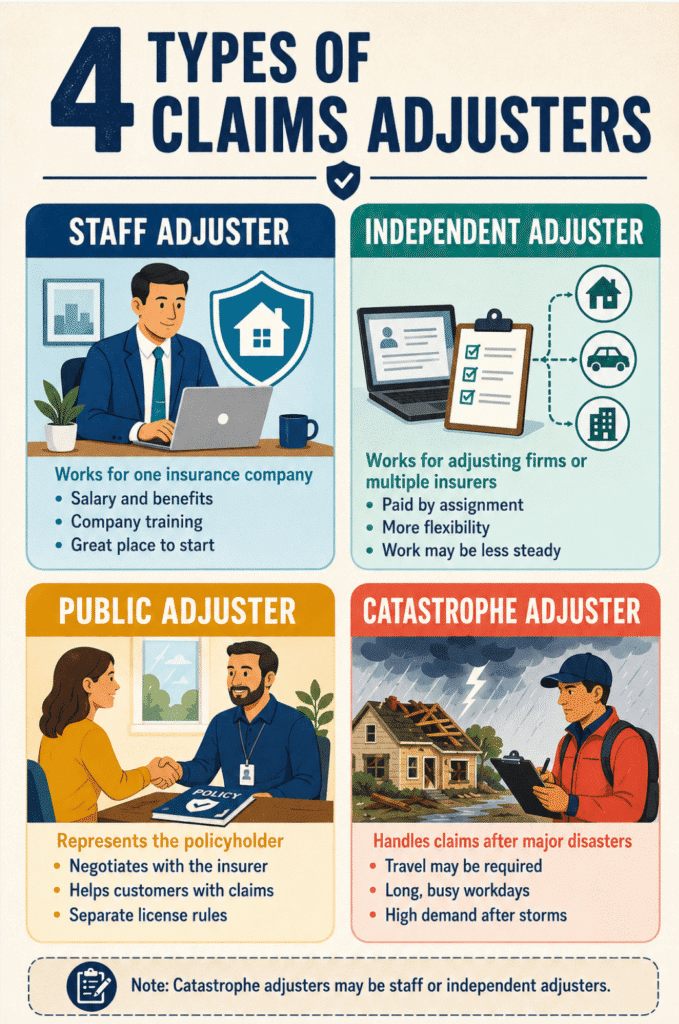
Before choosing a course, decide what kind of adjuster you want to become.
Staff Adjuster
A staff adjuster works directly for one insurance company. You are normally a regular employee and may receive a salary, benefits, equipment, and company training.
This is often the easiest route for beginners.
Independent Adjuster
An independent adjuster works for adjusting firms or handles assignments from different insurance companies.
You may have more freedom, but work is not always guaranteed. Independent adjusters are often paid based on the assignments they complete.
Public Adjuster
A public adjuster works for the policyholder and helps them negotiate with their insurance company.
Public adjusters follow different licensing and contract rules. Do not choose this license unless you specifically want to represent policyholders.
Catastrophe Adjuster
Catastrophe adjusters respond after major disasters. They may work long days, travel with little notice, and handle a large number of claims quickly.
The income can be appealing, but it is not easy money. The work can be stressful, physical, and unpredictable.
What If Your State Does Not License Adjusters?
Some states do not issue resident claims adjuster licenses. If you live in one, you may be able to get a designated home state license somewhere else.
That license can give you a home state for licensing purposes and may help you apply in other states. Check your eligibility through your state insurance department or the NIPR state requirements page.
Complete Prelicensing Training and Pass the State Exam
Some states require an approved prelicensing course before you can take the claims adjuster exam. Other states allow you to take the exam without completing a course first.
Course requirements and exam rules are different everywhere, so always check your state’s current instructions.
What You Will Study
Claims adjuster courses commonly cover:
- Insurance policies and terminology
- Property and casualty coverage
- Claim investigations
- Repair and replacement costs
- Settlement practices
- State laws and ethics
Pay attention to terms like deductible, subrogation, indemnity, actual cash value, and replacement cost. They can sound like insurance nonsense at first, but they show up constantly.
How to Prepare for the Exam
Start with the official exam outline so you know which subjects matter most.
Take practice tests, but do not memorize the answer letters. Review every missed question and make sure you understand why your answer was wrong.
You should also complete at least one timed practice exam without notes. It is better to discover your weak areas at home than during the real test.
Pro tip: A prep course can make the material much easier to follow. Check out my review of the best claims adjuster courses to compare your options.
Apply for Your License, Find Work, and Maintain Your Credentials
After passing the exam, submit your license application through your state insurance department, NIPR, or Sircon.
You may need to provide your exam results, fingerprints, background information, and other documents. Wait until your license appears as active before accepting work that requires it.
Finding Your First Job
Try searching for:
- Claims adjuster trainee
- Claims representative
- Auto claims trainee
- Inside property adjuster
- Junior claims adjuster
Large insurance companies often hire beginners and teach them how to use claim software, read policies, speak with customers, and document decisions.
You can also join independent adjusting firm rosters. However, being added to a roster does not guarantee that you will receive assignments.
Keeping Your License Active
Your state may require continuing education and regular renewals. The deadline and number of hours depend on where you are licensed.
You may eventually apply for licenses in other states through reciprocity. Just avoid collecting random licenses with no work plan because every license costs money to obtain and maintain.
Final Thoughts
You do not need an insurance background or a college degree to start working toward this career. You do need to choose the right type of adjusting work and follow your state’s licensing rules carefully.
A staff trainee position is usually a practical place to begin. You can learn the job, gain experience, and decide later whether you want to move into independent or catastrophe work.
Start with your home state’s requirements. Once you know whether you need a course, an exam, and a license, the rest becomes much easier to plan.
If the exam is the part that worries you, read how hard the insurance license exam is.
FAQs
How long does it take to become a claims adjuster?
It may take a few weeks to several months. Your timeline depends on course requirements, exam dates, application processing, and your job search.
Do you need a degree to become a claims adjuster?
A college degree is optional for most claims adjuster jobs. Many employers accept applicants who finished high school or earned a GED, especially for trainee roles.
Is the claims adjuster exam difficult?
It can be challenging because insurance terms and state laws may be completely new to you. A good course and realistic practice exams can make it much easier.
Can you become a claims adjuster without experience?
Yes. Search for trainee positions that provide beginner training. Customer service, construction, auto, medical, or office experience can still help your application.
How much do claims adjusters make?
The median annual salary was $76,790 in May 2024. Pay varies based on your location, employer, experience, and the types of claims you handle.
Can claims adjusters work from home?
Yes, some desk adjusters work remotely and handle claims through phone calls, email, and claims software. Field adjusters still travel to inspect damage.
Can a claims adjuster work in multiple states?
Yes, but you may need a separate license for each state. Reciprocity can simplify the process, although you still have to apply and meet each state’s rules.

![Bluehost Promo Codes and Discounts [Verified Coupons]](https://www.miamiherald.com/careers-education/wp-content/uploads/sites/2/2026/10/bluehost-promo-code-mh-1024x768.jpg)
![Incogni Promo Codes [Verified Discounts]](https://www.miamiherald.com/careers-education/wp-content/uploads/sites/2/2026/10/incogni-promo-code-mh-1024x768.jpg)
![Shopify Promo Codes [Verified Discounts]](https://www.miamiherald.com/careers-education/wp-content/uploads/sites/2/2026/10/shopify-promo-code-mh-1024x768.jpg)