
The insurance license exam is moderately difficult, especially for first-time test takers. Pass rates vary by state and license type, but many exams have reported pass rates between 50% and 70%.
Still, most candidates can pass with consistent studying and plenty of practice questions. Here’s what makes the exam challenging, which license exams are the hardest, and how to prepare.
Key Takeaways
- The Exam Is Manageable: Most candidates can pass with consistent preparation.
- Pass Rates Vary: Reported pass rates commonly range from approximately 50% to 70%.
- P&C Is Often the Hardest: Property and Casualty covers a particularly wide range of policies, risks, and regulations.
- Applica/tion Matters: Candidates must apply insurance concepts, not simply memorize definitions.
- State Laws Are Important: Every state has unique rules that may appear on its licensing exam.
- Practice Tests Help: Exam-style questions can reveal weak areas and make the test format feel more familiar.
How Difficult Is the Insurance License Exam?
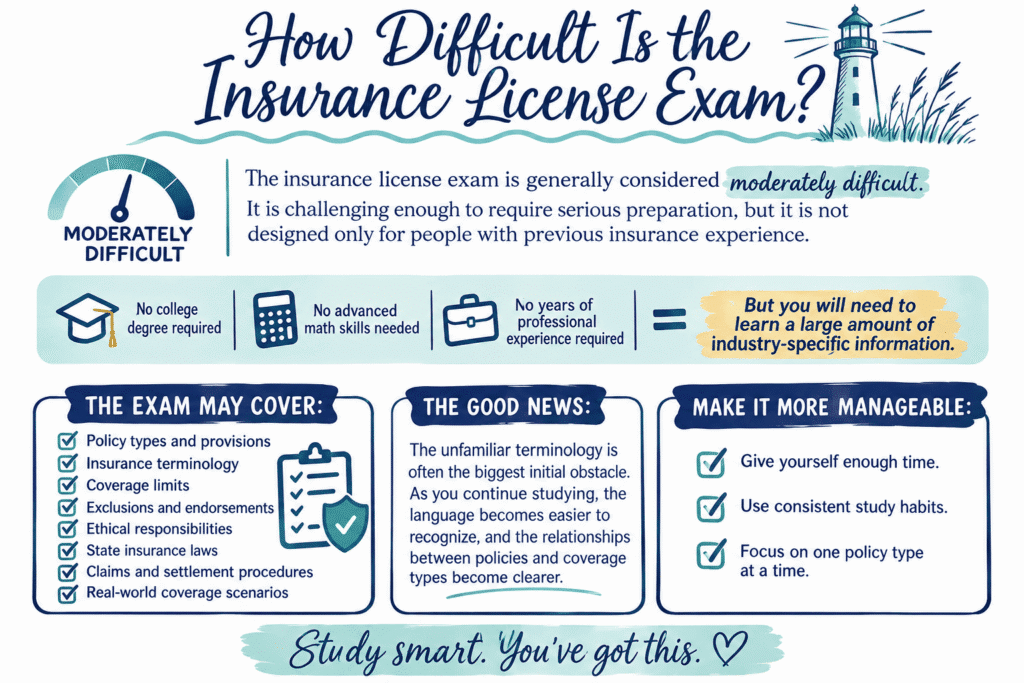
The insurance license exam is generally considered moderately difficult. It is challenging enough to require serious preparation, but it is not designed only for people with previous insurance experience.
You do not typically need a college degree, advanced math skills, or years of professional experience to understand the material. However, you will need to learn a large amount of industry-specific information.
The exam may cover:
- Policy types and provisions
- Insurance terminology
- Coverage limits
- Exclusions and endorsements
- Ethical responsibilities
- State insurance laws
- Claims and settlement procedures
- Real-world coverage scenarios
The unfamiliar terminology is often the biggest initial obstacle. As you continue studying, the language becomes easier to recognize, and the relationships between policies and coverage types become clearer.
The exam becomes much more manageable when you give yourself enough time, use state-specific study materials, and complete practice questions throughout your preparation.
What Is the Insurance License Exam Pass Rate?
There is no single national pass rate for all insurance licensing exams. Each state oversees its own licensing requirements, and pass rates can differ based on the exam category, year, and testing provider.
Many insurance licensing exams have reported pass rates between 50% and 70%. That means a significant number of candidates may not pass on their first attempt.
The Property and Casualty exam pass rate, for example, is commonly estimated at around 50% to 60%, although the actual rate varies by state and testing period.
These numbers may sound intimidating, but they do not mean that passing is unlikely. Candidates sometimes struggle because they underestimate the test or depend too heavily on passive studying.
Reading a textbook once is rarely enough. Successful candidates usually spend time reviewing difficult concepts, completing practice exams, and learning how insurance rules apply in real situations.
Why Do Candidates Fail the Insurance License Exam?
Many candidates who fail are capable of passing but are not fully prepared for the exam’s format or depth.
Common reasons for failing include:
- Waiting until the last minute to study
- Memorizing definitions without understanding them
- Skipping state-specific regulations
- Taking too few practice exams
- Ignoring weak subject areas
- Misreading questions containing words like “not” or “except”
- Scheduling the exam before earning consistent practice scores
Some candidates assume the exam will be easy because insurance licensing does not always require a degree. However, the absence of a degree requirement does not mean the exam can be passed without preparation.
Approaching the test like a serious professional credential can help you avoid this mistake.
What Makes the Insurance License Exam Challenging?
Several factors influence how difficult the exam feels.
The Volume of Insurance Terminology
Insurance uses hundreds of legal, financial, and policy-related terms.
You may need to understand words such as:
- Indemnity
- Subrogation
- Insurable interest
- Consideration
- Fiduciary
- Endorsement
- Exclusion
- Replacement cost
- Actual cash value
Recognizing a definition is only the first step. You also need to know how that term affects a policy, customer, insurer, or claim.
Flashcards are useful, but try to connect each definition to an example. That will help you answer questions that require more than simple recall.
Scenario-Based Questions
Insurance exams often test whether you can apply what you learned.
For example, a question may describe a homeowner experiencing a covered loss, a policyholder missing a payment, or an agent handling client funds. You must determine which provision, law, or ethical responsibility applies.
These questions can be difficult because several answers may appear reasonable. Understanding the underlying concept will help you choose the most accurate response.
State-Specific Regulations
Insurance is regulated at the state level. While general policy concepts may be similar throughout the country, each state has its own laws.
Your state exam may include questions about:
- License applications and renewals
- Continuing education
- Policy cancellation and nonrenewal
- Unfair insurance practices
- Required coverage limits
- Producer responsibilities
- Claim settlement deadlines
- Penalties for violating insurance laws
- Authority of the state insurance commissioner
State rules often involve specific dates, dollar amounts, or time limits. These details can be difficult to remember, so it helps to study them separately from general insurance concepts.
The Amount of Material Covered
Some licensing exams cover multiple lines of insurance in a single test.
A combined Property and Casualty exam, for example, may include homeowners insurance, auto coverage, commercial policies, liability, workers’ compensation, and state laws.
None of those subjects may be impossible on its own. The challenge comes from learning all of them at the same time.
Careful Wording
Questions may contain qualifiers such as “always,” “most,” “except,” “not,” or “best.” Missing one of these words can change the meaning of the entire question.
Slow down long enough to identify what the question is actually asking before reviewing the available answers.
Which Insurance License Exam Is the Hardest?
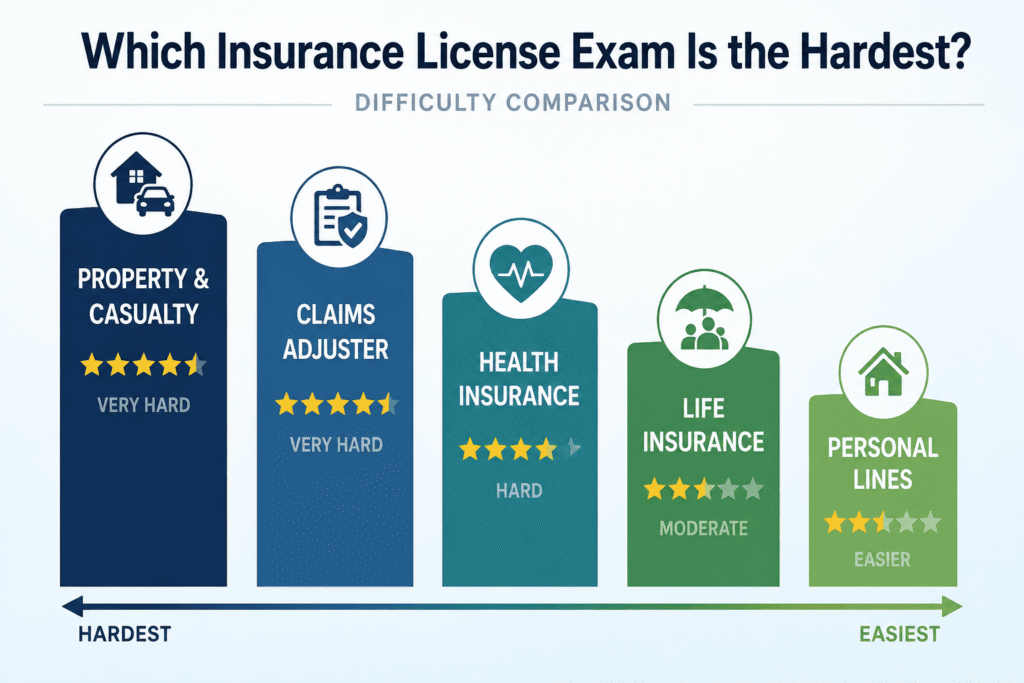
Difficulty depends partly on your background and learning style. However, some license categories are consistently considered harder than others.
Property and Casualty Insurance Exam
Property and Casualty, commonly called P&C, is often ranked as the hardest major insurance license exam.
Property insurance covers physical assets such as homes, vehicles, and business property. Casualty insurance generally focuses on liability and the legal responsibility for injuries or damages.
The combined exam can include:
- Homeowners and dwelling policies
- Personal auto insurance
- Commercial auto coverage
- Commercial property
- General liability
- Businessowners policies
- Workers’ compensation
- Flood insurance
- Marine insurance
- Policy exclusions and endorsements
- State regulations
According to XCEL’s comparison of insurance exams, P&C is especially demanding because of its broad scope and detailed liability concepts.
Within P&C, Casualty is often considered more difficult than Property. Property losses can be relatively concrete, while Casualty questions may require candidates to interpret legal responsibility and complicated liability situations.
The exam is challenging, but candidates can make the material easier by studying one policy type at a time and comparing coverage, exclusions, and conditions.
Claims Adjuster Exam
Claims Adjuster exams are generally considered similar in difficulty to P&C exams.
Adjusters must understand how property and casualty policies work. They also need to know how to investigate damage, interpret policy language, calculate settlements, document losses, and comply with state claim-handling rules.
The exam may include:
- Policy coverage
- Claims investigation
- Loss valuation
- Depreciation
- Settlement procedures
- Adjuster responsibilities
- Fraud detection
- State deadlines and regulations
The combination of insurance knowledge and practical claim-handling rules can make this exam particularly technical.
Health Insurance Exam
The Health Insurance exam is usually considered more difficult than the Life Insurance exam.
Health insurance includes many policy structures, benefit requirements, and medical terms. Candidates may need to study:
- Individual and group health policies
- Disability income insurance
- Medicare and Medicaid
- Long-term care insurance
- Managed care plans
- Deductibles and coinsurance
- Policy riders
- Coverage limitations
- Tax and compliance rules
Health policies can have similar features with important differences. Candidates must understand who qualifies, what is covered, how benefits are calculated, and when exclusions apply.
The amount of medical and regulatory terminology makes Health challenging for many first-time test takers.
Life Insurance Exam
Life Insurance is often considered more straightforward than Health, P&C, or Adjuster licensing.
The exam generally focuses on:
- Term life insurance
- Whole life insurance
- Universal life insurance
- Policy ownership
- Beneficiary designations
- Premiums and death benefits
- Cash value and policy loans
- Annuities
- Basic tax considerations
Life insurance products tend to follow more predictable structures. Once candidates understand the major differences between term and permanent coverage, the remaining concepts may be easier to organize.
Candidates sitting only that line can see what the life insurance license exam covers, how it is scored and how long most people study for it.
However, a combined Life and Health exam will usually be more challenging than either single-line test because candidates must study both subject areas.
Personal Lines Insurance Exam
Personal Lines is generally considered one of the more approachable insurance exams.
The license usually focuses on coverage for individuals and families, including:
- Homeowners insurance
- Renters insurance
- Dwelling policies
- Personal auto coverage
- Personal umbrella insurance
It does not usually include the extensive commercial risks found on a full P&C exam. This narrower focus makes the amount of material more manageable.
Personal Lines is still a professional licensing exam, so candidates must understand policy conditions, exclusions, limits, and state regulations.
How Long Should You Study for the Insurance License Exam?
The amount of study time you need depends on your state, license type, professional background, and daily schedule.
Someone preparing for a Life-only exam may need less time than someone studying for a combined Property and Casualty exam. The quality of your studying also matters more than the number of days you spend reviewing.
Rather than attempting to cram, create a regular schedule that includes reading, active recall, and practice questions.
Before taking the real exam, you should be able to:
- Explain major policy types in your own words
- Compare similar insurance products
- Apply definitions to short scenarios
- Recall important state laws and deadlines
- Complete a timed practice test
- Identify why an incorrect answer is wrong
- Earn passing practice scores consistently
If you are still guessing on major topics, postpone the exam if possible and give yourself additional time.
How To Prepare for the Insurance License Exam
The right study strategy can make the licensing exam feel much less intimidating.
Use a State-Specific Prelicensing Course
Choose a course designed for the state where you plan to become licensed. General information may help you learn the basics, but it may not include all the laws tested in your jurisdiction.
Understand Concepts Before Memorizing Details
Learn how each policy works before trying to memorize every number or definition.
For example, understand the purpose of replacement cost and actual cash value before focusing on the exact wording. Building that foundation makes detailed information easier to remember.
Practice Every Day
Complete exam-style questions throughout your preparation instead of waiting until the end.
Practice questions help you:
- Recognize common question formats
- Apply insurance concepts
- Improve your timing
- Identify weak subjects
- Become more comfortable with test wording
Review both correct and incorrect responses. You should know why the right answer works and why the other options do not.
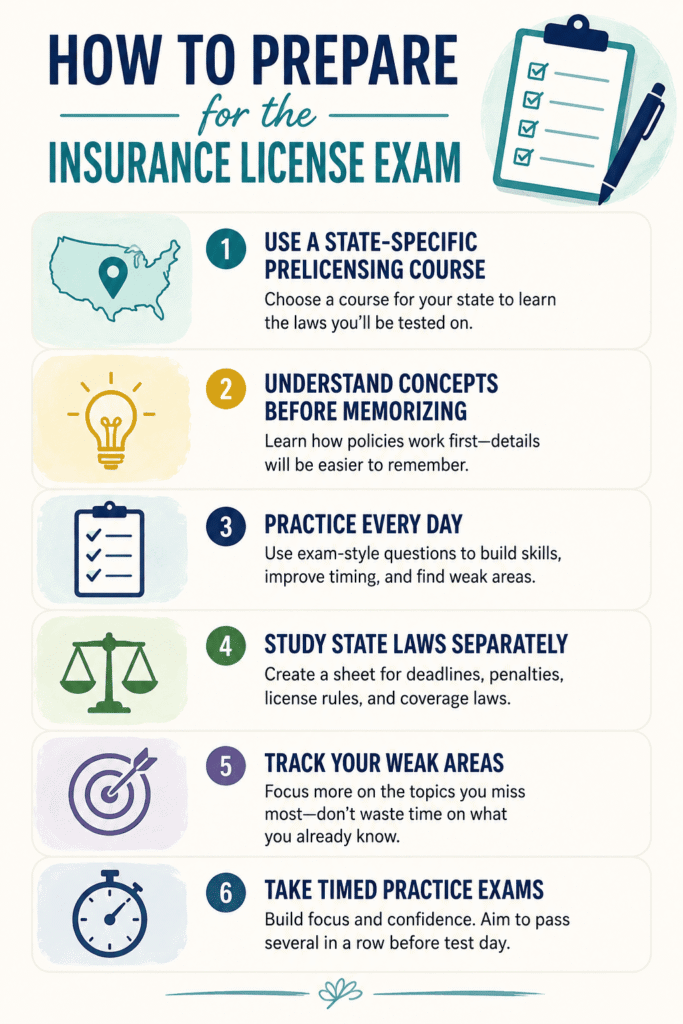
Study State Laws Separately
Create a dedicated study sheet for your state’s deadlines, penalties, license requirements, and coverage rules.
Reviewing these details together can make them easier to compare and memorize.
Track Your Weak Areas
Keep a list of the concepts you repeatedly miss.
You may struggle with commercial liability, health policy provisions, annuities, state regulations, or claim settlement procedures. Spend more time on those topics instead of repeatedly reviewing material you already understand.
Take Timed Practice Exams
Timed practice exams help you build focus and become comfortable answering questions under pressure.
Do not schedule the real test after earning a barely passing score. Aim to pass several practice exams in a row with enough room to account for test-day nerves and unfamiliar questions.
What Happens If You Fail?
Failing the insurance license exam does not mean you cannot work in the industry.
Most states allow candidates to retake the test. However, you may need to pay another exam fee, wait before rescheduling, or follow state-specific rules for repeated attempts.
Review your score report to determine which areas caused the most trouble. Then adjust your study plan, complete more practice questions, and retest when your scores improve.
Many successful insurance professionals needed more than one attempt to earn their licenses.
Final Verdict
The insurance license exam is challenging, but it is manageable for most candidates who prepare consistently.
Property and Casualty and Claims Adjuster exams are usually considered the hardest because of their broad scope and technical rules. Health Insurance can also be difficult because of its medical terminology and complicated policy provisions. Life Insurance and Personal Lines are often more approachable, especially when taken as individual license exams.
The biggest mistake is relying on memorization or assuming that completing a course automatically means you are ready. Focus on understanding the concepts, learning your state’s rules, and practicing with realistic questions.
With a structured study plan and enough preparation, passing the insurance license exam on your first attempt is an achievable goal.
FAQs
Is the insurance license exam hard for beginners?
The exam can be difficult for beginners because of the unfamiliar terminology and state laws. However, most candidates can learn the material through a structured prelicensing course and regular practice.
What percentage of people pass the insurance license exam?
Reported pass rates for many insurance license exams range from approximately 50% to 70%. The actual rate depends on the state, exam type, and testing period.
Which insurance license exam is the hardest?
Property and Casualty is commonly considered the hardest broad insurance exam. It covers numerous personal and commercial policies, liability risks, exclusions, and state regulations.
Is Life Insurance easier than Health Insurance?
Life Insurance is generally considered more straightforward. Health Insurance includes additional medical terminology, government programs, benefit structures, and compliance requirements.
Can you pass the insurance exam on your first attempt?
Yes. Many candidates pass on their first attempt by using state-specific materials, following a consistent study schedule, and completing multiple practice exams.

![Aceable Promo Code [Verified October 2026 Discounts]](https://www.miamiherald.com/careers-education/wp-content/uploads/sites/2/2026/10/aceable-promo-code-mh-1024x768.jpg)

![National Council on Strength and Fitness (NCSF) Coupon Codes [Verified Discounts]](https://www.miamiherald.com/careers-education/wp-content/uploads/sites/2/2026/10/ncsf-promo-code-mh-1024x768.jpg)
![Course Hero Promo Code [Verified Discounts]](https://www.miamiherald.com/careers-education/wp-content/uploads/sites/2/2026/10/course-hero-promo-code-mh-1024x768.jpg)
![Learn Laugh Speak Promo Code [Verified Coupons]](https://www.miamiherald.com/careers-education/wp-content/uploads/sites/2/2026/10/learn-laugh-speak-promo-code-mh-1024x768.jpg)
![Education.com Coupon Code [Verified Discounts]](https://www.miamiherald.com/careers-education/wp-content/uploads/sites/2/2026/10/education-com-promo-code-mh-1024x768.jpg)