The “RBT exam.”
How long is it? Is it one of those all-day certification exams, or something you can knock out in an afternoon?
The truth is, the length of the exam doesn’t just tell you how long you’ll be sitting there. It shapes how fast you need to think, how you should study, and whether the test will feel rushed or manageable. And once you look at the structure, timing becomes one of the biggest factors in how the exam actually feels.
. That’s exactly what this guide is here to break down so you know what to expect going in.
Key Takeaways
- 90-Minute Time Limit: The RBT exam gives you a total of 90 minutes to complete the entire test, which requires steady pacing from start to finish.
- 85 Total Questions: You’ll answer 75 scored questions plus 10 unscored ones that are mixed in and don’t affect your final score.
- Multiple-Choice Format: Every question includes four answer choices, with only one correct answer.
- Evenly Weighted Scoring: All scored questions are worth the same amount, so your result is based on overall performance, not specific sections.
- Six Content Areas: The exam is based on the RBT Test Content Outline (3rd ed.), covering key areas like behavior acquisition, reduction, data collection, and ethics.
RBT Exam Length and Timing
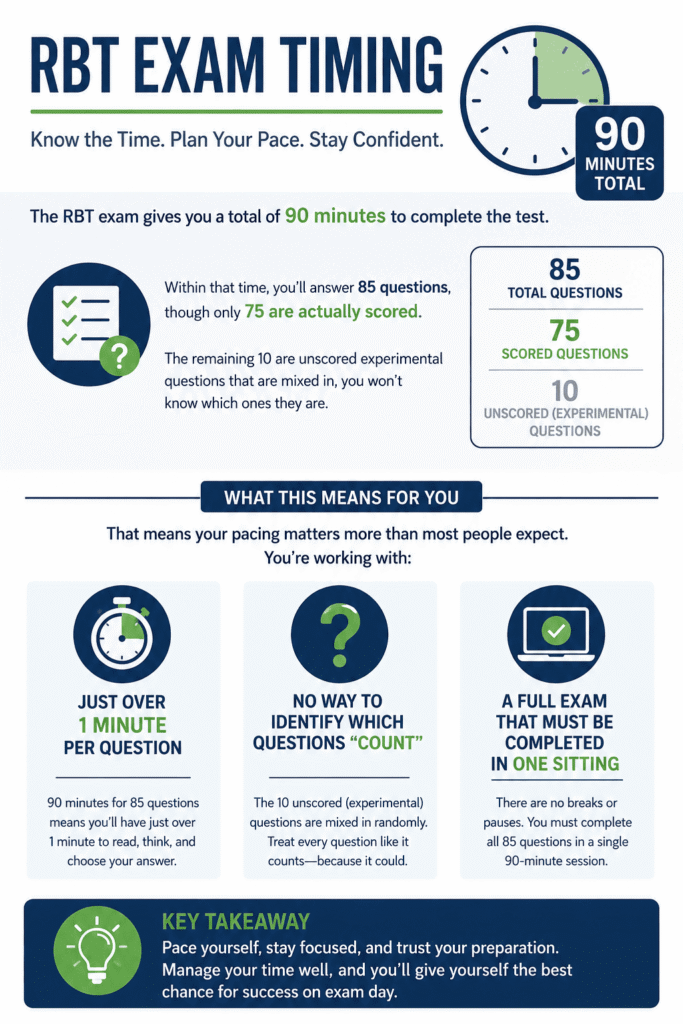
The RBT exam gives you a total of 90 minutes to complete the test.
Within that time, you’ll answer 85 questions, though only 75 are actually scored. The remaining 10 are unscored experimental questions that are mixed in; you won’t know which ones they are. To pass, you need a score of 200 out of 250, which requires more than just memorization and a strong ability to apply what you know.
That means your pacing matters more than most people expect. You’re working with:
- Just over 1 minute per question
- No way to identify which questions “count”
- A full exam that must be completed in one sitting
How the RBT Exam Is Structured
The RBT exam is designed to assess whether you’re ready to work as an entry-level behavior technician.
All questions are multiple choice, and each one:
- Has 4 answer choices
- Includes only 1 correct answer
- Is equally weighted (no question is worth more than another)
Your final score is based on your overall performance, not how you do in any single section.
RBT Exam Content Breakdown
The exam follows the RBT Test Content Outline (3rd edition) and is divided into six core areas:
- Data Collection and Graphing: 13 questions (17%)
- Behavior Assessment: 8 questions (11%)
- Behavior Acquisition: 19 questions (25%)
- Behavior Reduction: 14 questions (19%)
- Documentation and Reporting: 10 questions (13%)
- Ethics: 11 questions (15%)
These categories reflect real-world responsibilities you’ll handle on the job, which is why the exam focuses more on applied knowledge than memorization.
What RBT Exam Questions Actually Look Like
The RBT exam is made up of scenario-based questions that test how you would respond in real situations, not just what you remember.
Here’s an example of how a question might look:
An RBT is working with a client and notices that the client begins engaging in a target behavior when a demand is placed. What is the most appropriate next step?
- Immediately remove the demand to stop the behavior
- Continue the demand and follow the behavior intervention plan
- Ignore the behavior and move on to a new activity
- End the session early to prevent escalation
Correct answer: B. Continue the demand and follow the behavior intervention plan
Questions like this are designed to see if you can apply what you’ve learned, not just define terms. Many answer choices will seem reasonable, but only one aligns with best practices and ethical guidelines.
How the RBT Exam Is Scored
The RBT exam uses a scaled scoring system rather than a simple percentage.
Your score is reported on a scale up to 250, and you need a minimum of 200 to pass. While the BACB does not publish an exact number of correct answers required, most estimates suggest you generally need to answer around 60 to 68 questions correctly, which is roughly 80 to 90 percent of the scored questions.
Here’s what that means in practice:
- Only 75 questions are scored, even though you’ll see 85 total
- All scored questions are weighted equally
- Your final result is based on overall performance, not individual sections
Because of this, you don’t need a perfect score, but you do need to be consistently accurate across the exam.
This is why preparation should focus on both understanding the material and practicing under realistic conditions, when you can answer questions correctly at a steady pace, reaching that passing range becomes much more manageable.
How the Exam Is Developed
The RBT exam isn’t random. It’s built using a process called job task analysis (JTA), which ensures the questions reflect real responsibilities in the field.
That’s why the exam focuses on:
- Skills you’ll actually use on the job
- Practical decision-making
- Core behavior analysis principles
The current version of the exam is based on the 3rd edition of the Test Content Outline, and candidates must take the exam under the version active at the time of their exam.
How to Study for the RBT Exam
A lot of people approach this exam by just reviewing their 40-hour training and hoping it sticks. That’s usually not enough.
I’ve found that the most effective approach is to combine content review with active practice. Start by ensuring you understand the core concepts in the RBT Test Content Outline. Then shift quickly into applying that knowledge through practice questions.
This is where a structured course can make a difference. Programs like ATCC prep are designed to mirror how questions are actually asked, helping you move from recognizing terms to answering correctly under pressure.
The goal is not just to know the material. It is to be able to recognize what a question is really asking within seconds.
Prepare for the Timing
Most candidates focus on learning the material. Fewer prepare for the pace of the exam.
That is a mistake.
With just over a minute per question, you do not have time to overanalyze. The best way to prepare is to gradually introduce timing into your study routine.
Start with untimed practice so you understand the concepts. Then move into timed sets of 10 to 20 questions. By the final phase of your studying, you should be completing full-length practice exams within a 90-minute window.
Use Practice Questions
Practice questions are where most of your progress will come from, but only if you use them correctly.
Instead of just checking whether you got a question right or wrong, focus on understanding:
- Why is the correct answer right
- Why are the other answers
- wrong
- What clue in the question led you there
This is especially important for the RBT exam because many questions include similar answer choices. The difference often comes down to one key detail.
High-quality question banks, like the ones included in structured prep courses, tend to do a better job of explaining these differences, which helps you improve faster.
Build a Simple 1 to 2 Week Study Plan
You do not need months to prepare for the RBT exam, but you do need a plan.
A simple approach looks like this:
Days 1 to 3: Review core topics like data collection, behavior reduction, and ethics
Days 4 to 7: Begin daily practice questions and identify weak areas
Days 8 to 10: Focus on weaker sections and increase timed practice
Final days: Take at least one or two full-length practice exams under a 90-minute limit
The key is consistency. Short, focused study sessions tend to work better than long, inconsistent ones.
What to Do the Day Before the Exam
The day before the exam should not feel like a cram session.
At that point, your goal is to stay sharp, not learn new material.
Focus on:
- Light review of key concepts
- A short set of practice questions
- Getting comfortable with the pace
Avoid overwhelming yourself with too much information. Confidence and clarity matter more than squeezing in extra content at the last minute.
Bottom Line
The RBT exam is 90 minutes long, but the timing only tells part of the story.
With 85 questions, equal weighting, and a steady pace required, success comes down to more than just knowing the material. You need to move efficiently, stay focused, and manage your time from start to finish.
If you prepare with that in mind, the format becomes much more manageable and a lot less intimidating.
FAQs
No, the 10 unscored questions are included for testing purposes and do not impact your final result.
Yes, you can flag questions and return to them if you have time remaining at the end of the exam.
No, the exam is completed in one continuous 90-minute session without scheduled breaks.
The BACB does not publish an exact passing score, but results are based on overall performance across all scored questions.
The exam has one overall 90-minute time limit rather than separate timers for each content area.

![Bluehost Promo Codes and Discounts [Verified Coupons]](https://www.miamiherald.com/careers-education/wp-content/uploads/sites/2/2026/10/bluehost-promo-code-mh-1024x768.jpg)
![Incogni Promo Codes [Verified Discounts]](https://www.miamiherald.com/careers-education/wp-content/uploads/sites/2/2026/10/incogni-promo-code-mh-1024x768.jpg)
![Shopify Promo Codes [Verified Discounts]](https://www.miamiherald.com/careers-education/wp-content/uploads/sites/2/2026/10/shopify-promo-code-mh-1024x768.jpg)