Accounting has changed fast. AI tools can now handle parts of bookkeeping, data entry, and routine reporting in seconds. Fewer students are entering the profession, burnout is a growing concern, and many young professionals are starting to ask a serious question:
Is becoming a CPA even worth it anymore?
At the same time, accounting firms are making more money than ever. In fact, 74% of U.S. accounting firms reported higher revenue recently, even as the industry struggles with a shrinking talent pipeline.
But despite all the changes happening in accounting, the CPA still carries serious weight. In the right career path, it can unlock higher salaries, faster promotions, and stronger job security.. Let’s talk about it.
Key Takeaways
- Higher Career Ceilings In Traditional Accounting Roles: The CPA still carries major weight in audit, tax, public accounting, and financial leadership positions where promotions and salary growth often depend on licensure.
- The Real Cost Goes Beyond Exam Fees: Most candidates spend thousands on education, review courses, retakes, licensing fees, and ongoing CPE requirements.
- Not Every Finance Career Requires A CPA: Some professionals may see better ROI from analytics skills, an MBA, technology certifications, or hands-on experience, depending on their long-term goals.
- Employer Support Can Change The ROI: Companies that reimburse review courses, exam fees, bonuses, or continuing education can significantly reduce the financial burden of becoming licensed.
- Career Fit Matters More Than Ever: The CPA tends to make the most sense for professionals who enjoy structured accounting work, compliance-heavy environments, and long-term advancement within accounting and finance leadership.
The CPA Still Pays Off — But Not For Everyone
I think one of the biggest mistakes people make is treating the CPA like a universal requirement for accounting success.
It’s not.
There are plenty of professionals building strong careers in bookkeeping, FP&A, payroll, operations, and finance-adjacent roles without ever becoming licensed. In some industries, especially startups and smaller businesses, employers care more about software skills, adaptability, and experience than credentials.
But there are still major parts of the accounting world where the CPA remains incredibly valuable.
Public accounting is the obvious example. If your long-term goal involves audit, tax, assurance, or eventually moving into manager or partner-level positions, the CPA is still one of the clearest ways to increase your ceiling. In many firms, advancement eventually slows down without it.
The same is true for professionals aiming for controller, CFO, compliance, or high-level corporate finance positions. The credential signals technical credibility in a way few accounting certifications can match.
And despite conversations about AI replacing accountants, I actually think the CPA may become more valuable in some environments. As automation handles repetitive tasks, companies increasingly want professionals who can interpret financial data, advise leadership, manage risk, and make judgment-based decisions.
That’s where licensed professionals still stand out.
The Real Cost Is More Than Exam Fees
Most people underestimate what pursuing the CPA actually costs.
Yes, there are the obvious expenses:
- Exam application fees
- Registration fees
- Review courses
- Education requirements
- Licensing and renewal fees
But in my experience, the harder costs are the ones you can’t easily calculate.
Studying for the CPA often means giving up evenings, weekends, vacations, and personal time for months or even years. Many candidates are balancing full-time work during busy season while trying to memorize highly technical material after exhausting days.
That takes a real mental toll. I’ve also seen people underestimate the emotional side of repeated exam failures. Retakes can quickly become expensive and discouraging, especially when you’re already burned out from work.
And even after passing, the commitment doesn’t completely stop. Most CPAs still have to maintain continuing professional education (CPE), renewal fees, and ongoing compliance requirements throughout their careers.
That doesn’t mean the investment isn’t worth it. It just means people should evaluate the CPA honestly instead of treating it like a casual next step.
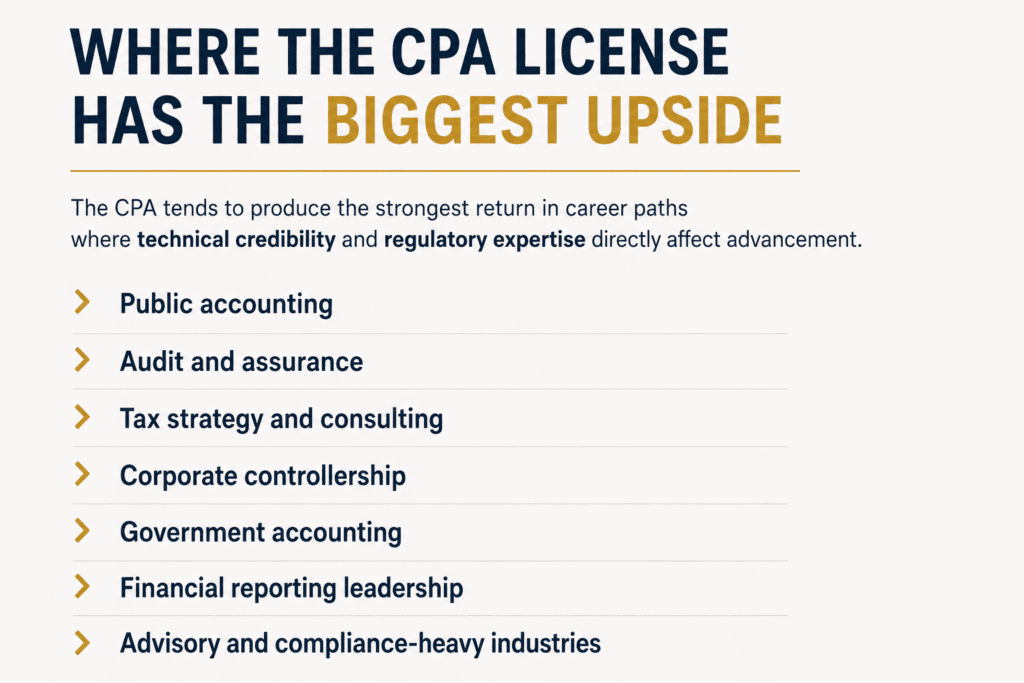
Where The CPA License Has The Biggest Upside
The CPA tends to produce the strongest return in career paths where technical credibility and regulatory expertise directly affect advancement.
That includes:
- Public accounting
- Audit and assurance
- Tax strategy and consulting
- Corporate controllership
- Government accounting
- Financial reporting leadership
- Advisory and compliance-heavy industries
In these environments, the CPA often functions less like a bonus and more like a career accelerator.
I’ve seen professionals move into leadership positions faster simply because employers trusted the credential. In many organizations, having “CPA” after your name immediately changes how clients, executives, and hiring managers view your expertise.
The salary upside can also compound over time. The difference between a non-licensed accountant and a CPA may not feel massive in year one, but over a 10- or 20-year career, higher raises, management opportunities, bonuses, and promotion eligibility can create a substantial gap.
The CPA can also provide long-term flexibility. Even professionals who eventually leave public accounting often carry the credibility of the license into consulting, leadership, education, or independent business work later in their careers.
When Becoming A CPA May Not Be Worth It
This is the section many articles avoid, but I think it matters. The CPA is not automatically the best financial decision for everyone. In some career paths, the opportunity cost is simply too high.
For example, if your goals are more aligned with:
- Startup finance
- Data analytics
- Operations
- Product strategy
- Entrepreneurship
- Financial technology
- General business leadership
…you may benefit more from technical skills, software expertise, networking, or a broader graduate degree than from a CPA license.
I also think personality fit matters more than people admit.
The CPA exam — and many CPA-track careers — require comfort with regulation-heavy work, compliance standards, documentation, and detail-oriented analysis. Some people genuinely enjoy that structure. Others absolutely hate it.
And if you already have significant student debt, limited employer support, or little interest in traditional accounting paths, the financial payoff may take much longer to justify.
That doesn’t mean the credential lacks value.
How To Decide Before Committing
Before committing to the CPA path, I think it helps to stop thinking emotionally and start thinking strategically.
One of the smartest things you can do is look directly at job postings for the roles you eventually want. Is the CPA listed as:
- Required?
- Preferred?
- Barely mentioned?
That tells you a lot.
I’d also strongly recommend talking to professionals already working in your target field. Ask whether the CPA actually helped them earn promotions, increase salary, or open doors.
Employer support matters too. Some companies reimburse exam fees, review courses, bonuses, or continuing education costs. That can dramatically improve the ROI.
And honestly, lifestyle fit should be part of the conversation.
Some people thrive in structured accounting environments. Others discover they would rather build careers around analytics, business operations, or strategy without maintaining a demanding professional license forever. If you do decide to go for it, see our best CPA prep courses comparison for the prep options most candidates rely on.
For the step-by-step licensing process, see our guide to becoming a CPA.
The Bottom Line: Who Should Pursue The CPA?
If your goals involve public accounting, tax, audit, financial leadership, or long-term executive growth, the CPA can absolutely be worth the investment. The salary potential, promotion opportunities, and professional credibility are still very real.
But if your interests lean more toward startups, analytics, entrepreneurship, or flexible business roles, there may be faster, cheaper, and more modern ways to build a successful career.
The smartest approach is not to ask whether the CPA is universally worth it. It’s asking whether it aligns with the career — and life — you actually want.
FAQs
Is becoming a CPA still worth it?
Yes, for most accounting careers. The CPA raises your earning ceiling, accelerates promotions, and opens doors to controller, CFO, audit, and public accounting roles. It is less valuable if your target path is startups, analytics, or fintech, where employers weigh skills over credentials.
How expensive is it to become a CPA?
Most candidates spend a few thousand dollars total on exam fees, review courses, education requirements, and licensing — plus ongoing CPE after passing. The harder cost is time: hundreds of study hours per section, often balanced with full-time work and busy season.
Does every accountant need a CPA license?
No. Many accountants build strong careers in bookkeeping, FP&A, payroll, analytics, and startup finance without ever sitting the exam. The CPA is typically required for public accounting work and for promotion past senior-level roles in audit, tax, and corporate finance.
What careers benefit the most from a CPA license?
Public accounting (audit, tax, advisory), corporate controllership, and CFO-track positions benefit most. The CPA also matters in government accounting, financial reporting leadership, and compliance-heavy industries where licensure is often required for promotion. Expect bigger salary jumps and faster advancement in these paths.
What should I consider before pursuing a CPA?
Three things: career fit (does your target role actually require it?), employer support (will they reimburse fees and review courses?), and time bandwidth (can you protect study hours alongside your job?). Read job postings in your target field first — that tells you fastest.





![Surgent EA CE Promo Code [Verified 2026 Discounts]](https://www.miamiherald.com/careers-education/wp-content/uploads/sites/2/2026/07/surgent-ea-ce-promo-code-1-1024x768.jpg)