
Stress, pay, burnout, moving cities, growing families.
Changing careers is normal throughout a working life. A 43-year BLS study found that people had an average of 12.9 jobs from ages 18 to 58.
But if that path includes becoming a CMA, the real question is whether the credential actually helps with the kind of switch someone wants.
In this guide, I’ll walk through when the CMA can support a career switch, when another path may make more sense, and what to think about before choosing it.
Key Takeaways
- Best For Corporate Finance: CMA fits FP&A, budgeting, analysis, and management accounting.
- Not A Shortcut: The credential helps, but experience still matters.
- Weak Fit For Tax Or Audit: CPA may make more sense for public accounting goals.
- May Beat Another Degree: CMA can be more focused than going back to school.
- Target Role Matters: Start with the job you want, then choose the credential.
CMA Can Help Career Changers, But Only In The Right Lane
The CMA can be useful for career changers, but it works best when the goal is specific.
It is strongest for people trying to move closer to corporate finance, management accounting, financial planning, budgeting, forecasting, analysis, or operations-focused leadership.
That is a different path from public accounting.
Someone trying to move into tax prep, external audit, or CPA firm work may not get the same value from the CMA. It can still show effort and finance knowledge, but it is not the credential most tied to those lanes.
A better way to think about it:
- Good Fit: FP&A, budgeting, forecasting, cost accounting, finance analyst roles, management accounting, operations finance
- Weaker Fit: Tax, external audit, public accounting licensure, bookkeeping-only roles
- Depends: Controller-track roles, corporate accounting, internal audit, operations leadership
The CMA helps most when the career move needs business finance language, not just a new line on a résumé.

Where The CMA Has The Most Career Value
The CMA has the most value when a role uses numbers to make business decisions.
That is why it can fit people coming from operations, business, banking, payroll, bookkeeping, data work, or general accounting support. The credential can help connect past experience to more finance-heavy work.
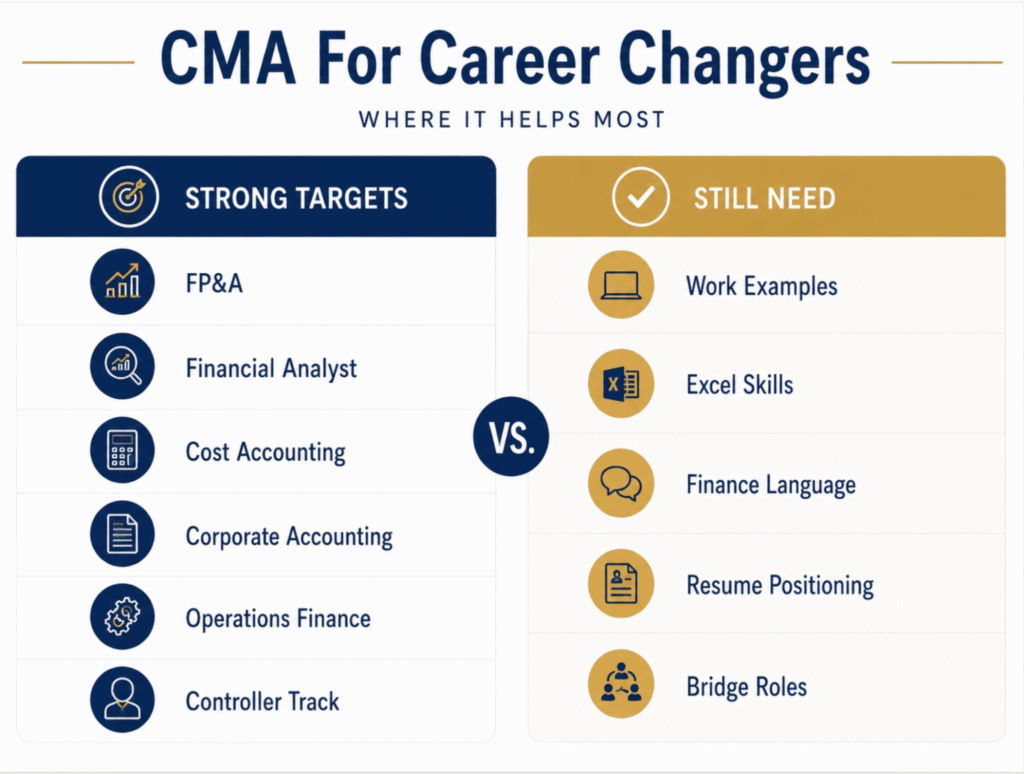
It may be useful for career changers aiming for:
- FP&A Roles: Budgeting, forecasting, variance analysis, and planning.
- Financial Analyst Jobs: Turning numbers into business takeaways.
- Cost Accounting: Tracking costs, margins, and operations data.
- Corporate Accounting: Moving closer to reporting, planning, or internal decision support.
- Operations Finance: Connecting business activity to financial results.
- Controller-Track Roles: Building toward leadership inside a company.
This is where the CMA has a real story behind it.
It can help say, “I understand how accounting connects to business decisions.” That matters more than just saying, “I want to switch careers.”
For exam requirements and certification steps, see our guide to becoming a CMA.
When The CMA May Not Be Enough By Itself
The CMA can help open the door, but it usually cannot do the whole job alone.
A hiring manager may still want proof that someone can use spreadsheets, explain numbers, work with financial statements, understand business drivers, and handle real reporting or analysis tasks.
That means the CMA may need support from other pieces, like:
- Relevant Work Examples: Budget tracking, reporting, analysis, or operations metrics.
- Excel Skills: Pivot tables, lookups, models, cleanup, and basic dashboards.
- Finance Language: Margins, variance, cash flow, budget, forecast, and performance.
- Resume Positioning: Past work framed around numbers, decisions, and business results.
- Entry-Level Bridge Roles: Analyst, accounting associate, staff accountant, or operations finance support.
This is the part people sometimes miss.
The CMA can make the career change look more serious, but the résumé still has to connect the old work to the new path.
How It Compares With Going Back To School
For some career changers, the CMA may be a cleaner option than another degree.
Going back to school can make sense for someone who needs a full education reset, wants recruiting access, or lacks any business background. But it can also take more time and money than needed if the goal is corporate finance or management accounting.
The CMA is more focused.
It points toward finance, planning, performance, analysis, and business decision-making. That can be useful for someone who already has a degree, some work history, or a nearby career background.
A simple way to compare it:
| Option | Better Fit For |
|---|---|
| CMA | Corporate finance, FP&A, management accounting, cost accounting |
| MBA | Broader business pivot, leadership, networking, and management roles |
| Accounting Degree | Foundational accounting education or career reset |
| CPA Path | Public accounting, audit, tax, licensed accounting work |
The CMA is not automatically better than school. It is just more targeted. If the goal is a finance-facing role inside a company, that focus can be a major point in its favor.
Who Should Consider The CMA First?
The CMA may be worth looking at first when the career change is close enough to accounting or finance that the credential adds credibility.
It may make sense for someone who:
- Already Works Near Numbers: Operations, payroll, bookkeeping, banking, sales ops, or business admin.
- Wants Corporate Finance: FP&A, financial analyst, budgeting, or forecasting roles.
- Does Not Want Public Accounting: Less interest in audit, tax, or firm life.
- Has A Degree Already: Especially if another full degree feels unnecessary.
- Needs A Stronger Finance Story: Past work is relevant, but not obvious enough on paper.
- Wants Management-Focused Work: Planning, performance, reporting, and decision support.
The CMA is not for every career changer.
But for the right person, it can make the switch easier to explain.
Bottom Line For Career Switchers
The CMA can support a career switch, but it should match the job someone actually wants next. It is not a magic fix or a guaranteed offer. It is a signal that the move has direction.
- If you want to move into FP&A, budgeting, forecasting, or management accounting, then you might consider the CMA.
- If you’re aiming for financial analyst, cost accounting, or operations finance roles, then you might consider the CMA.
- If your goal is tax, external audit, or public accounting, then you might consider the CPA instead.
- If you’re deciding between another degree and a targeted finance credential, then you might consider whether the CMA gets you closer to your specific career goal.
- If your current experience already involves numbers, reporting, operations, or business analysis, then you might consider using the CMA to strengthen your transition story.
If the target role lines up with the credential, it can help the switch look more serious. If not, another path may make more sense. Get started with one of the top CMA prep courses and be on your way to a new career.
FAQs
Can the CMA help someone switch careers?
Yes, the CMA can help with a career switch when the target role is tied to corporate finance, FP&A, budgeting, forecasting, cost accounting, or management accounting. It is less useful for career changes focused on tax or external audit.
Is the CMA enough to get a finance job?
The CMA can help, but it may not be enough alone. Employers may still look for Excel skills, relevant experience, financial analysis ability, and a résumé that connects past work to finance tasks.
Is the CMA better than going back to school?
It depends on the career goal. The CMA may be better for a focused move into corporate finance or management accounting. A degree or MBA may fit better for a broader career reset, recruiting access, or leadership pivot.
What careers does the CMA help with?
The CMA can help with FP&A, financial analyst roles, cost accounting, corporate accounting, operations finance, management accounting, and controller-track roles.
Is the CMA good for public accounting?
The CMA is usually not the main credential for public accounting. People focused on audit, tax, or licensed public accounting work may get more value from the CPA path.
Who should consider the CMA first?
The CMA may fit someone who already works with numbers and wants to move into corporate finance, budgeting, forecasting, analysis, or management-focused accounting.





![Surgent EA CE Promo Code [Verified 2026 Discounts]](https://www.miamiherald.com/careers-education/wp-content/uploads/sites/2/2026/07/surgent-ea-ce-promo-code-1-1024x768.jpg)