Paying a company to remove your personal information can feel a little strange when the first thing it asks for is…your personal information.
However, that’s how Incogni works: it needs enough details to identify you before it can ask data brokers to delete records connected to you. From there, most of the work happens in the background.
But… what is it actually doing? What does Incogni actually do after you sign up? Here’s how the process works, from start to finish.
Key Takeaways
- You Provide Identifying Details: Incogni needs enough information to match you with broker records.
- You Authorize Incogni: A signed form lets Incogni submit removal requests for you.
- Incogni Contacts Brokers: The standard service automatically sends requests across its covered network.
- You Can Track Progress: The dashboard shows individual requests and their status.
- Removal Is Ongoing: Incogni follows up and sends recurring requests while your subscription is active.
How Incogni Works, Step by Step
1. You Give Incogni Enough Information to Identify You
After you subscribe, Incogni asks for your personal info, including things like your name, date of birth, current address, email address, and, for U.S. addresses, a phone number.
That can feel backward, believe me, I get it. If you’re trying to get your information off the internet, why hand over more of it?
The reason is practical: Incogni needs enough information to tell data brokers who the removal request is for. A broker can’t delete your record if it can’t tell which record belongs to you.
Incogni says this is the minimum information it needs to make requests on your behalf.
2. You Sign an Authorization Form
Next, you sign an authorization form.
This gives Incogni permission to contact data brokers and ask them to remove your personal information. It can also escalate certain cases to data-protection authorities if a broker refuses to comply.
Incogni says the authorization for a broker ends once that request is resolved.
Once you review your information and hit “Start data removal,” the process officially begins.
3. Incogni Sends Removal Requests to Data Brokers
This is the main job you’re paying Incogni to handle.
Instead of finding broker websites, locating opt-out forms, and submitting requests yourself, Incogni automatically contacts the data brokers in its standard network. Incogni currently says that network covers more than 420 brokers.
You don’t choose each broker individually, either. The standard service sends requests across the network for you.
One important detail: Incogni can send a request without already knowing whether a particular broker has your data.
So, a request may end with the broker deleting your information or simply confirming that it couldn’t find a matching record.
4. What Happens After a Broker Gets the Request?
Once a request goes out, the broker has to process it.
That can end a few ways, such as:
The broker removes or suppresses your information.
The broker says it couldn’t find matching information.
The request stays in progress while Incogni waits.
Incogni follows up if the broker doesn’t respond or comply.
That distinction matters when you look at your results.
Incogni’s main dashboard can count a broker as “completed” when it either removes your data or confirms it doesn’t have a matching record. So “completed” doesn’t always mean Incogni found a profile about you and deleted it.
How Do You Know What Incogni Is Doing?
You can follow the process from your dashboard.
For individual requests, Incogni lets you see the broker, request status, timeline, last update, and the data included in the request.
| Status | What It Means |
|---|---|
| In progress | The request was sent and is being processed |
| Completed | The request has been resolved |
| Scheduled | A recurring request or follow-up is planned |
| Escalated | Incogni is taking additional steps after noncompliance |
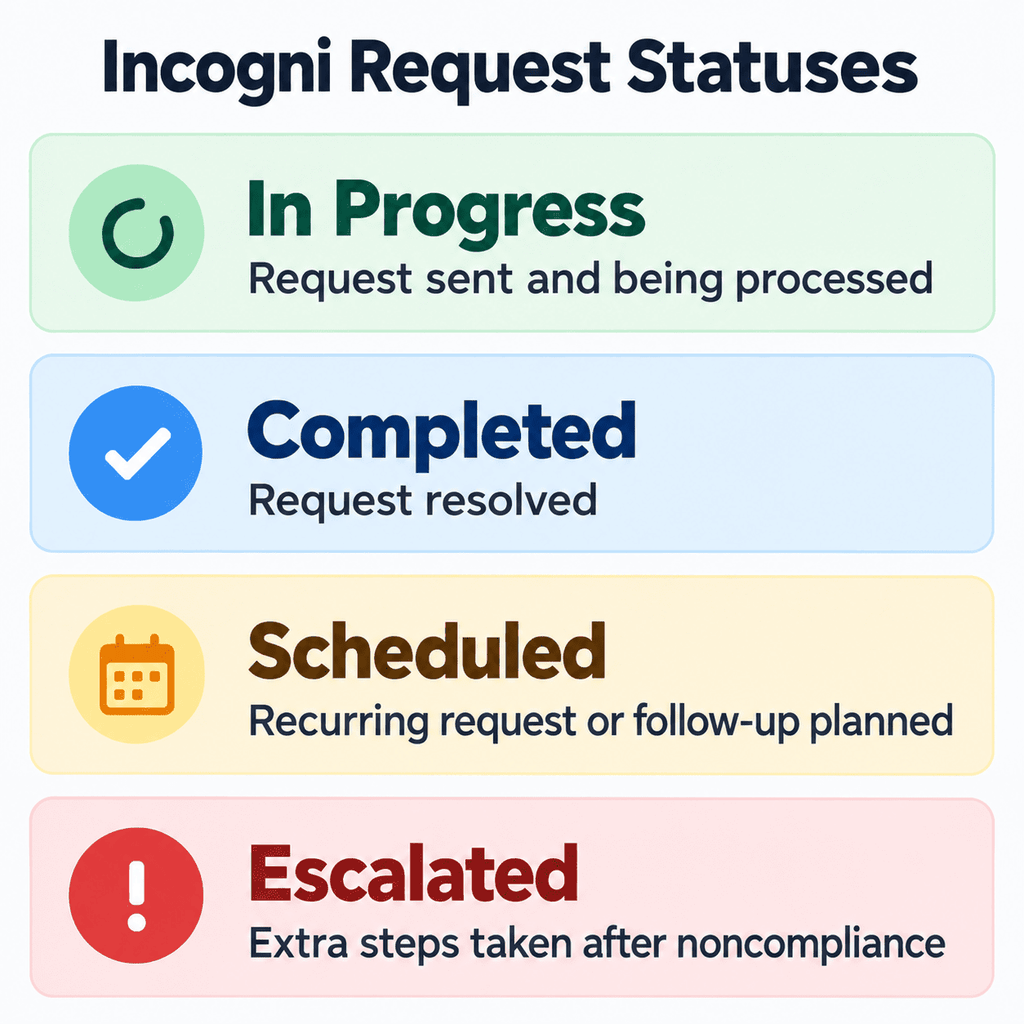
You can also view request histories for individual brokers.
Why Does Incogni Keep Sending Requests?
Getting your information removed once, unfortunately, often doesn’t mean it’s permanently gone.
Data brokers update their databases, so they can collect or list information again. Incogni therefore treats removal as an ongoing process; they have to.
How are data brokers legal? I literally couldn’t tell you. But it’s the truth.
While your subscription is active, it can schedule recurring requests and follow up with brokers that haven’t responded. Incogni also sends monthly progress emails.
How Long Does Incogni Take?
There isn’t one fixed timeline, especially because of what we talked about earlier: data brokers often pop back up with more of your info.
Plus, it relies a lot on response time, which varies wildly from site to site. Some brokers respond within a day, while others take longer. Incogni says timing depends on the broker’s policies and systems.
Privacy laws can also set deadlines. Incogni notes that GDPR requests generally have a 30-day timeframe and CCPA deletion requests generally have a 45-day timeframe.
If a broker is late or doesn’t cooperate, follow-ups can extend the process.
What About Websites Outside Incogni’s Regular Broker List?
Certain higher-tier plans include Custom Removals.
You can submit a specific page where your information appears, or use Incogni’s exposure scanner to review possible matches and choose which ones you want removed.
This is separate from the standard broker process, and it doesn’t mean Incogni can remove anything from anywhere online.
Bottom Line
Incogni’s main value is taking a repetitive job off your plate.
You give it enough information to identify you, authorize it to act for you, and let it send requests, track responses, follow up, and repeat the process when needed.
You can do broker opt-outs yourself. Incogni makes the process much less hands-on.
If the goal is shrinking a public trail, how to prevent doxxing covers usernames, photos, and people-search opt-outs that Incogni will not handle.
FAQs
Does Incogni actually search for your information?
Its standard service sends removal requests across its covered broker network. On eligible plans, its exposure scanner can also surface possible listings for you to review.
Why does Incogni need my personal information?
It needs enough identifying information to help brokers determine which records belong to you.
Do I have to contact data brokers myself?
Not for brokers covered by Incogni’s standard automated service. Incogni sends and tracks those requests for you.
How do I know if Incogni removed my information?
You can track request statuses in your dashboard. A completed request can also mean a broker confirmed it didn’t have matching data.
Does Incogni keep removing data after the first request?
Yes. While your subscription is active, Incogni can send recurring requests and follow up because information may be collected again.

![Hosting.com Coupon Discounts [Verified October 2026 ]](https://www.miamiherald.com/careers-education/wp-content/uploads/sites/2/2026/10/hosting-com-promo-code-mh-1024x768.jpg)

![Bluehost Promo Codes and Discounts [Verified Coupons]](https://www.miamiherald.com/careers-education/wp-content/uploads/sites/2/2026/10/bluehost-promo-code-mh-1024x768.jpg)
![Incogni Promo Codes [Verified Discounts]](https://www.miamiherald.com/careers-education/wp-content/uploads/sites/2/2026/10/incogni-promo-code-mh-1024x768.jpg)
![Shopify Promo Codes [Verified Discounts]](https://www.miamiherald.com/careers-education/wp-content/uploads/sites/2/2026/10/shopify-promo-code-mh-1024x768.jpg)