If you are exploring event planner certification, you already know planning a party sounds fun until 12 tiny problems happen at once.
The flowers are late. The DJ needs an outlet. The cake is melting. Someone moved the seating chart.
That is where a good event planner steps in… but this is not some tiny career path. More than 145,000 people worked as meeting, convention, and event planners in 2024, according to Data USA and the Bureau of Labor Statistics, with the field expected to keep growing.
But do you need an event planner certification to start? Will clients care about it? And what do these programs even teach?
Today, I’ll walk you through how certification works, what you may learn, and whether it makes sense for your event planning goals. Let’s dive in!
Key Takeaways
- Certification Builds Trust: A credential can help you look more prepared.
- Requirements Vary: Some welcome beginners, while others require experience.
- Several Options Exist: You can focus on weddings, meetings, or general events.
- It Is Not Always Required: Many planners can legally work without certification.
- Career Goals Matter: The right credential depends on your experience and plans.
What Even Is an Event Planner Certification?
An event planner certification is a credential showing that you completed training or passed an exam.
Some programs are made for total beginners. They teach the basics through videos, lessons, quizzes, projects, or a final test.
Other credentials are for planners who already have work experience. These may require proof that you have worked in the industry before you can take the exam.
Two simple ways to think about it:
- Beginner certificate: Learn the job → finish the course → earn a certificate
- Professional certification: Get experience → meet the rules → pass an exam
These are not always the same thing, even when schools use similar names. Always read the program details before signing up.
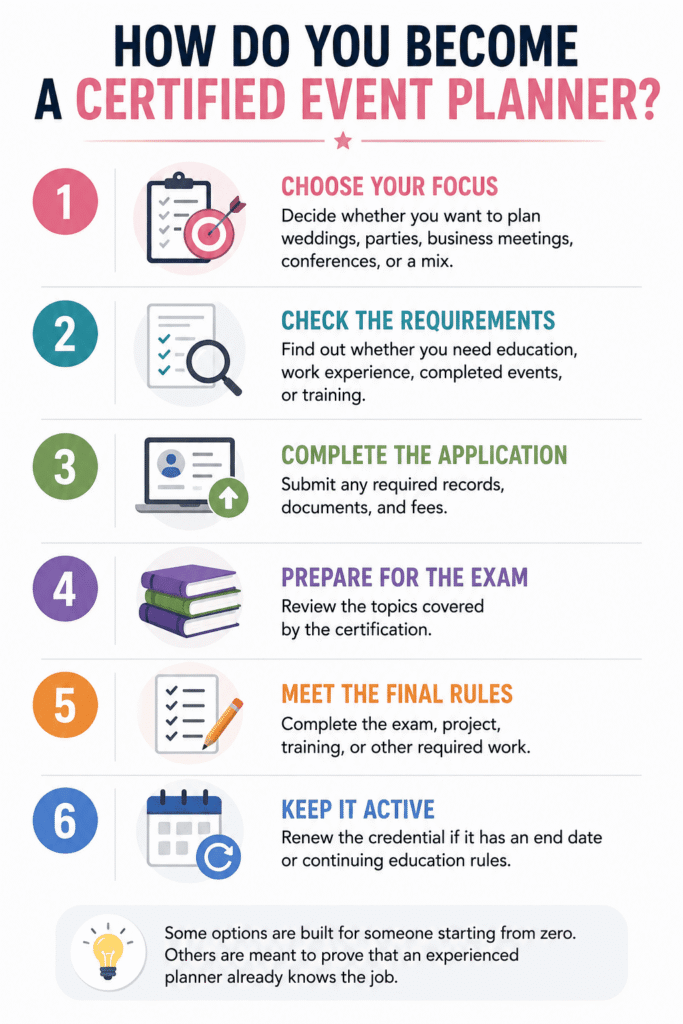
How Do You Become a Certified Event Planner?
There is no single path that every event planner must follow. The steps depend on the credential you want.
The process may look like this:
- Choose Your Focus: Decide whether you want to plan weddings, parties, business meetings, conferences, or a mix.
- Check the Requirements: Find out whether you need education, work experience, completed events, or training.
- Complete the Application: Submit any required records, documents, and fees.
- Prepare for the Exam: Review the topics covered by the certification.
- Meet the Final Rules: Complete the exam, project, training, or other required work.
- Keep It Active: Renew the credential if it has an end date or continuing education rules.
Some options are built for someone starting from zero. Others are meant to prove that an experienced planner already knows the job.
That difference is important. You do not want to choose an advanced credential and then discover that you need years of experience to apply.
Certificate vs. Certification: What Is the Difference?
These two words are often used like they mean the same thing. Technically, they can describe different things.
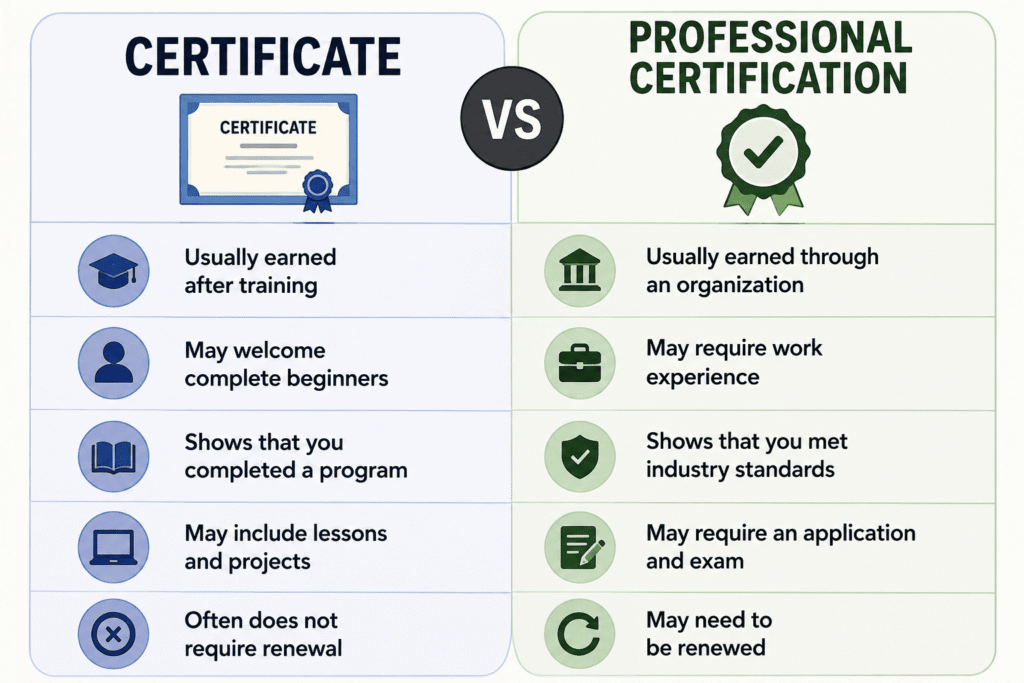
| Certificate | Professional Certification |
|---|---|
| Usually earned after training | Usually earned through an organization |
| May welcome complete beginners | May require work experience |
| Shows that you completed a program | Shows that you met industry standards |
| May include lessons and projects | May require an application and exam |
| Often does not require renewal | May need to be renewed |
Neither option is automatically better. A beginner certificate may make more sense when you want to learn the job. A professional certification may make more sense when you already have experience and want a credential that proves it.
The best choice depends on where you are right now.
Types of Event Planner Credentials
Event planning is a huge field, so credentials can focus on very different career paths.
General Event Planning
General credentials may cover parties, celebrations, fundraisers, business events, and other common projects.
This option can make sense when you are new and have not chosen one type of event yet.
Wedding Planning
Wedding credentials focus on ceremonies, receptions, couples, wedding parties, rehearsals, vendors, and detailed wedding-day schedules.
This may fit you if you already know that weddings are your main goal.
Meetings and Corporate Events
These credentials focus on conferences, trade shows, company meetings, and other business events.
More advanced options may require professional experience before you can apply.
Specialty Events
Planners can also find credentials for destination events, event design, virtual events, fundraising, floral design, and other smaller areas.
You do not need to collect every title. One credential that fits your real career plans is more helpful than five random ones.
What Can Event Planner Certification Do for You?
Certification cannot promise instant clients or a full calendar. It can still give you a stronger way to begin or grow.
Add Trust to Your Name
A credential shows that you invested time in your career. You can add it to your résumé, website, email signature, and business pages when the program allows it.
That extra detail may help you look more serious when someone is comparing new planners.
Give You a Clear Starting Point
Beginning a career can feel messy when you do not know what should happen first.
A certification path can place the steps in a clearer order. That gives you direction instead of leaving you to piece together your next move from random online advice.
Support a Career Change
Certification can also help when you are moving into event planning from another job.
You may already have helpful skills in sales, customer service, design, hospitality, or business. A planning credential gives you a way to connect those skills to your new career.
Build More Confidence
Clients may ask about budgets, vendors, contracts, timelines, and backup plans.
Certification gives you a base of knowledge before you enter those conversations. You may still be new, but you will not be starting completely blind.
Do You Need Certification to Be an Event Planner?
Usually, certification is not legally required to call yourself an event planner or start taking clients. If you are weighing credentials as you launch a company, our guide on how to start an event planning business walks through what clients and partners often expect.
That does not mean it has no value.
Without certification, you may have to build your path through work experience, mentors, online research, or venue jobs. That route can work, but it may take longer to understand how everything connects.
Certification gives you another option. It can help you enter the field with more direction and something clear to show for your work.
Clients may still want to see:
- Photos from past events
- Reviews and referrals
- Clear service packages
- Fast communication
- Professional contracts
- Strong backup plans
Certification adds to those things. It can help you build a more complete professional image while you continue gaining experience.
How to Choose the Right Certification
The best credential is not always the one with the fanciest title. It is the one that matches your current experience and future plans. Before you enroll, it helps to compare the best event planner courses so you can see how each option fits your timeline and budget.
Before choosing, ask:
Does It Match My Experience? Beginners need a different path than planners with five years of work behind them.
Does It Fit My Event Type? A wedding credential may not help much if you want to run large business conferences.
What Must I Complete? Check for training, exams, projects, work records, and application rules.
Will I Need to Renew It? Some credentials expire unless you complete more education or pay a renewal fee.
Can I Use the Title Publicly? Make sure you understand how the credential can appear on your résumé or website.
Does It Help My Main Goal? Your goal may be learning the job, getting hired, building trust, or growing a business.
Pick based on what you actually need, not just what sounds impressive.
Is Event Planner Certification Worth It?
Yes, it can be worth it, especially when you want a clearer path into event planning.
A beginner may use certification to build knowledge and feel more prepared. Someone with experience may use a professional credential to prove their skills and support the next step in their career.
It may be a good fit when you:
- Want to enter event planning with more direction
- Need a credential for your résumé or website
- Are changing careers
- Want to focus on a certain type of event
- Plan to apply for event planning jobs
- Want clients to see that you take the work seriously
🎉 Planner Sticky Note: Certification is not about knowing every answer. It is about building a stronger base before people trust you with their important days.
My Final Thoughts
Event planner certification can be a smart move when it fits your experience and career goals.
It can give beginners a clear place to start, help career changers enter a new field, and give experienced planners another way to show what they know.
The main thing is choosing the correct type. A beginner certificate and an advanced professional certification serve different people, even when their names sound almost the same.
Before committing, check the requirements, focus, renewal rules, and career value. The right credential should move you closer to the kind of planner you want to become.
FAQs
How long does event planner certification take?
It depends on the credential. A beginner program may take a few weeks or months. An advanced certification may require years of work experience before you can even apply.
Can I become an event planner without certification?
Yes. Certification is usually optional. However, it can give you more direction, add trust to your professional image, and support your career goals.
Is a certificate the same as a certification?
Not always. A certificate commonly shows that you completed training. A professional certification may require experience, an application, an exam, and future renewals.
Will certification help me get clients?
It can help you look more prepared and serious. Clients may also consider your experience, reviews, portfolio, communication, and service packages.
Can beginners earn an event planning credential?
Yes. Some options are designed for complete beginners. Always check the rules because advanced credentials may require past event planning experience.
Does event planner certification expire?
Some credentials do. You may need to renew them by completing more education, proving continued work, or paying a renewal fee. Other certificates do not expire.

![Bluehost Promo Codes and Discounts [Verified Coupons]](https://www.miamiherald.com/careers-education/wp-content/uploads/sites/2/2026/10/bluehost-promo-code-mh-1024x768.jpg)
![Incogni Promo Codes [Verified Discounts]](https://www.miamiherald.com/careers-education/wp-content/uploads/sites/2/2026/10/incogni-promo-code-mh-1024x768.jpg)
![Shopify Promo Codes [Verified Discounts]](https://www.miamiherald.com/careers-education/wp-content/uploads/sites/2/2026/10/shopify-promo-code-mh-1024x768.jpg)