
According to U.S. Bureau of Labor Statistics data, “meeting, convention, and event planners” are growing at a rate that’s faster than the average career.
But event planning doesn’t follow a simple “get this degree and then this job” career path.
Far from it.
Many event planners start with a side hustle, but where do you even start? How do you build a business, get clients, and go full-time?
I went through these online event planning courses myself to see which courses and certifications are actually worth it, so you can build a better business from the beginning.
The Best Courses at a Glance
- Best Overall: IAP Career College
- Best For Taking a Certification Exam: Management & Strategy Institute (MSI)
- Best For Hands-On Training: QC Event School
- Best For Feedback on Your Work: New York Institute of Art and Design (NYIAD)
- Best For Learning Specific Skills: Udemy
- Best For Beginners: Skillshare
| Best Event Planner Courses | ||
 |
| LEARN MORE |
 |
| LEARN MORE |
 |
| LEARN MORE |
 |
| LEARN MORE |
 |
| LEARN MORE |
 |
| LEARN MORE |
IAP Career College: Best Overall
When I first reviewed IAP College, everything was laid out in a simple dashboard with clear sections. I clicked into the event planning training modules, and they were broken into step-by-step lessons covering planning, client work, and business management. It didn’t feel overwhelming, which matters if you’re new to event planning.

There’s no massive bank of practice tools, but the course content is detailed enough to walk through real scenarios like venue selection, event contracts, and working with vendors. It also covers social events, corporate events, and special events, so you’re not stuck in one niche.
If the corporate side is where you want to land, the corporate event planner career path lays out the experience and credentials those employers actually look for.
One limitation is that it’s mostly reading-based, so if you want heavy video or interactive tools, this may feel basic. But for beginners who want to learn event planning at their own pace and build toward a professional certificate, it works.
Course Ratings Table
| Feature | Rating |
|---|---|
| Course Structure | 9.0 |
| Beginner Friendliness | 8.5 |
| Practical Event Knowledge | 9.2 |
| Depth of Content | 8.7 |
| Flexibility | 9.5 |
| Support Access | 9.0 |
| Career Guidance | 9.3 |
| Certification Value | 8.8 |
| Overall Value | 9.4 |
Package Details
Full Course Access: Includes all lessons, a certificate in event planning, and support.
→ Best for students who want a complete start-to-finish program
Save 10% on IAP Career College Courses
Take a look at IAP Career College promo codes on this promo page.
Package Perks
- Lifetime access
- Faculty support
- Downloadable certificate
- E-book included
- Self-paced structure
- Career guidance
- Business planning sections
- Client acquisition lessons
Pros
✅ Clear Layout From Start To Finish: It walks through event planning in a way that’s easy to follow without jumping around.
✅ Includes The Business Side: You’re not just learning events—you see how event planners actually make money.
✅ Covers Different Event Types: You’re exposed to corporate events, social events, and more.
✅ Easy To Stay Consistent With: Nothing about it slows you down or makes it feel like work to log in.
✅ Works Well At Your Own Pace: You can move through it without pressure or deadlines.
Cons
❌ Mostly Text-Based: It would’ve helped to see more visual or video explanations in some sections.
Bottom Line: Should You Choose IAP Career College?
From my experience, this is one of the most balanced event planning courses if you’re starting from zero. It gives you a solid foundation in both planning events and building a business, which a lot of courses skip. The biggest strength is how clearly it walks through real-world event work without overcomplicating it. The limitation is the lack of interactive tools or deeper event management tech. If you want something structured, flexible, and focused on building a professional certificate program, this is a strong pick for beginners.
IAP Career College
Management & Strategy Institute (MSI): Best for Taking a Certification Exam

When I opened this one, it felt very focused right away. I clicked into the material, and it’s mostly PDFs with some short videos—nothing overwhelming, just straight into event management concepts.
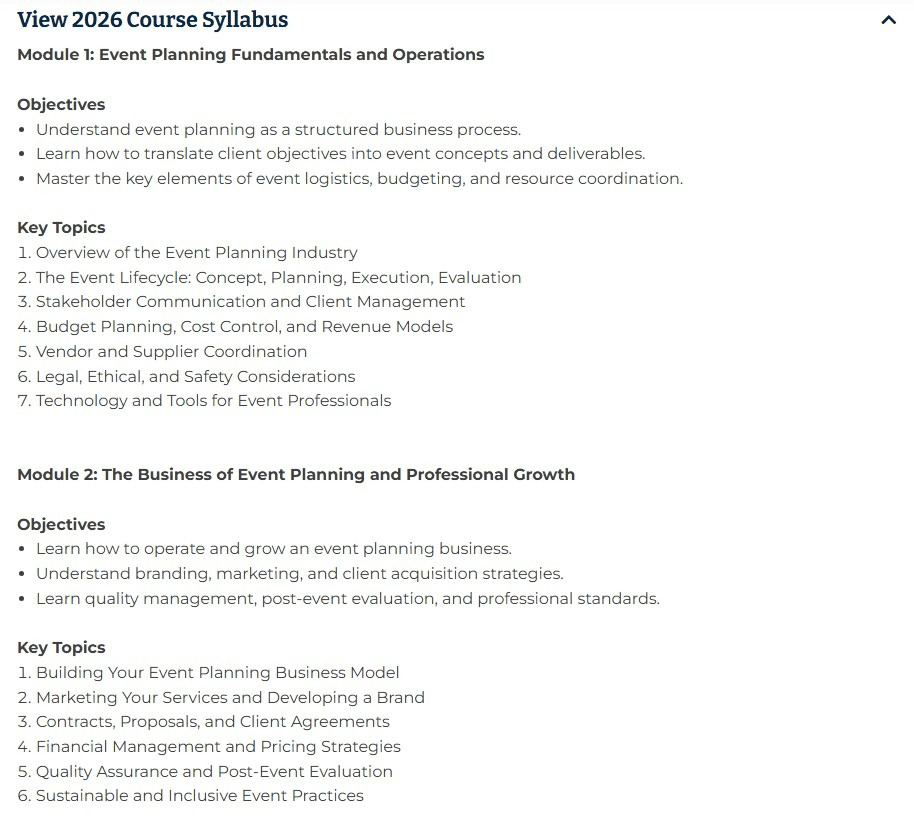
It leans into things like budgeting, logistics management, and risk management, which are all real parts of executing successful events. So even though it’s quick, you’re still covering important areas you’ll actually use, like. It just doesn’t walk you through planning events step by step in a hands-on way.
What I liked is how efficient it is. You can move through the online course fast and take the final exam without dragging it out for weeks. The only thing is, it doesn’t have the same step-by-step structure or business-building detail that IAP Career College does. But if you’re more interested in getting certified and operating with your own creativity and vision, this is a great fit.
Course Ratings Table
| Feature | Rating |
|---|---|
| Course Structure | 8.6 |
| Beginner Friendliness | 8.7 |
| Practical Event Knowledge | 9.1 |
| Depth of Content | 9.5 |
| Flexibility | 9.3 |
| Support Access | 8.4 |
| Career Guidance | 8.9 |
| Certification Value | 9.7 |
| Overall Value | 9.1 |
Package Details
CQEP Certification Program: Includes study materials, certification exam, and digital certificate.
→ Best for students who want a fast, recognized professional certificate.
More Management and Strategy Institute discounts are listed on this promo page.
Package Perks
- Certification exam included
- Digital certificate
- Shareable badge
- Mobile certification card
- Self-paced structure
- Study materials (PDFs + videos)
- 1-year access
- Competency units included
Pros
✅ Straightforward Structure: You move through it quickly without distractions.
✅ Covers Useful Topics: Budgeting, logistics, and risk management are actually relevant.
✅ Clear End Goal: Everything leads directly to the final exam.
✅ Flexible Timing: Easy to complete around your schedule.
✅ Recognized Certificate: Gives you something you can add to your resume.
Cons
❌ Less Hands-On: You’re not really planning events as you go.
❌ Short Overall: It feels like it could’ve gone a bit deeper before the exam.
Bottom Line: Should You Choose Management & Strategy Institute (MSI)?
From my experience, this is a solid option if your goal is to get a professional certificate without overcomplicating things. It covers key areas like risk management and logistics in a way that actually feels useful instead of like filler. It’s not the most hands-on course, so you won’t be deeply practicing event planning as you go. But if you want something straightforward, flexible, and respected enough to put on a resume, it does its job really well.
Management and Strategy Institute (MSI)
QC Event School: Best for Hands-On Training
This one felt more involved right away. When I opened the lessons, there were graded-style assignments tied to real situations, like planning parts of an event or thinking through client decisions. It’s not just reading or watching; I actually had to respond to prompts.
The program is broken into different tracks, so I could focus on areas like wedding planning, corporate events, or event decor. Some sections also include business tools like pricing outlines and marketing templates, so aspiring event planners have real tools they can use as they launch their business.
While the assignments were helpful, they did add a significant amount of time. They weren’t long individually, but they slowed things down compared to courses with IAP College, where I just moved from lesson to lesson.
QC Event School is more structured than most, but it’s also a bigger commitment if you’re not sure how far you want to go with event planning.
Course Ratings Table
| Feature | Rating |
|---|---|
| Course Structure | 8.5 |
| Beginner Friendliness | 8.9 |
| Practical Event Knowledge | 8.8 |
| Depth of Content | 8.5 |
| Flexibility | 8.7 |
| Support Access | 9.0 |
| Career Guidance | 8.6 |
| Certification Value | 8.4 |
| Overall Value | 8.6 |
Package Details
- Single Course Program: Focuses on one area, like event planning or wedding planning.
→ Best for students who want to focus on one type of event. - All-Access Program: Includes multiple courses and certifications.
→ Best for students who want broader event planning training across different areas.
Package Perks
- Tutor feedback on assignments
- Scenario-based projects
- Multiple course options
- Lifetime access
- Business templates
- Certification included
- Self-paced structure
- Ongoing student support
Pros
✅ Includes Assignments: You’re applying event planning instead of just reading.
✅ Feedback Is Built In: You’re not left guessing if you’re doing things right.
✅ Covers More Areas: Includes event design, event coordination, and business topics.
✅ Multiple Course Options: You can choose what type of events you want to focus on.
Cons
❌ Takes Longer To Get Through: You have to stay consistent to finish it.
❌ Feels Heavier At The Start: It can be a lot if you’re completely new.
Bottom Line: Should You Choose QC Event School?
This is solid for someone who already knows they’re serious about event planning and wants something more in-depth. The assignments and feedback help you build real event management skills over time, but it’s not the easiest or fastest option. It can feel like a lot at first, but if you’re willing to stick with it and want something that goes beyond just a certificate in event planning, it gives you more to work with long-term.
QC Event School
New York Institute of Art and Design (NYIAD): Best for Mentor Feedback

NYIAD stands out because of its mentor-based teaching style. When I went through the lessons, I noticed a mix of written content, video, and real projects that you’re required to complete, so it’s not just passive learning since you actually have to submit work.
The biggest difference is the feedback. You send in assignments and get responses from a mentor, which really changes how you learn event planning. The course covers different types of events like meetings, fundraisers, and corporate events, along with business management and overall event coordination.
It also goes into areas like client communication, event contracts, and problem-solving skills, which are essential if you want to work as a professional event planner. The downside is that the course moves slowly and feels more structured, so I couldn’t just click through at my own pace without putting in real effort. Still, it was useful to have something more hands-on and feedback-focused instead of just watching lessons.
Course Ratings Table
| Feature | Rating |
|---|---|
| Course Structure | 8.0 |
| Beginner Friendliness | 9.2 |
| Practical Event Knowledge | 8.8 |
| Depth of Content | 8.7 |
| Flexibility | 8.6 |
| Support Access | 9.4 |
| Career Guidance | 7.9 |
| Certification Value | 8.8 |
| Overall Value | 8.0 |
Package Details
Full Course Program: Includes lessons, projects, and mentor feedback.
→ Best for students who want a structured event planning program with guidance.
Package Perks
- Mentor feedback on assignments
- Project-based learning
- Online lessons and videos
- Student support access
- Self-paced structure
- Certificate included
- Community access
- Advisor support
Pros
✅ Mentor Feedback: You get real input on your work, not just passive learning.
✅ Project-Based Learning: You’re actively working through planning events.
✅ Covers Multiple Event Types: Includes corporate events and other special events.
Cons
❌ Takes More Time: Slower than quick online course options.
❌ More Structured: Less flexible if you prefer something casual.
❌ Requires Effort: You have to complete projects, not just watch lessons.
Bottom Line: Should You Choose NYIAD?
This felt more guided than most event planning courses. The biggest strength is the feedback; I wasn’t just guessing if I was doing everything correctly. It helped build real event management skills over time, especially with projects and mentor input. The tradeoff is that it takes more effort and doesn’t move as fast as simpler online courses. If you want structure and support while learning event planning, this is a solid option. If you prefer something quicker and more flexible, it might feel a bit heavy.
New York Institute of Art and Design (NYIAD)
Udemy: Best for Learning Specific Skills

Unlike the other options, Udemy is more of a course platform than a provider for a specific option. There’s good and bad to this: you get to piece together your own curriculum, but the cost can quickly build up, and it’s difficult to know what to take and what to ignore.
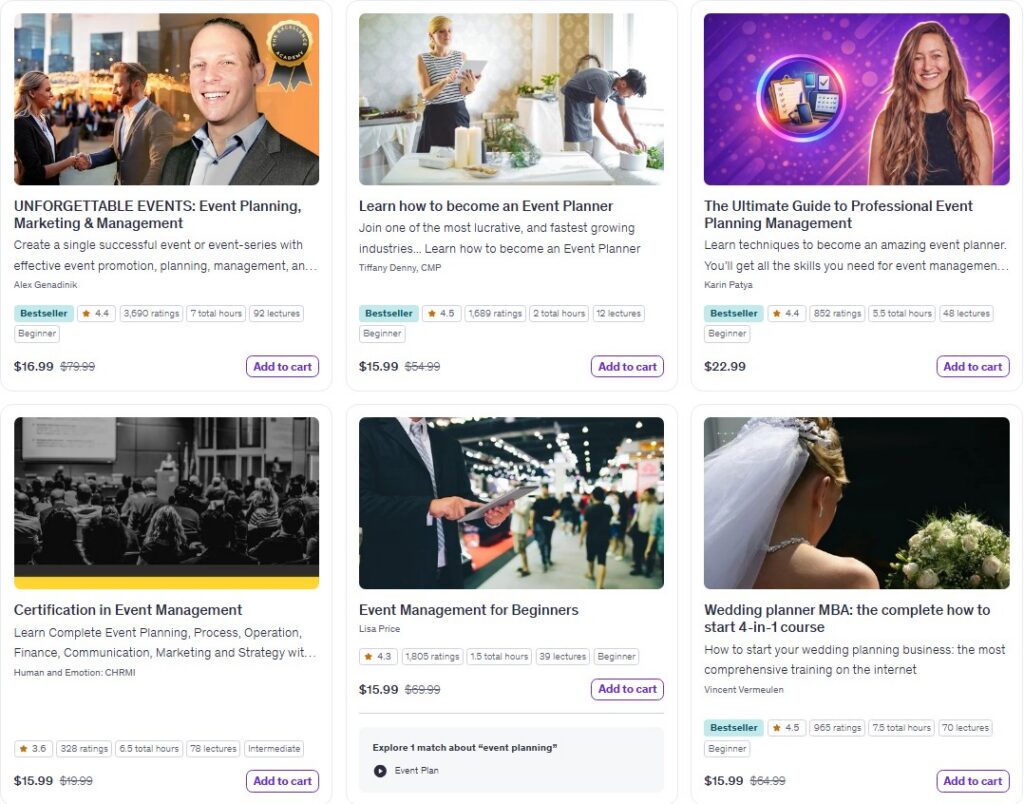
I enjoyed that the different courses had star ratings and quick samples of the video lessons, so I knew which were better to buy.
That said, the certifications aren’t as reliable; while some of them prep you for more reputable certification exams, most gave their own certification, and sometimes just referred to Udemy completion certificates.
Ultimately, I found Udemy best for building specific skills to bolster yourself as an event planning entrepreneur, but perhaps not the best for comprehension or earning certifications to impress prospective clients.
Course Ratings Table
| Feature | Rating |
|---|---|
| Course Structure | 8.2 |
| Beginner Friendliness | 7.8 |
| Practical Event Knowledge | 8.0 |
| Depth of Content | 7.5 |
| Flexibility | 9.4 |
| Support Access | 7.0 |
| Career Guidance | 7.6 |
| Certification Value | 6.0 |
| Overall Value | 7.8 |
Package Options
Single Course Purchase: One-time payment for lifetime access to the course.
→ Best for students who want a quick, focused online course on a specific topic.
Package Perks
- On-demand video lessons
- Lifetime access
- Mobile and TV access
- Certificate of completion
- Self-paced structure
- Short course format
- Closed captions
- Choose the subjects that interest you
- Build a personalized curriculum
- 30-day refund policy
Pros
✅ Very Quick To Complete: You can get through it in a short amount of time.
✅ Simple Format: Just video lessons, nothing complicated.
Cons
❌ Surface-Level Content: It doesn’t go very far into the content.
❌ No Real Application: You’re not practicing event coordination.
❌ Limited Support: There’s minimal feedback and guidance.
Bottom Line: Should You Choose Udemy?
This is more of a quick add-on than a full event planning course. It’s useful if you want to understand how event management or event marketing works without spending weeks on it. But it’s probably not going to prepare you for a full event planner role on its own.
Udemy

This was definitely the most beginner-friendly option and easy to jump into. The setup is similar to Udemy: instead of just one course, the platform gives you access to multiple event planning classes, many of which are split into short mini-lessons (often under an hour total), so it feels more like a quick introduction than a full event-planning program.
A course helps, but it will not manufacture a portfolio. We wrote separately about getting the first jobs without a track record.
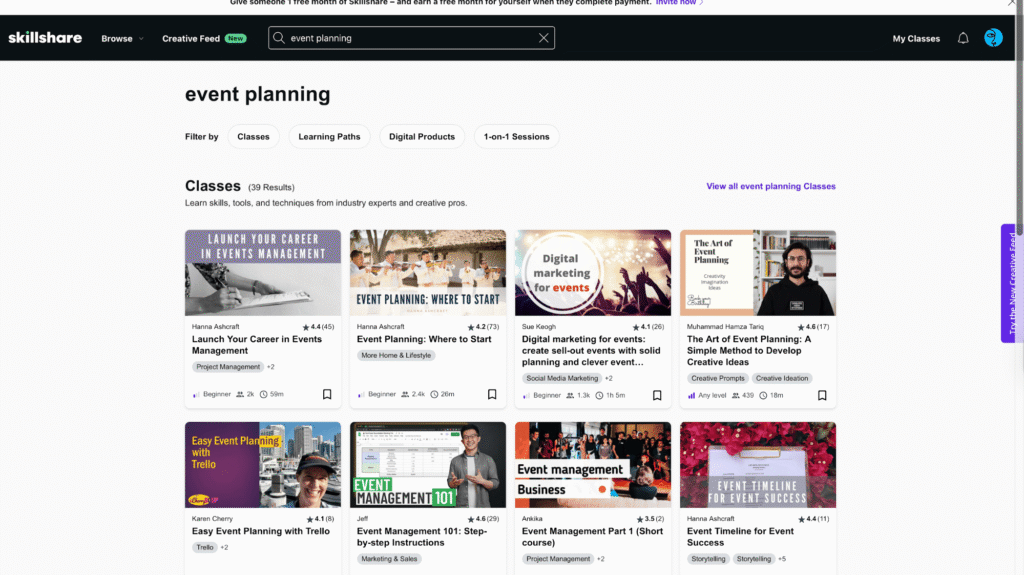
The content focuses on early steps like figuring out what types of events you want to plan, gaining experience, building relationships, and how planners find clients. There’s also a section on pricing in some classes, which adds some helpful real-world context.
It leans more toward mindset and getting started than actual event management skills. You’re not really getting into logistics, risk management, or detailed coordination here. It makes sense if you’re exploring or want something quick for a side hustle.
Course Ratings Table
| Feature | Rating |
|---|---|
| Course Structure | 8.0 |
| Beginner Friendliness | 9.8 |
| Practical Event Knowledge | 7.6 |
| Depth of Content | 6.9 |
| Flexibility | 9.6 |
| Support Access | 7.4 |
| Career Guidance | 8.2 |
| Certification Value | 5.0 |
| Overall Value | 7.3 |
Package Details
Skillshare Membership: Includes access to multiple event planning classes, short lesson formats, and project-based activities.
→ Best for students who want flexible access to different topics without committing to one structured course
Package Perks
- Access to multiple event planning classes
- Short video lessons
- Class project worksheets
- Goal-setting prompts
- Community access
- Self-paced structure
- Subscription-based access
- Mobile access
Pros
✅ An Easy Way To Start: Good if you’re just exploring event planning.
✅ Short and Manageable Lessons: Classes are broken into short, easy sections.
Cons
❌ Basic Certificate: Completion certificates are platform-based, not professional credentials.
❌ Light Project Work: The worksheet stays pretty basic.
❌ Limited Depth: Most classes don’t go far beyond early-stage concepts.
❌ Not Enough For Real Work: You’ll likely need more structured training before planning actual events.
In my opinion, this felt more like a starting point than a full event planning course. It’s helpful if you’re trying to understand the basics of the events industry without committing to something bigger. The biggest strength is how simple and low-pressure it is.
The tradeoff is that the content stays focused on early-stage concepts, so it doesn’t get into deeper areas like logistics or full event execution. And since the certificate is more basic compared to something like the Management & Strategy Institute (MSI), it’s better suited as a first step rather than something you’d rely on long-term.
Skillshare
Event Planning Course Matchups: A Close Comparison
IAP Career College vs. Management & Strategy Institute (MSI)
IAP Career College follows a clear progression from fundamentals into planning events, working with clients, and setting pricing, so the pieces connect into a full workflow. Management & Strategy Institute (MSI) centers on core areas like budgeting, logistics, and risk management through focused materials tied to the CQEP certification, but it treats those topics more individually rather than as one continuous process.
→ Choose IAP Career College if a complete, start-to-finish approach matters
→ Pick Management & Strategy Institute (MSI) if a more focused, concept-based certification path stands out
QC Event School vs. New York Institute of Art and Design (NYIAD)
QC Event School is built around multiple course tracks, with options like event planning, wedding planning, and event design, each with assignments tied to that area. I noticed it allows more movement between topics instead of following one fixed order. New York Institute of Art and Design (NYIAD) runs as a single structured program, where lessons and projects follow a set sequence and include feedback as part of the process.
QC Event School leans more toward flexibility across different specialties. New York Institute of Art and Design (NYIAD) keeps everything on one guided path with consistent feedback built in.
→ Choose QC Event School if focusing on specific areas across different tracks stands out
→ Pick New York Institute of Art and Design (NYIAD) if a more guided structure with feedback matters
Udemy and Skillshare work pretty similarly in practice. Both are built around individual online classes, so the structure mostly depends on the instructor rather than the platform itself. The main difference is that Udemy usually sells courses one by one, while Skillshare gives you access through a subscription.
Both keep everything in one place, but neither follows one clear learning path across the whole platform. You can find solid beginner content on both, though depth and quality really come down to the specific class.
→ Choose Udemy if a single course with a defined set of topics stands out
→ Pick Skillshare if switching between different classes and topics matters
Extra Resources to Check Out
These aren’t always full courses, but they can still work as supplemental help to build skills or give more insight into the events industry.
- Business Meeting & Event Planning For Dummies (EBook or Print)
- Transitioning to Virtual and Hybrid Events (Hardcover Book)
- Quizlet (Flashcards)
- LinkedIn Learning (Video-based lessons)
How I Tested and Ranked These Courses
I reviewed each course by looking at its structure, course content, and how well it reflects real event planning work. I focused on how clearly it covers planning events, client work, pricing, and coordination, along with areas like logistics management and problem-solving. I also compared how connected the material felt from start to finish versus more scattered formats.
Ranking Criteria Table
| Feature | Weight | What This Measured |
|---|---|---|
| Course Structure | 12% | Logical flow, step-by-step progression, connected lessons |
| Beginner Friendliness | 10% | Ease of starting, clarity, and low overwhelm |
| Practical Event Knowledge | 12% | Real scenarios, client work, planning events |
| Depth of Content | 10% | Detail level, beyond basics, topic coverage |
| Flexibility | 10% | Own pace, access style, time control |
| Support Access | 6% | Instructor help, feedback, and response availability |
| Career Guidance | 12% | Job direction, client building, next steps |
| Certification Value | 8% | Recognition, resume value, credibility |
| Overall Value | 20% | Real-world outcomes, skill readiness, career impact |
Courses that ranked higher showed stronger alignment with real event planning workflows and more complete training, while lower-ranked options stayed more basic or focused on isolated topics.
My Final Verdict
From everything I tested, IAP Career College felt the most complete because it actually walks through how everything connects, planning events, working with clients, and setting up the business side in one flow. Management & Strategy Institute (MSI) felt more centered around earning a recognized certification, while QC Event School leaned more into assignments and specialization.
At the end of the day, this career comes down to how well you can adapt, stay organized, and handle real situations as they come up, and a robust certification course is the best way to prepare for the real thing.
FAQs
The event planning industry includes social events, corporate work, and destination events, so there are multiple entry points depending on your interests. Many event professionals start in an entry-level position and build experience over time.
Not everyone needs event planning training, but it helps build essential skills like project management, logistics management, and venue selection. It also gives structure to learn event design, marketing strategies, and problem-solving skills.
Virtual and hybrid events are events hosted online or a mix of in-person and digital experiences. Hybrid events combine both formats to reach a wider audience and increase flexibility.
Executing successful events requires event coordination, stakeholder management, and strong problem-solving skills. It also involves risk analysis, strategic planning, and attendee engagement, along with working closely with other industry professionals.
Yes, with the right experience and course content, event planning can turn into a successful career in the job market. Many people use it for professional development or grow into a rewarding career over time.

![Aceable Promo Code [Verified October 2026 Discounts]](https://www.miamiherald.com/careers-education/wp-content/uploads/sites/2/2026/10/aceable-promo-code-mh-1024x768.jpg)

![National Council on Strength and Fitness (NCSF) Coupon Codes [Verified Discounts]](https://www.miamiherald.com/careers-education/wp-content/uploads/sites/2/2026/10/ncsf-promo-code-mh-1024x768.jpg)
![Course Hero Promo Code [Verified Discounts]](https://www.miamiherald.com/careers-education/wp-content/uploads/sites/2/2026/10/course-hero-promo-code-mh-1024x768.jpg)
![Learn Laugh Speak Promo Code [Verified Coupons]](https://www.miamiherald.com/careers-education/wp-content/uploads/sites/2/2026/10/learn-laugh-speak-promo-code-mh-1024x768.jpg)
![Education.com Coupon Code [Verified Discounts]](https://www.miamiherald.com/careers-education/wp-content/uploads/sites/2/2026/10/education-com-promo-code-mh-1024x768.jpg)