You bought the perfect domain name.
Now, you need a website.
This is where domain vs hosting gets confusing. They’re usually sold side by side, sometimes bundled together, and both are necessary for many websites. But they do completely different jobs.
And yes, you’ll usually need both.
Before you accidentally buy three services that sound like the same thing, here’s exactly what each one does and what you actually need to get a website online.
Key Takeaways
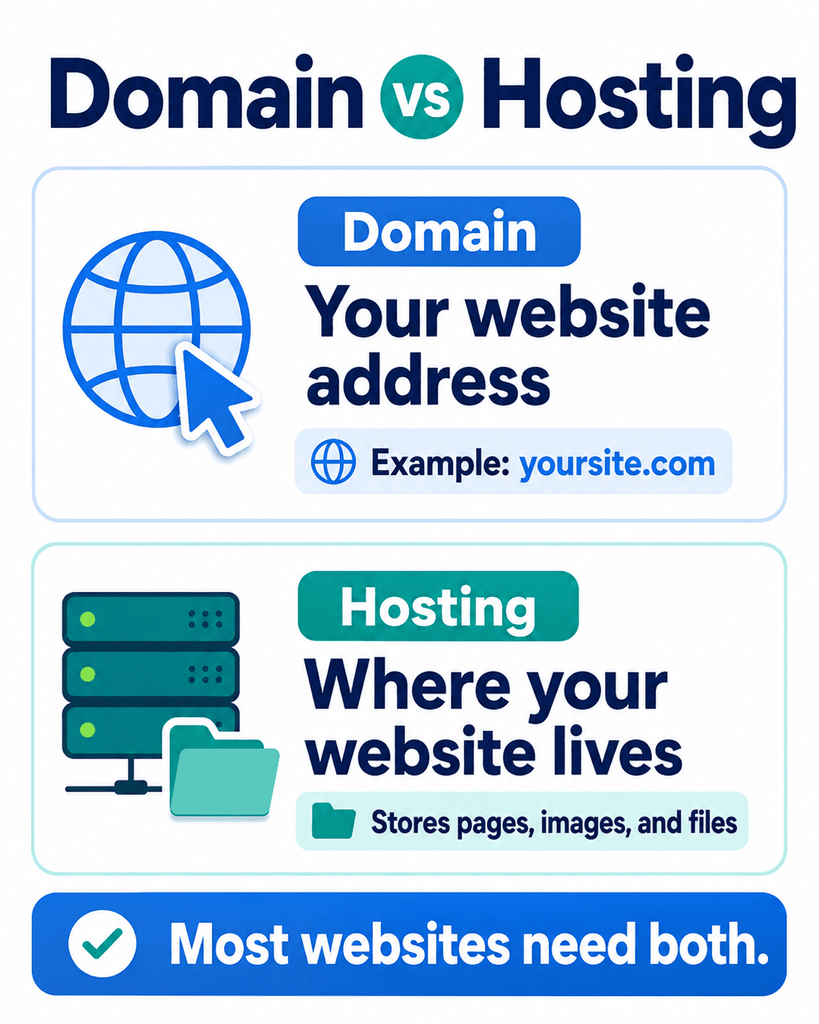
- Domain = Address: Your domain is the name people type to reach your website, what comes after the HTTPS and WWW.
- Hosting = Website: Web hosting stores the files and data that make up your actual site.
- Most Sites Need Both: A domain gets people there, while hosting gives them something to see.
- You Can Shop Separately: Your domain and hosting don’t have to come from the same company.
- Builders Can Bundle Them: Platforms like Wix and Shopify may handle hosting automatically, so you don’t always buy it separately.
Domain vs Hosting at a Glance
| Domain | Web Hosting | |
|---|---|---|
| What is it? | Your website’s address | Where your site “lives” |
| Example | actualrealwebsite.com | Server space holding your site |
| How is it billed? | Yearly | Monthly or yearly |
| Do most websites need it? | Yes | Yes |
That’s really the difference.
What Is a Domain Name?
A domain is the web address someone uses to find you.
Google.com is a domain, for example.
Without domain names, you’d generally have to reach internet resources through numerical IP addresses. The Domain Name System, or DNS, lets us use much easier-to-remember names instead.
When you register a domain, you’re essentially reserving the right to use that name for a specific period. You’re not permanently buying the word itself.
You usually register it through a domain registrar and renew it every year or every few years. ICANN notes that registrants manage things like registration, renewal, transfers, and domain settings through their registrar.
But here’s the important part:
Buying a domain doesn’t mean you have a website. What we’re going to talk about next brings you closer to the finish line.
What Is Web Hosting?
Your website is made up of things like images, text, code, databases, and other files. Hosting gives those files a home on a server that’s connected to the internet.
When someone enters your domain, they’re directed to that server so the website can load.
Think About It Like This:
Domain
123 Main Street
If you only own the address, there’s no house to visit.
Hosting
The actual house at 123 Main Street
If you have the house but nobody knows the address, good luck finding it.
Together
Domain + Hosting
Put them together, and you have a normal website setup.
Do You Need Both a Domain and Hosting?
For a traditional website with its own custom address, usually, yes.
But you don’t always need to buy both at the same time.
You can register a domain now and do absolutely nothing with it. I’ve definitely done this before, it’s pretty cheap, and if you have a great idea for your business or project, you should grab it.
You can also technically have hosting without buying your own domain. Some platforms give you a free subdomain, such as:
yourname.platform.com
And yes, it works. It just doesn’t look as clean or professional as your own domain.
Then, there are website builders that make the whole process a lot easier.
Shopify, for example, includes web hosting with its plans, so store owners don’t need to purchase a separate hosting service. You can connect a domain you already own or buy one for the store.
So if you’re thinking, I’ve had a website for two years, and I’ve never paid for hosting, you’re not missing something.
Your platform may already be handling it for you.
Can You Buy Your Domain and Hosting Separately?
Absolutely.
You could register your domain with Company A and host your website with Company B.
The two are connected using DNS settings, which basically tell your domain, “Hey, this is the server where my website lives.”
You do not need to understand the inner workings of DNS to set up a normal website.
Usually, your hosting provider gives you the information you need, and you enter it wherever your domain is registered.
Buying both services from one company can make setup easier because there’s less connecting to do. But keeping them separate can give you more flexibility.
And you’re not married to either provider forever.
Domains can generally be transferred between registrars, and websites can be moved between hosting companies.
Should You Buy a Domain or Hosting First?
I’d buy the domain first, especially if you’ve already found a name you really want.
Domains are unique. If someone else registers that exact available name before you do, you can’t just buy another copy.
Hosting, on the other hand, isn’t like that.
So if you’ve finally found a short, memorable domain that’s available, securing it first makes sense. Then, you can take your time comparing hosting plans or website builders.
If you’re using an all-in-one platform, though, you may be able to handle both during setup.
That brings us to the part everyone actually cares about.
How Much Do Domains and Hosting Cost?
Domains are usually the cheaper half of the equation.
For a standard .com, roughly $10 to $20 per year is a useful ballpark, although the exact price depends on the registrar, extension, and whether you’re looking at an introductory offer or renewal price.
For example, Namecheap currently lists .com registration around the low teens, with renewal closer to $20 per year. Shopify says its domains generally start around $9 per year.
Hosting has a much wider range.
Basic shared hosting can start at only a few dollars per month. But those eye-catching introductory prices don’t always last.
SiteGround, for example, currently advertises its starter hosting at $2.99 per month for the introductory term, but lists a $17.99 monthly renewal price. Namecheap’s basic shared hosting also costs more at renewal than some of its promotional offers.
So when you’re comparing prices, don’t just stare at the giant “$2.99” price on the homepage.
Instead, look for the renewal price. That’s the real cost.
What About Website Builders?
This is where the lines between domain and hosting start getting blurry.
Website builders are designed to package more of the process together.
Instead of separately buying:
- Hosting
- Website software
- A design theme
- Technical tools
…you pay the website builder, and it handles most of that behind the scenes.
Hosting is generally built into the platform.
The domain is still its own thing, though. You may get one included for the first year with certain plans, buy one directly through the platform, or connect a domain you purchased somewhere else.
That means you can absolutely have:
Wix + a Namecheap domain
or
Shopify + a domain purchased elsewhere
The companies don’t have to match.
Domain vs Hosting: Which One Do You Need?
Here’s the thing:
Domain and hosting aren’t alternatives.
Choosing between them would be like asking whether your new business needs an address or an actual building.
For most traditional websites, you need both:
If you’re using Wix, Shopify, or another hosted website builder, the hosting part may already be included in what you’re paying.
So before buying anything, check what your website platform already gives you.
Otherwise, you might end up paying separately for something you already have.
Final Verdict
If domain vs hosting still feels confusing, just remember the address analogy.
Your domain is what people type to find you. Your hosting is where your website actually lives.
If you’re starting from scratch, secure the domain you want first. Then choose either a hosting provider or an all-in-one website builder that fits what you’re trying to create.
When you are ready to go live, use our how to host a website steps to connect the domain and publish the files.
FAQs
Can I have a domain without hosting?
Yes. You can register a domain and hold onto it without building a website or purchasing hosting.
Can I have hosting without a domain?
Yes. Some hosting services and website builders let you access your site through a temporary address or platform subdomain, although most businesses eventually use a custom domain.
Can I buy my domain and hosting from different companies?
Yes. Your domain registrar and hosting company don’t have to be the same provider. You’ll simply connect the domain to your hosting through its DNS settings.
Does buying a domain mean I own a website?
No. Registering a domain gives you the right to use that web address during your registration period. You still need hosting or a hosted website platform to put an actual website there.
Do website builders include hosting?
Most hosted website builders do. Shopify, for example, includes web hosting with its plans, while Wix bundles hosting into its site plans as well. You can buy your custom domain separately or include it temporarily, depending on the platform and plan.