
Florida GOP candidate’s money woes on display in federal court
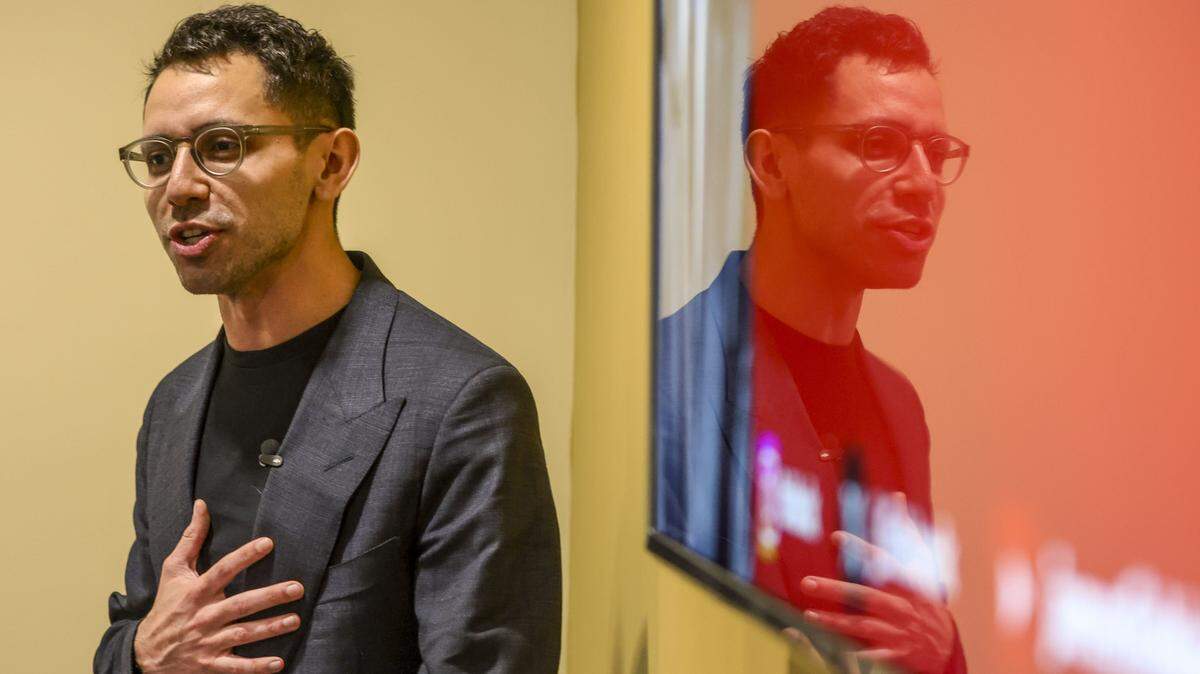
A federal judge on Wednesday decided not to hold Florida gubernatorial candidate James Fishback in contempt of court in a legal case that exposes the Republican’s considerable financial problems.
U.S. District Judge Mark Walker told Fishback that he has two weeks to turn over personal financial records, or swear they don’t exist, to avoid facing the “wrath of the court,” including referring the case to federal prosecutors.
“I’m not shy about taking action,” Walker said. “I don’t want to do that.”
Fishback, 31, has gained traction as a long-shot candidate in the Republican primary contest, receiving backing from young men drawn to his racist remarks about front-runner U.S. Rep. Byron Donalds, his anti-Israel stance and his populist views on the economy.
He owes his former employer, the hedge fund Greenlight Capital, more than $228,000 as part of a federal court order in New York last year. Fishback admitted to sending the company’s confidential information to his own email account and trying to launch his own investment fund while working there.
Fishback has said multiple times that he won’t pay it back.
“I am not going to pay him a penny just because some Democrat judge in New York who has sided against President Trump time and again says that I owe him his attorney’s fees,” he told the Miami New Times in February.
To recoup the money, Fishback’s financial accounts have been garnished and U.S. Marshals seized and sold a Tesla.
Attorneys for Greenlight have also sought records from Azoria Capital, the New York-based investment firm that Fishback co-founded and led as its CEO.
After Azoria did not respond to requests for documents last year, a federal magistrate judge in Tallahassee last month ordered Fishback, as the company’s CEO, to appear before Walker and show why he shouldn’t be held in contempt of court. The penalty for being held in contempt could be fines or imprisonment.
During a nearly two-hour hearing in Walker’s Tallahassee courtroom Wednesday, lawyers for Greenlight said it’s been “frustrating” to pursue a debtor who wasn’t complying with court orders.
Miami lawyer Edward H. Davis said there is evidence that Fishback has assets and income, but because Fishback and Azoria Capital haven’t turned over records, it’s been difficult to prove.
“We’re in a dark room looking for a light switch,” Davis said.
Fishback, who appeared without a lawyer, told Walker that he was there in “good faith” and intended to comply with any orders. (Fishback’s former lawyers claim he owes them more than $150,000 in fees and costs.)
“I’ve provided, your honor, anything and everything I have,” he said.
But Davis noted that subpoenas served on bank records showed that Fishback made $37,000 in purchases at Nordstrom, eBay and luxury retailers in the first six months last year, including a $7,500 watch at the luxury retailer Bucherer in June.
They’ve requested he return those assets to pay off the debt. But Fishback told Walker the watch was a gift, and he no longer had it — the only watch he possessed was the Swatch on his wrist.
When Davis produced a photo he said showed Fishback wearing a Cartier watch six months after the purchase, Fishback said he gave the item away afterward.
Fishback also owns a condominium in Washington, D.C., and a house in Madison about 50 miles from Tallahassee, which is also the site of his campaign headquarters.
He said Wednesday that the condo was taken over by his parents, who were renting it out to a family friend.
Davis quickly noted that rental revenue was a source of income that is supposed to be used to pay back Greenlight.
“We’re just finding out today there’s a lease to a family friend,” Davis said.
Fishback then clarified he didn’t know if there was a formal lease in place.
Davis also noted that financial records showed that a company called Azoria Partners, controlled by Fishback, was paying the mortgage on both properties. Under the terms of the court order, Azoria Partners is supposed to pay Greenlight before anyone else.
Fishback said both he and members of his family owned Azoria Partners.
He was also questioned about why Azoria Capital, when it finally responded to a subpoena for records, produced a document that wasn’t on company letterhead.
Fishback said he didn’t know — he had asked someone at the company to provide the documents because he’s no longer the CEO. He also said he never owned a majority of shares in the company.
“I am no longer involved in Azoria Capital,” he said.
He also said he wasn’t able to provide records from his financial accounts either because he was either locked out of them or because he couldn’t provide the precise types of statements requested.
He told the Herald/Times afterward that he left Azoria Capital on Jan. 9 and had not been paid by it since the summer. He said he didn’t respond to subpoenas for records sent to the company in November because he was “not aware” it was served.
The subpoena was sent to the company’s registered agent, not the company directly, he said. When lawyers wrote to Azoria Capital’s only public email address, he said he didn’t see it.
“That is not an email address that I actively monitored,” he wrote in a text message.
Walker said that Fishback was “being very careful with how he phrases things, which I understand.”
“I certainly understand your frustrations,” Walker said to Davis. “This hearing has been telling.”
He told attorneys to provide a list of the documents they’re seeking and questions they wanted answered, such as whom the watch was given to. Fishback will then have a week to either turn over the records or file a signed statement that the records don’t exist.
If Fishback’s answers aren’t satisfying, he could face questions in a deposition and, ultimately, be found in contempt.
But Walker said he was only looking for the discovery requests to be satisfied, acknowledging that everyone had other things they wanted to be doing, such as Fishback running for office.
“I’m grateful that he made the decision not to hold me in contempt today,” Fishback told the Herald/Times afterward, adding that it showed “this is going to be a fair and objective process.”
“Judge Walker recognizes this is a very complex case,” Fishback said. “I look forward to fully cooperating with whatever he requires.”
When asked whether he still intended to not pay back his debt to Greenlight, he implied he’d never said such a thing.
“I can’t pay for something for which I do not have the funds to pay,” he said. “I said I won’t pay because I can’t pay, not because I shouldn’t.”